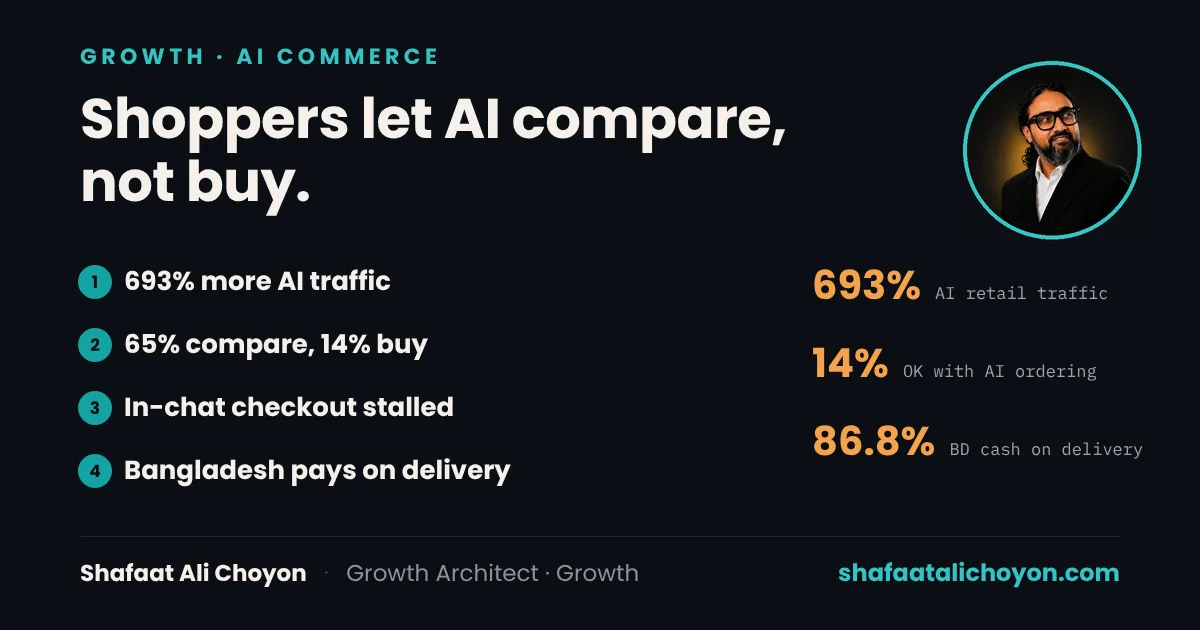
Last holiday season, traffic from AI tools to US retail sites rose 693.4%1 on the year before, according to Adobe, which tracks more than a trillion visits to US retail sites. People asked chatbots what to buy, in huge numbers. Then YouGov asked Americans what they would actually let AI do. 65%2 were comfortable with AI comparing prices across stores. Only 14% were comfortable with AI placing orders for them. Shoppers have handed AI the research. They have not handed it the wallet.
Will shoppers let AI buy for them?
Not yet, and the gap is the point. YouGov polled 1,287 US adults in December 2025. Comparing prices was the job people trusted most. Product recommendations came in at 44%. Placing the order came last, by a long way.
This is not a technology gap. An agent that can find the cheapest blender can also click "buy". It is a consent gap. People are happy to hand off the work of looking. They want to keep the decision, and especially the part that moves their money. Any brand planning for AI shoppers should design for that line, not wait for it to disappear.
The checkout inside the chat stalled
When I wrote When the buyer is an AI, much of the industry was betting that the chatbot would become the store. This year tested that bet. On 24 March 2026, OpenAI said it would let merchants use their own checkout and focus ChatGPT on discovery, admitting that the first version of its Instant Checkout did not offer the flexibility it wanted. Walmart told Modern Retail that items sold inside the chatbot converted at rates three times lower3 than items where shoppers clicked out to Walmart's own site.
The looking kept growing. Adobe expects AI traffic to US retail sites to grow 130%4 this holiday season. So the shape of agentic commerce in late 2026 is clear: the agent builds the shortlist, and the human goes to a seller they trust to pay. That is not a failure of AI shopping. It is AI shopping finding its real job.
Bangladesh built e-commerce on a held-back yes
None of this would surprise a shopper in Dhaka. The Bangladesh Bureau of Statistics found that 14.4% of people bought something online in 2024-25, and 86.8%5 of those online shoppers paid cash on delivery. Among people who had not bought online, 75.8%5 said they preferred to see or touch a product first.
Cash on delivery is a consent device. You let the website or the Facebook page do the showing and the comparing. You keep your money until the product is in your hand. Bangladeshi shoppers split "help me choose" from "take my money" years ago, because trust was thin and bad experiences were real. In the same survey, the most common problem among online shoppers who reported one was goods that did not arrive as ordered, cited by 50.7%5.
Here is the flip. US agentic commerce is reinventing cash on delivery: delegate the search, keep the final yes. Bangladesh shows what comes next. The market grew when sellers designed for the held-back yes instead of fighting it.
Trust by design wins the last step
At Ekhanei, we built the country's number one motorbike category from zero in about two and a half months. The online listings did the comparing. But a motorbike is a big purchase, and buyers wanted to see it, sit on it and meet the seller. So we ran Bike Bazaar, an offline trade event where an online shortlist could become a handshake. We did not ask people to trust a screen with the whole decision. We built a place for the last step.
The click-out from an AI answer is the new Bike Bazaar. It is the moment a shopper arrives with a shortlist and checks whether you are what the answer promised. If the price, the stock or the return policy differs from what the AI said, you lose them, just as a Dhaka buyer refuses a parcel that is not as ordered. The AI did your marketing. Your page now has to keep its promise.
What I would build for this holiday season
I build and run agentic AI in production, and I am bullish on agents for shopping. The designs that win will respect the consent gap instead of pretending it is gone:
- Be on the shortlist. Check every month whether AI tools name your products, and what they say about them. My free AI share-of-answer tracker sets that up.
- Make the click-out match the answer. Price, stock, delivery date and returns on the landing page should confirm, in plain words, what the shopper was just told.
- Offer a held-back yes. Free returns, pay on delivery, or "approve before we charge". These are the cash on delivery of agentic commerce.
- Ask for one thing at a time. My free value exchange checker tests whether what you ask of a shopper at each step is worth what you give back.
- Count orders, not visits. AI traffic is a vanity number until you know how many of those shoppers finished the purchase on your site.
The short version
- AI traffic to US retail sites rose 693.4% in the 2025 holiday season, and Adobe expects 130% more growth this year.
- 65% of Americans are comfortable with AI comparing prices, but only 14% with AI placing orders: a consent gap, not a technology gap.
- OpenAI stepped back from in-chat checkout in March 2026, and Walmart saw in-chat conversion three times lower than click-out.
- 86.8% of Bangladesh's online shoppers pay cash on delivery, a long-running design for "you choose, I pay when I trust it".
- Win the last step: match the AI's answer on your page, offer a held-back yes, and count completed orders.
If an AI sent you a shopper with a shortlist tomorrow, would your page confirm what it said, or contradict it?
Frequently asked questions
Do Americans trust AI to shop for them?
For research, mostly yes; for buying, no. In a December 2025 YouGov poll of 1,287 US adults, 65% were comfortable with AI comparing prices and 44% with AI recommending products, but only 14% were comfortable with AI placing orders for them.
How much has AI shopping traffic grown?
Adobe reports that traffic from AI tools to US retail sites rose 693.4% in the 2025 holiday season compared with the year before. It expects AI traffic to retail sites to grow 130% in the 2026 holiday season.
What happened to ChatGPT's Instant Checkout?
On 24 March 2026, OpenAI said it would let merchants use their own checkout and focus ChatGPT on discovery. Walmart said items sold inside the chatbot converted at rates three times lower than items where shoppers clicked out to its own site.
Sources
- Adobe, Holiday shopping season drove a record $257.8 billion online with consumers embracing generative AI tools (7 January 2026). news.adobe.com ↗
- YouGov, American trust in AI for retail: consumer sentiment in 2025 (2 January 2026). yougov.com ↗
- Modern Retail, What went wrong with ChatGPT's Instant Checkout (27 March 2026). modernretail.co ↗
- Adobe, 2026 Adobe Digital Insights Holiday Forecast (September 2026). business.adobe.com ↗
- BSS, BBS ICT Access and Use survey 2024-25: online shopping and cash on delivery (2 June 2026). bssnews.net ↗
Md Shafaat Ali Choyon (MPH, CHES®, MBA, MCIM) is a growth, marketing and public-health strategist who builds and runs AI in production, with 17 years across telecom, fintech, e-commerce, consumer tech and healthcare in the US and Bangladesh. See the essays or the portfolio.