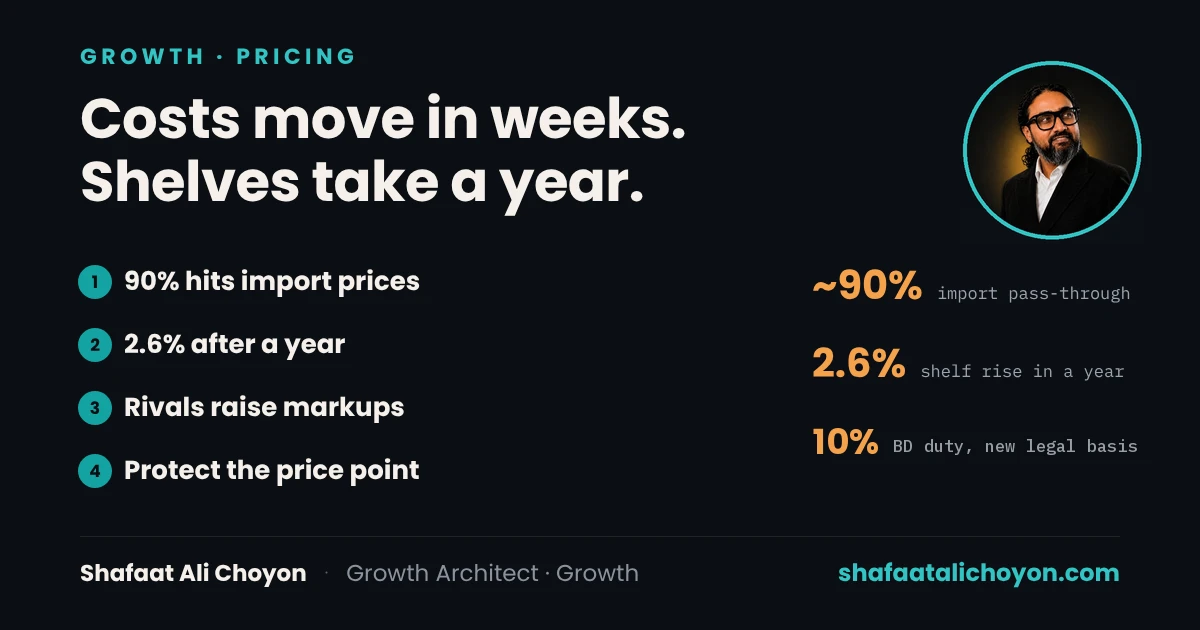
When the US raised tariffs in 2025, foreign exporters barely cut their prices. New research from the New York Fed, published on 6 October 2026, finds that nearly 90%1 of the tariffs passed through to US import prices, and that import prices rose almost one for one in the first month. Yet in the researchers' scenario, a 10%2 tariff on all imports raises consumer goods prices by only about 2.6% after twelve months. The cost hits a business in weeks. The shelf catches up over a year. What you do in between is your pricing strategy, whether you planned one or not.
How fast do tariffs reach consumer prices?
Slower than they reach your costs. The researchers find that about half of the direct effect on imported goods shows up in consumer prices within three months, and all of it within six. Then a second wave builds: the effect on US-made goods more than doubles between six and twelve months.
Part of the gap is simple. Distribution margins, the retail and wholesale share, make up about half of what a consumer pays. So a 10% jump in the cost of an imported item does not become a 10% jump at the till. By February 2026, tariffs were adding 2.9 percentage points to goods inflation. Without them, the researchers estimate, goods prices would have fallen slightly.
For an operator, that lag is the point. Your margin takes the hit first. Your customers notice later. The months in between are when you choose whether to absorb, pass on, or redesign.
Your domestic competitors will raise prices too
The least discussed finding is about goods made in America. About a third of the total price effect comes from them1, not from imports. Most of that comes from pricier imported inputs. The researchers also find that domestic producers raise their markups when the imports they compete with get more expensive.
That changes the question. If you sell against imports, a tariff gives you pricing cover, and your competitors are likely to use it. If you hold your price while everyone else moves, you are not being kind to customers. You are repositioning your brand as the cheap option, maybe without meaning to. I argued in Pricing is positioning that a price is a message. A tariff year is when that message gets rewritten for you if you do not write it yourself.
The rules will change again, so build a system, not a reset
Tariff policy has moved every few months. In early 2026, the Supreme Court ended the tariffs imposed under emergency powers, and a temporary 10% surcharge took their place. When that expired, the US imposed new Section 301 tariffs on 60 economies from 24 July 2026, including a 10% tariff on goods from Bangladesh, with some exclusions and a planned quota for certain textiles and apparel.
Bangladesh sold $3.86 billion3 of goods to the US in the first five months of 2026, according to US Census data reported by Bonik Barta. So the same policy shift squeezes a garment exporter in Bangladesh and a retailer in Michigan, from two ends of one supply chain.
When the rules change this often, a single big price increase is the wrong tool. You will either move too much, too early, or have to move again and lose trust. What works is a pricing system: a set review date, clear cost triggers, and a plan for which products move first.
Bangladesh has priced through inflation for years
Bangladesh's consumers have lived with high inflation for more than three and a half years. It was 8.34%4 in September 2026, according to the Bangladesh Bureau of Statistics. The country's consumer brands have learned to price under pressure, and they rarely start with the sticker price.
In April 2026, when fuel prices jumped, PRAN-RFL told The Daily Star it was cutting trade margins and consolidating deliveries, and called a higher retail price "a last resort"5. Bombay Sweets said it raises prices or cuts weights for each product, never both at once. Shoppers moved too. Bonik Barta reports that for PRAN's biscuits, the contribution of small packs surged from 12% to 60%6, and Meghna Group's products priced at Tk 10 to 20 have grown about 25% since 2024.
That is the flip. US brands tend to treat price as one number to raise or hold. Bangladeshi brands treat it as a ladder: protect the price point people remember, then change the pack, the size or the bundle around it. I learned this at Samsung, where the J2 was our mass-market entry, and in a mass market the price point is the first thing the product says. And I learned the other half at Praava Health, where most patients paid out of pocket. When we replaced referral kickbacks with transparent pricing, lab margins rose from about 30% to 50%. Honest prices built trust, and trust carried volume.
One caution from Dhaka: a quietly smaller pack is a trust risk. Offer a new, smaller size at the old price point as a choice, and say what changed. That is pack design. Shrinking the old pack in silence is just a hidden increase.
Price like you mean it
If I were advising a US consumer brand or retailer this quarter, I would do five things:
- Map exposure by product. Which items carry imported inputs, and how much of their cost is tariff? Not every SKU needs to move.
- Use the lag. Costs arrive in weeks, the market moves over twelve months. Stage your changes instead of moving once and hard.
- Build the ladder. Keep a clear entry price point, add a smaller or simpler option, and let the premium tier carry more of the increase.
- Change one thing at a time, and tell customers why, in plain words. A short note beats a surprise at checkout.
- Watch your competitors' moves. If domestic rivals raise markups, holding your price is a positioning choice. Make it on purpose.
My free price increase calculator shows how much volume you can lose before an increase stops paying, and my free profit margin calculator shows what a tariff does to each product's margin before you decide.
The short version
- About 90% of the 2025 tariffs passed through to US import prices, almost one for one in the first month, per New York Fed research.
- In the researchers' scenario, a 10% tariff lifts consumer goods prices about 2.6% after a year, so costs hit fast and shelves catch up slowly.
- About a third of the effect comes from US-made goods, mostly through pricier imported inputs, with some from higher domestic markups.
- Policy keeps moving: from 24 July 2026, a 10% Section 301 tariff on Bangladesh replaced an expiring temporary 10% surcharge.
- Bangladesh's lesson: protect the price point, flex the pack, change one thing at a time, and be open about it.
If your costs rose 10% next month, which of your prices would you change first, and what would you tell your customers?
Frequently asked questions
How much of a tariff is passed on to consumers?
New York Fed research published in October 2026 finds nearly 90% of the 2025 tariffs passed through to US import prices. In the researchers' scenario, a 10% tariff on all imports raises consumer goods prices about 2.6% after twelve months, partly because distribution margins make up about half of what consumers pay.
How long does it take for tariffs to raise prices?
About half of the direct effect on imported goods reaches consumer prices within three months, and all of it within six. The effect on US-made goods more than doubles between six and twelve months.
What new US tariff applies to goods from Bangladesh in 2026?
From 24 July 2026, the US imposed Section 301 tariffs on 60 economies, including a 10% tariff on goods from Bangladesh that replaced an expiring temporary 10% surcharge, with some product exclusions and a planned quota for certain textiles and apparel.
Sources
- Federal Reserve Bank of New York, Liberty Street Economics, How Fast Do Tariffs Pass Through into Consumer Prices? (6 October 2026). libertystreeteconomics.newyorkfed.org ↗
- PwC, USTR imposes Sec. 301 tariffs following forced labor investigations (28 July 2026). pwc.com ↗
- Bonik Barta, US forced labour tariff leaves Bangladesh facing at least 25% duty (25 July 2026). en.bonikbarta.com ↗
- Dhaka Tribune, Inflation rises in September (7 October 2026). dhakatribune.com ↗
- The Daily Star, Firms trim margins, shrink packs as fuel price hike bites (23 April 2026). thedailystar.net ↗
- Bonik Barta, Rising prices push Bangladeshi consumers toward small and mini packs (29 April 2026). en.bonikbarta.com ↗
Md Shafaat Ali Choyon (MPH, CHES®, MBA, MCIM) is a growth, marketing and public-health strategist who builds and runs AI in production, with 17 years across telecom, fintech, e-commerce, consumer tech and healthcare in the US and Bangladesh. See the essays or the portfolio.