In the West, "social commerce" is a slide in a growth deck. In Bangladesh, it's just how commerce works. Millions of people discover, negotiate, and buy inside Facebook and WhatsApp — from a person in a chat thread, not a checkout page on a branded store. Watching both markets, I'm convinced the Dhaka version isn't behind the American one. It's ahead of it.
The scale is not a niche
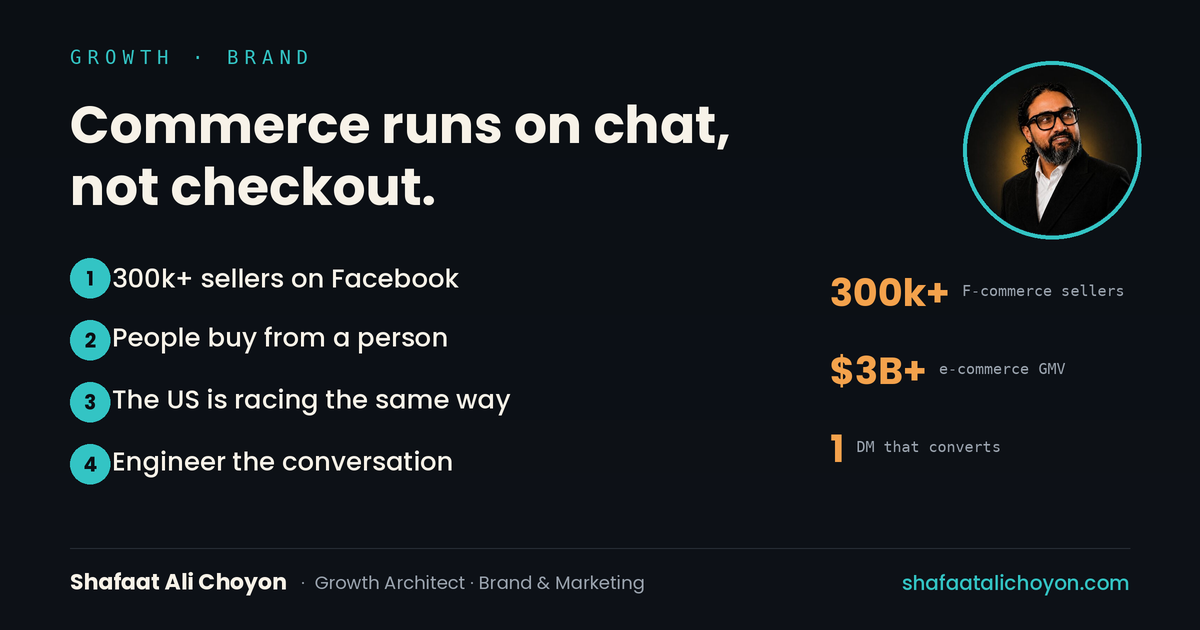
Bangladesh runs one of the largest F-commerce ecosystems on earth: more than 300,000 sellers using a Facebook page as their entire storefront, inside a market where the broader e-commerce economy crossed $3 billion in 2025 and is climbing toward $4 billion, with tens of millions of active social users. These aren't hobby shops. They're real businesses — inventory, delivery, repeat customers — run through a profile, a comment section, and a DM. No website, no app, no logo. The relationship *is* the store.
Because people buy from people
This works for a reason that scales anywhere: in a low-trust market, people don't trust a faceless brand — they trust a person they can message, question, and hold accountable. A chat thread does what a polished landing page can't: it answers the specific worry, in real time, from someone with a name. That's not a workaround for missing infrastructure. It's a better trust mechanism, and it's exactly why the model keeps winning even as "real" e-commerce platforms mature.
The US is arriving at the same place
American commerce is racing toward conversational, creator-led, in-feed buying — shopping inside social apps, purchases driven by a person you follow rather than an ad you skip. Same underlying shift: away from the anonymous storefront, toward the trusted individual. The US is rebuilding, with great effort, the thing Bangladesh's sellers do natively. Which means the emerging market is the R&D lab here, not the laggard.
What I'd take from it
I've built on both sides of this — I took the used-motorbike category to number one in two and a half months, a pure trust-and-liquidity problem, and ran digital-marketing growth that lived or died on whether a real person believed a real seller. The lesson for any operator: stop optimizing the storefront and start engineering the conversation. Put a credible human in the loop, make it easy to ask and get answered, and treat the DM as your highest-converting channel — because in more and more of the world, it already is.
The short version
- Bangladesh's F-commerce ecosystem tops 300,000 sellers running businesses from a Facebook page and a chat.
- It wins because people in low-trust markets buy from a person they can message, not a faceless store.
- The US is racing toward the same conversational, creator-led buying — the emerging market is the R&D lab.
- The operator's move: engineer the conversation and put a credible human in the loop, not just the storefront.
In your business, is the highest-trust channel your website — or a conversation you're not treating as a sales channel yet?
Md Shafaat Ali Choyon (MPH, CHES®, MBA, MCIM) is a growth, marketing and public-health strategist who builds and runs AI in production, with 16+ years across telecom, fintech, e-commerce, consumer tech and healthcare in the US and Bangladesh. See the essays or the portfolio.