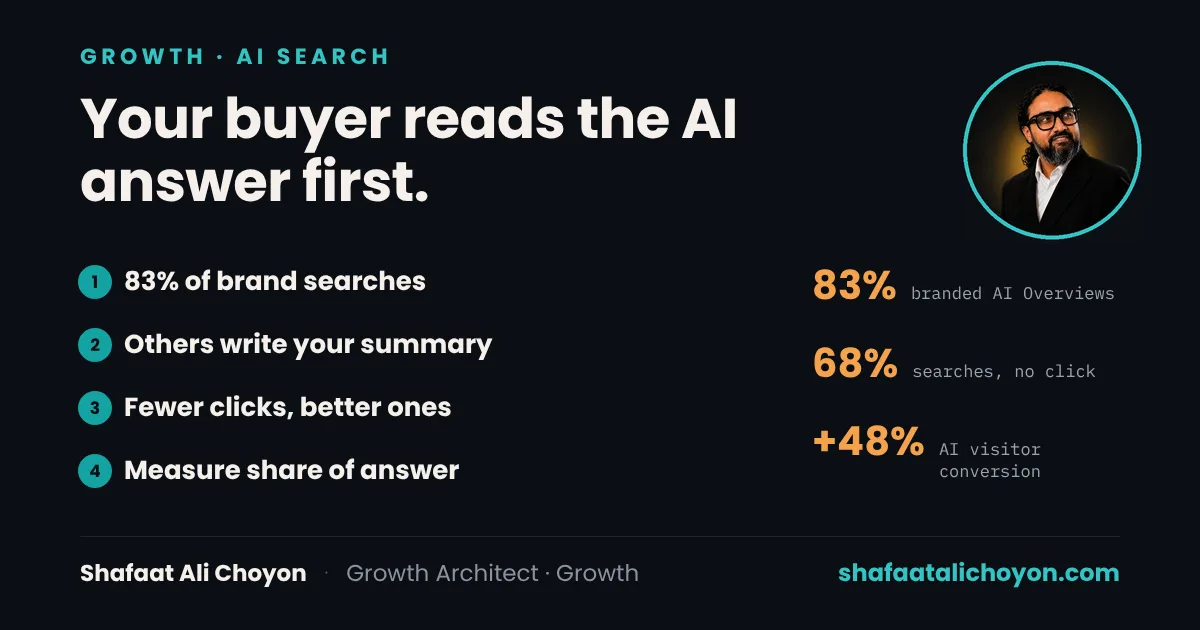
Search your own company's name on Google this week. There is a good chance the first thing you see is not your website but a paragraph Google wrote about you. On 29 September 2026, Ahrefs found AI Overviews on 83%1 of branded US desktop searches. Your next customer will meet that paragraph before they meet you, and most of them will never click past it.
What does a buyer see when they search your brand now?
Ahrefs looked at 232.8 million1 US desktop searches from July to September. Branded queries, the ones companies assume they own, showed an AI Overview in 61.3% of results in July and 73.3% in September, before reaching 83% at the end of the month. In late 2025, AI Overviews were far more common on general questions than on brand names. That gap has almost closed.
The bigger surprise is who writes your summary. Ahrefs also tracked 100 of the world's best-known brands. Among their AI Overviews that listed sources, Wikipedia was cited in 71.9%1, YouTube in 38.6% and LinkedIn in 22.8%3. Your own site is one voice among many. The answer about you is built from what other people have published about you.
The click is now the second meeting
Most searches no longer send anyone anywhere. SparkToro's 2026 clickstream study found that 68%2 of US Google searches in the first four months of the year ended without a click, up from about 60% in 2024. Pew Research tracked the real browsing of 900 US adults and found that when an AI summary appeared, people clicked a regular result in 8% of visits, against 15% when there was no summary. Links inside the summary itself were clicked in just 1% of visits.
I started my career in customer service, answering about 80,000 customers. The lesson from that job applies here: the first answer a person hears shapes everything after it. If the first answer is wrong or vague, the rest of the conversation is repair work. That first answer is now written by a machine, from sources you mostly do not control. Your website has become the second meeting, for the few who come.
Fewer visits, better visits
Here is the hopeful part. The people who do click through from an AI answer arrive ready to act. Adobe reports that in August 2026, AI-referred visitors to US retail sites converted 48%4 better than other traffic. A year earlier, it was the other way round. Adobe expects AI traffic to retail sites to grow 130% this holiday season.
So the old scoreboard misleads. If you judge marketing by sessions, you will see a decline and panic. If you judge it by how often you are named in the answer, and how well the people who arrive convert, you may see growth. The work moves upstream, to the answer, and downstream, to the page that confirms it.
Bangladesh has always bought on someone else's answer
The US numbers are early. Bangladesh's are earlier. Microsoft estimates that 7.8%5 of working-age people in Bangladesh used generative AI in early 2026, against 31.3% in the US. About 58.6%6 of Bangladeshis aged five and older now use the internet, by the statistics bureau's latest count. The AI answer is not yet the front door there.
But the habit behind it is old. In Bangladesh, buyers have always asked someone first: the pharmacist, the shopkeeper, the relative, the doctor. In diagnostics, the doctor's referral decided which lab a patient used, and labs paid for those referrals. At Praava Health we took the other path: we replaced referral kickbacks with transparent, published prices, and lab margins went from about 30% to about 50%. When someone else answers for your customer, you can pay whoever is answering, or you can make yourself the answer that is easy to check.
That is the lesson the US is now learning. An AI Overview is a referrer you cannot pay. You can only make the facts about you clear, consistent and easy to verify. And for Bangladeshi brands, the 7.8% is a window. The public record that AI will read about them, in Bangla and in English, is still thin. They can write it well before adoption catches up.
How do you measure your share of AI answers?
I rebuilt my own website to be read by AI, and I run an assistant, Ask Shafaat, that answers from it. The main thing building it taught me is that measurement comes first. In my MPH capstone, fixing the measurement up front made a campaign's reach about 3x larger. The same rule applies to AI answers. My free AI share-of-answer tracker sets up the scoreboard in an afternoon:
- Write down the 20 questions your buyers ask. Your brand name, "best X for Y", "X versus a competitor", "is X worth it". Run them every month in Google, ChatGPT, Gemini and Perplexity.
- Score three things in every answer: were you named, was it accurate, and which sources were cited. That is your share of answer.
- Fix the sources, not just your site. If Wikipedia, YouTube or LinkedIn feed the answer, make sure the public record there is correct, through each platform's proper channels.
- Publish plain facts in plain text. Prices, locations, who you serve and what you do not do. Answers quote what is easy to read.
- Track arrivals, not sessions. Watch how AI-referred visitors convert. That is the number that pays.
The short version
- AI Overviews appeared on 83% of branded US desktop searches by 29 September 2026, up from 61.3% across July.
- The summary is built mostly from other people's pages: Wikipedia was cited in 71.9% of big-brand answers that listed sources.
- 68% of US Google searches ended without a click in early 2026, and AI summaries cut clicks on regular results from 15% to 8% of visits.
- The visitors who do arrive convert better: AI-referred retail visitors converted 48% better than other traffic in August 2026.
- Bangladesh is earlier on AI (7.8% use it) but older at this habit: buyers there always relied on someone else's answer, and the winners made themselves easy to verify.
If a buyer asked an AI about your company tonight, would you be happy with the first paragraph they read?
Frequently asked questions
How often do AI Overviews appear on branded Google searches?
Ahrefs found AI Overviews on 83% of branded US desktop Google searches on 29 September 2026, up from 61.3% across July. Its sample covered 232.8 million US desktop searches from July to September 2026.
What share of Google searches end without a click?
SparkToro's 2026 study found that 68% of US Google searches from January to April 2026 ended without a click, up from about 60% in 2024. Pew Research found that when an AI summary appeared, people clicked a regular result in 8% of visits, against 15% without one.
Does traffic from AI tools convert better than other traffic?
In US retail, it currently does. Adobe reports that in August 2026, AI-referred visitors to retail sites converted 48% better than other traffic, a reversal from a year earlier. Adobe expects AI traffic to retail sites to grow 130% this holiday season.
Sources
- Ahrefs, AI Overviews Currently Appear for 83% of Branded Searches (2 October 2026). ahrefs.com ↗
- Search Engine Land, Google zero-click searches 2026 study (SparkToro data) (9 June 2026). searchengineland.com ↗
- Pew Research Center, Google users are less likely to click on links when an AI summary appears in the results (22 July 2025). pewresearch.org ↗
- Adobe, 2026 Adobe Digital Insights Holiday Forecast (September 2026). business.adobe.com ↗
- Microsoft, AI Diffusion Report 2026 Q1 (May 2026). microsoft.com ↗
- The Daily Star, Internet use in Bangladesh climbs steadily in Q3 (BBS ICT survey) (4 July 2026). thedailystar.net ↗
Md Shafaat Ali Choyon (MPH, CHES®, MBA, MCIM) is a growth, marketing and public-health strategist who builds and runs AI in production, with 17 years across telecom, fintech, e-commerce, consumer tech and healthcare in the US and Bangladesh. See the essays or the portfolio.