For twenty years, everything I built for commerce assumed the same customer: a human, scrolling, deciding. That assumption is quietly expiring. The next shopper is increasingly an AI agent — one that reads your listing, compares you against rivals, and completes the purchase on its owner's behalf. When the buyer is a machine, most of the marketing playbook stops working, and a new one opens up.
This isn't a prediction anymore
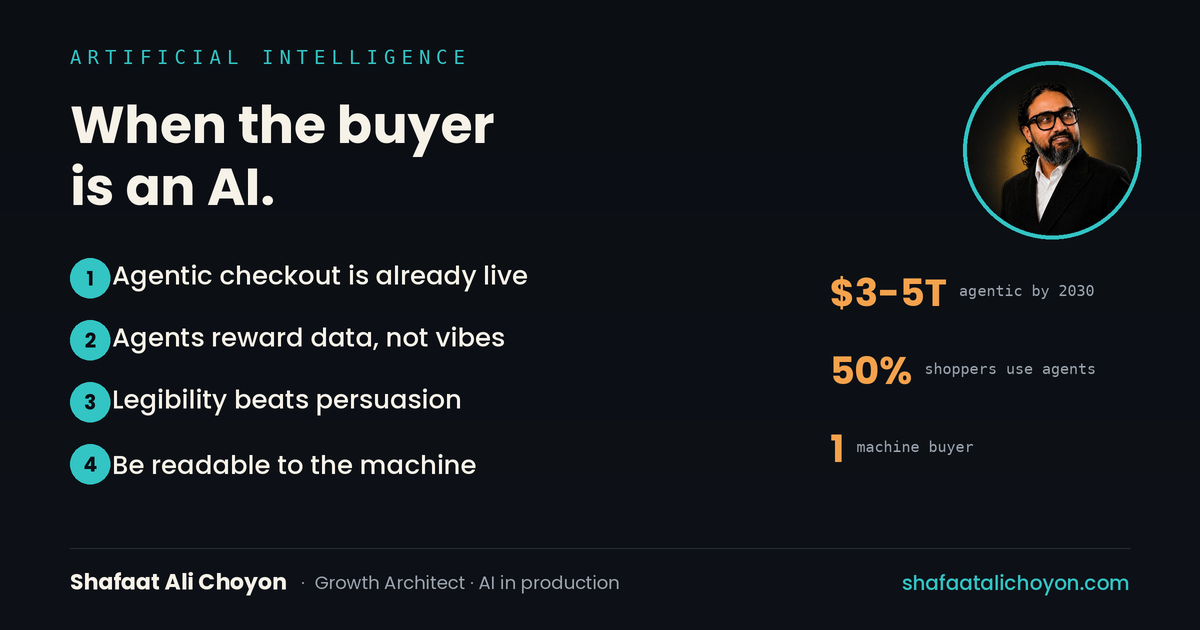
The infrastructure is already live. Google has rolled out agentic checkout — a "Buy for me" flow in AI Mode and Gemini that lets an agent complete a purchase on a merchant's site. ChatGPT Shopping is live for US users, steering buyers to merchants, with over a million Shopify stores connected. Major platforms are standardizing the plumbing with new universal commerce protocols. McKinsey estimates agentic AI will influence $3–5 trillion in retail commerce by 2030, and Morgan Stanley expects roughly half of online shoppers to use AI agents by then. The machine buyer isn't coming. It's checking out right now.
An agent shops nothing like a human
A person is swayed by a hero image, a clever tagline, a familiar logo, a burst of social proof. An agent ignores all of it. It wants structured, machine-readable truth: precise specs, real availability, clean pricing, verifiable reviews, and permissions that let it transact without friction. Persuasion gives way to legibility. The brand that wins the agent isn't the loudest — it's the clearest and most trustworthy to a system that can't be charmed, only informed. Half your funnel is about to be immune to vibes.
I've lived both sides of this shift
This is the sequel to a bet I already made. I rebuilt my own site to be read by machines — structured, quotable, welcoming to AI crawlers — because I saw discovery moving from ranking on a list to being the answer. Agentic commerce is that same move, one step further: from being *quoted* by an AI to being *bought* by one. And I've run the marketplace side of trust and liquidity — taking a category to number one in two and a half months is, at bottom, about making the right option unmistakable to the buyer. Now the buyer just happens to be code.
The dual-market angle
This reshuffles the board in a way that favors the fast and the clear, not the incumbent and the loud. A small, well-structured merchant in Dhaka can be exactly as legible to a shopping agent as a giant — the agent doesn't care about brand budget, only about clean data and a trustworthy transaction. For markets long overlooked by Western commerce, being machine-legible is a cheaper, more level path to discovery than any ad auction. The move for everyone is the same: stop optimizing only for the human eye and start being unmistakable to the machine that buys.
The short version
- Agentic checkout is already live (Google "Buy for me," ChatGPT Shopping); McKinsey sees $3–5T influenced by 2030.
- Agents ignore images and taglines — they reward structured, verifiable, transaction-ready data. Legibility beats persuasion.
- It's the sequel to building for AI search: from being quoted by an AI to being bought by one.
- It favors the clear over the loud, which is a cheaper discovery path for overlooked merchants and markets.
When an AI agent shops your category next year, will it be able to read, trust, and buy from you — or will it skip you for something it can actually parse?
Md Shafaat Ali Choyon (MPH, CHES®, MBA, MCIM) is a growth, marketing and public-health strategist who builds and runs AI in production, with 16+ years across telecom, fintech, e-commerce, consumer tech and healthcare in the US and Bangladesh. See the essays or the portfolio.