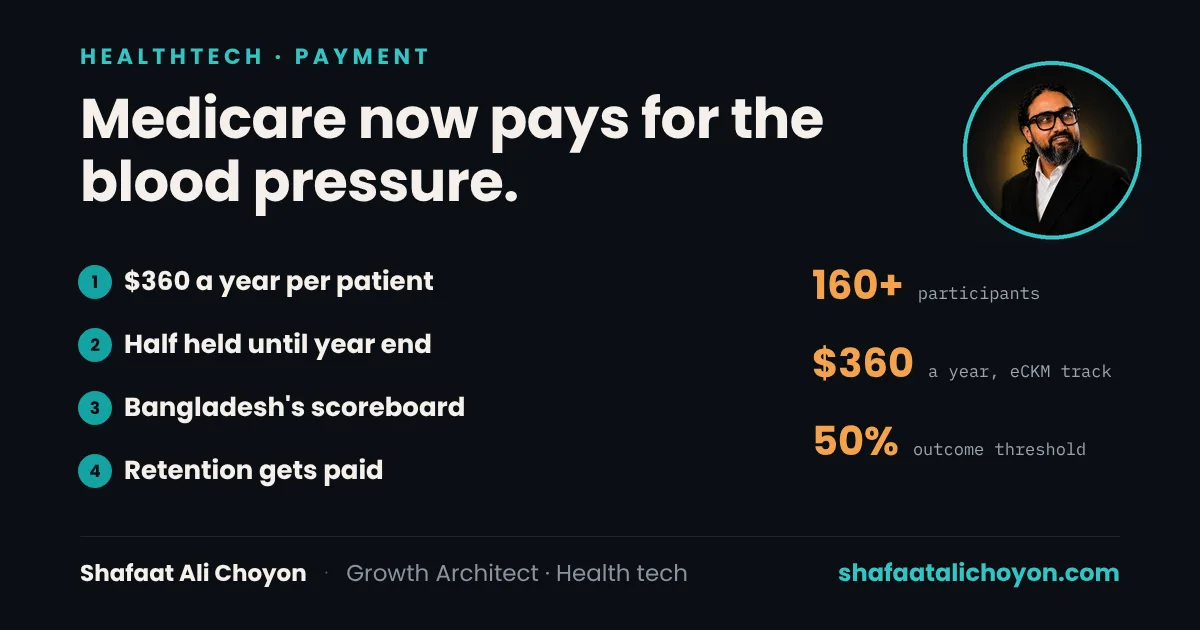
On 5 July 2026, Medicare started a ten-year experiment that changes what a digital health company sells. Under the ACCESS model, a care team gets up to $360 a year2 for managing an early cardio-kidney-metabolic patient, someone with high blood pressure, high cholesterol, prediabetes or obesity. It keeps the full amount only if at least half of its patients reach a clinical target. Medicare is no longer paying for the app, the device or the minutes. It is paying for the blood pressure.
How does the Medicare ACCESS model pay?
CMS picked 150 organizations in April; its own page now lists more than 1601 participants, from Verily, Noom and Withings to kidney practices and community health centers. There are four tracks. Early cardio-kidney-metabolic care pays $360 in the first year and $180 in follow-on years. Diabetes, kidney disease and heart disease pay $420. Musculoskeletal pain and behavioral health pay $180 each. Heart failure, COPD, addiction and quitting tobacco join in April 2027.
The catch is in the timing. Medicare pays monthly, but those monthly payments can add up to no more than half of the year's Medicare amount. The rest is settled after twelve months, against an outcome attainment threshold of 50%2. If at least half of a team's patients meet every target for their condition, it earns the full payment. Below that, the payment shrinks. For blood pressure, the target is a final systolic reading under 130, or a drop of 15 mmHg2.
Private payers are watching closely. Insurers covering 165 million3 members across Medicare Advantage, Medicaid and commercial plans have pledged to line up behind the same approach.
The low price is the point
Critics noticed the number fast. One health lawyer compared about $216.834 a month that a practice can bill today for remote monitoring and care management with roughly $354 a month under ACCESS. Analysts warned of thin or negative margins.
They are right about the margin and wrong about the meaning. A price that low is a filter. It does not reward the company with the most features or the most nurse minutes. It rewards the company whose cost to keep one patient on track for a year is lowest. That is an operating model question, not a product question.
I learned this at Praava Health in Bangladesh, where I ran marketing and corporate sales. When we replaced referral kickbacks with transparent pricing, lab margins went from about 30% to 50%. Once the hidden payments were gone, the price was honest, and the operation behind it had to carry the business. ACCESS asks digital health for the same discipline: a price you cannot game, and an operation that has to earn it.
Bangladesh already runs this scoreboard
Here is the part only someone reading both markets sees. Bangladesh has been grading its blood pressure program on outcomes for years, with a free app and a two-minute consultation.
The country has 22.8 million5 adults aged 30 to 79 with hypertension, and only 16%5 have it under control, according to WHO figures for 2024. But at the government facilities running the national hypertension program, 56%5 of treated patients reached control. Same country, same drugs, more than three times the result.
Much of the difference was follow-up. Health workers record each visit in an open-source app called Simple, in a median of 13 seconds6. The app builds a list of overdue patients and sends reminders. In one rollout, the share of patients who missed a three-month visit fell from 50% to 26%6 in six months, and control rose with it.
Retention decides who gets paid
Read the ACCESS rules with Bangladesh in mind and the strategy becomes plain. Blood pressure drugs work. Measuring blood pressure is cheap. What fails is the person who stops coming back in month four. Under a 50% threshold, every patient who drifts away is a target missed, and a payment cut.
That is a retention problem, and retention is something operators can engineer. As COO at Laser Treat, a multi-entity clinical group in Bangladesh, I digitized operations with an ERP and business intelligence. Patient retention rose about 13% and operating cost fell by about $0.5 million. Nothing about the medicine changed. We simply knew who had not come back, and could reach them.
The companies that win ACCESS will look less like app makers and more like that: a tight loop of measure, notice, call, adjust. I wrote earlier that prevention-first is a design window that closes. ACCESS is the moment the window gets a payment attached.
What I would build for the first twelve months
If I were running a care team in ACCESS, I would treat the first care period as a retention sprint:
- Enroll for the threshold, not the headcount. A smaller panel you can keep is worth more than a large one you lose. My free prevention ROI calculator shows what each controlled patient is worth.
- Build the overdue list on day one. Bangladesh's program cut missed visits nearly in half with a simple list and reminders. Copy the idea before buying anything fancy.
- Model the half you do not get until year end. With half the money held back, cash planning matters. My free recurring revenue bridge maps what arrives monthly and what waits for reconciliation.
- Let AI do the noticing. An agent that reads home readings and flags who has gone quiet is cheap to run and fits the price. Keep a person on the phone call.
- Report the control rate weekly, not the enrollment count. It is the only number Medicare will pay for.
The short version
- Medicare's ACCESS model began 5 July 2026 with more than 160 participants and runs for ten years.
- Early cardio-kidney-metabolic care pays $360 a year, with half held until the year's outcomes are counted.
- Full payment needs at least 50% of patients on target, such as systolic blood pressure under 130.
- Bangladesh shows the lever: 16% control nationally, 56% at program facilities that tracked follow-up.
- Retention is the business model: the team that keeps patients coming back gets paid.
If Medicare paid you only for patients who reached their target, how many of yours would still be with you in month four?
Frequently asked questions
What is the CMS ACCESS model?
It is a ten-year Medicare payment model that began on 5 July 2026. It pays participating organizations for managing chronic conditions with technology-supported care, and ties full payment to whether patients reach clinical targets. More than 160 organizations take part.
How much does ACCESS pay per patient?
The first-year amount is $360 a year for early cardio-kidney-metabolic conditions, $420 for diabetes, kidney disease and heart disease, and $180 each for musculoskeletal pain and behavioral health. Follow-on years pay less, such as $180 for the early cardio-kidney-metabolic track.
What happens if patients do not reach their targets?
Organizations earn full payment if at least 50% of their patients meet every target for their condition. Below that threshold, the payment is reduced. For blood pressure, the target is a systolic reading under 130 or a drop of 15 mmHg.
Sources
- CMS, ACCESS (Advancing Chronic Care with Effective, Scalable Solutions) Model (page updated 8 October 2026). cms.gov ↗
- CMS Innovation Center, ACCESS Model Payment Amounts and Performance Targets (2026). cms.gov ↗
- Fierce Healthcare, CMS taps 150 digital health companies, providers for ACCESS model (13 April 2026). fiercehealthcare.com ↗
- Fierce Healthcare, Low pay rates for Medicare's ACCESS model will pressure digital health margins: Capstone (24 February 2026). fiercehealthcare.com ↗
- The Daily Star, World Heart Day: Drug shortage risks hypertension control effort (28 September 2025). d11.thedailystar.net ↗
- Resolve to Save Lives, Better data, better outcomes for blood pressure in Bangladesh (2023, updated 2026). resolvetosavelives.org ↗
Md Shafaat Ali Choyon (MPH, CHES®, MBA, MCIM) is a growth, marketing and public-health strategist who builds and runs AI in production, with 17 years across telecom, fintech, e-commerce, consumer tech and healthcare in the US and Bangladesh. See the essays or the portfolio.