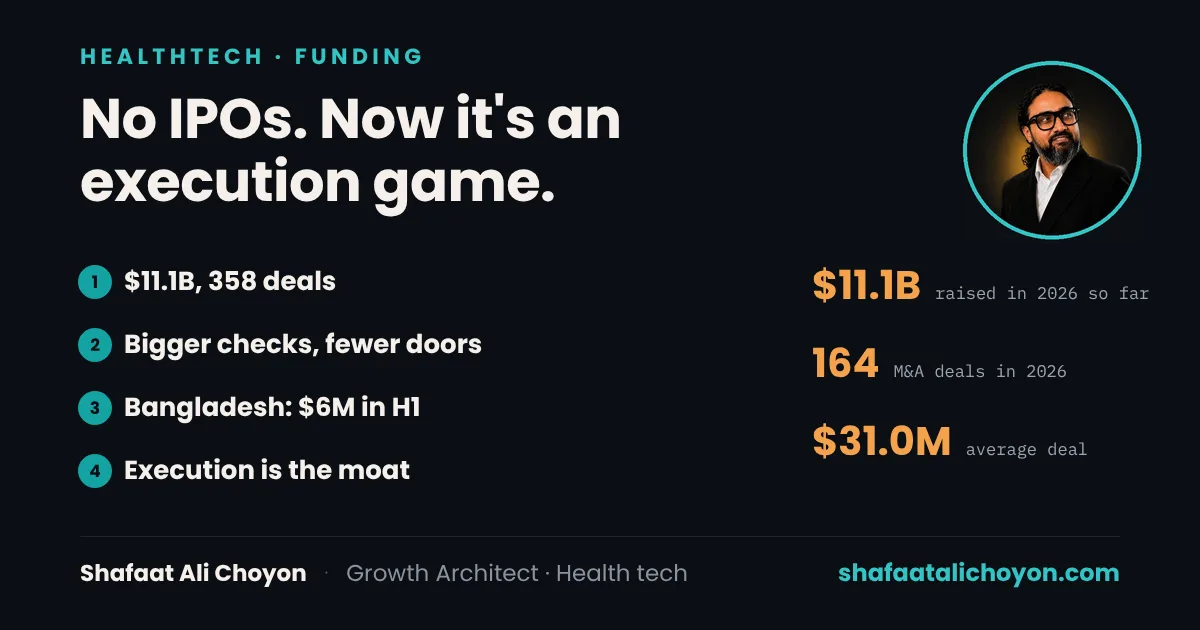
US digital health startups raised $3.7B1 across 114 deals in the third quarter of 2026, which takes the year to $11.1B1 across 358 deals. That is real money. But no digital health company has gone public since HeartFlow in August 2025, and the one that tried last month pulled out. When capital keeps coming and the exit door stays shut, the business changes. Digital health is no longer a story you sell to the next investor. It is an operation you have to run.
Is digital health funding recovering in 2026?
On the surface, yes. Rock Health, which has tracked the sector for fifteen years, notes that 2026 could pass $14.8B if the pace holds. For scale, the whole sector raised $1.2B in 2011.
Look closer and the money is concentrating. The average deal so far this year is $31.0M1, up from $29.5M in 2025 and $20.6M in 2024. Bigger checks, fewer companies. Rock Health's own reading is that building software is no longer the hard part, because APIs and generative AI make it cheap. What separates companies now is implementation, integration and evidence. Health systems are tired of pilots and point solutions. They want fewer vendors that fit together.
I wrote earlier about zero digital health IPOs in six months. The new development is that the drought now runs past a year, and the market has started to tell even strong companies to wait.
The exit is now a merger, not a listing
On 29 September, Oura, the smart ring company, postponed a planned $2.1 billion2 IPO, citing uncertainty in the market, despite about $1.4 billion in revenue over the prior twelve months. If a company that size waits, a Series B company should not plan around a listing.
Mergers are where the exits are. The sector logged 45 acquisitions in the third quarter and 1641 so far this year, about level with 2025's pace. An acquirer buys something that already works inside a customer's walls: a product that is installed, used and paid for. That is a different thing to build than a product that demos well.
Bangladesh never had the exit, so it built the operation
Here is what the US market is learning that Bangladesh's operators have always known. In the first half of 2026, startups in Bangladesh raised $6 million3 in total, down 95% from $120 million a year earlier, across just six deals. Domestic investors put in 0%3 of it. In 2025 the country's startups raised $124 million4, but about 89% of that came from a single merger deal.
Since 2013, about 98%3 of the country's late-stage startup money has come from foreign investors. There is no deep local market to sell into or list on. So the health companies that survive are built to pay for themselves. At Praava Health, where I led marketing and corporate sales, most patients paid out of pocket. Growth of about 45% a year from 2021 to 2023 came from patients and corporate clients who had to see the value before they paid. Every new service had to work in the clinic on Monday, not in a pitch deck.
That is the flip. US founders are treating "execution business" as a new condition. In Bangladesh it was always the only condition, and it produced operators who know how to make a health business run on its own cash.
What execution actually looked like
As COO at Laser Treat, a multi-entity clinical group in Bangladesh, I ran customer service, clinical operations, business functions and finance. There was no product launch to point to. The work was integration and process: an ERP to put operations on one system, and business intelligence so managers saw the same numbers each week.
The result was about $0.5M lower operating cost and about 13% better patient retention. Neither number would excite a venture investor in 2021. Both are exactly what an acquirer checks in 2026, because they show a company that runs well without new money.
This is also where AI earns its place. I build and run agentic AI in production, and the useful work is rarely the flashy demo. It is reconciling records, chasing follow-ups and flagging the patient who did not come back. That is the same integration and process work, done at a lower cost per patient. Rock Health's point about cheap building cuts both ways: if anyone can build the feature, the moat is how well you run it.
How to run a health company when no one is coming
If I were advising a digital health company today, I would plan on five things:
- Assume no listing for 24 months. Plan the next two years on your own cash plus one round, not two. My free cash runway calculator shows how many months you really have.
- Show the revenue that repeats. Acquirers pay for contracts that renew. My free recurring revenue bridge separates new, expanded, lost and kept revenue so you can see which one is moving.
- Sell integration, not features. Health systems want fewer vendors. Be the one that plugs into what they already run.
- Track cost to serve per patient. If AI lowers it, prove it with a number each month.
- Count retention before growth. At Laser Treat, lifting patient retention about 13% was worth more than any campaign.
The short version
- US digital health raised $11.1B in the first nine months of 2026, across 358 deals, with an average deal of $31.0M.
- No digital health IPO since August 2025; Oura postponed a $2.1 billion listing in September.
- Mergers are the exit: 164 so far in 2026, so build what an acquirer wants to run.
- Bangladesh startups raised $6 million in the first half of 2026, so its health operators learned to run on their own cash.
- Execution is the moat: integration, process, retention and cost to serve, with AI doing the routine work.
If no investor and no stock market were coming for the next two years, which part of your company would you fix first?
Frequently asked questions
How much did digital health raise in 2026?
US digital health startups raised $3.7B across 114 deals in the third quarter of 2026, bringing the year-to-date total to $11.1B across 358 deals, according to Rock Health. The average deal size so far this year is $31.0M.
Have any digital health companies gone public in 2026?
No. There has been no new digital health listing since HeartFlow in August 2025. Oura, the smart ring maker, postponed a planned $2.1 billion IPO in September 2026, citing market uncertainty.
How much startup funding did Bangladesh get in 2026?
Bangladeshi startups raised $6 million in the first half of 2026 across six deals, down 95% from $120 million a year earlier. Domestic investors provided none of it.
Sources
- Rock Health, Q3 2026 market update: Crystallizing fifteen years of digital health (9 October 2026). rockhealth.com ↗
- Renaissance Capital, Smart ring maker Oura postpones $2.1 billion IPO (29 September 2026). renaissancecapital.com ↗
- Dhaka Tribune, Report: Bangladesh startup funding craters 95% to $6m in H1'2026 (28 July 2026). dhakatribune.com ↗
- The Financial Express, Startups fetch $124m in 2025 (3 March 2026). thefinancialexpress.com.bd ↗
Md Shafaat Ali Choyon (MPH, CHES®, MBA, MCIM) is a growth, marketing and public-health strategist who builds and runs AI in production, with 17 years across telecom, fintech, e-commerce, consumer tech and healthcare in the US and Bangladesh. See the essays or the portfolio.