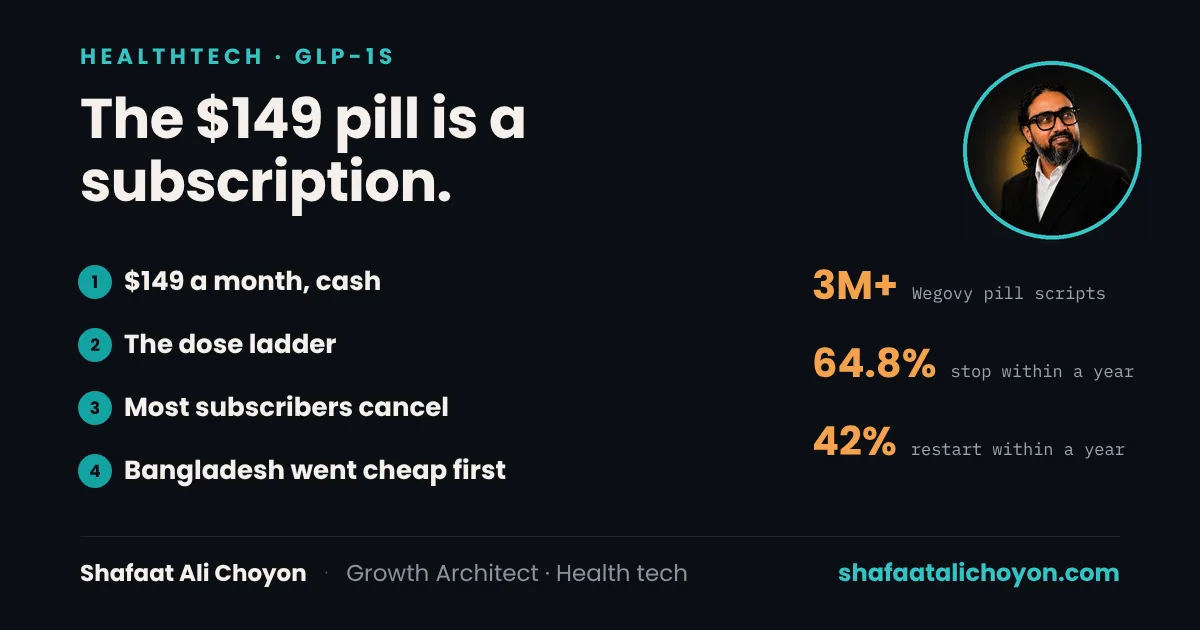
On 5 January 2026, Novo Nordisk launched the Wegovy pill in the US at $1491 a month for anyone paying cash. In April, Eli Lilly's Foundayo arrived at the same starting price. Within five months the Wegovy pill passed 3 million2 US prescriptions, and more than 80% of new prescriptions went to people who had never taken a GLP-1 before. A weight-loss drug has become something you buy monthly, online, with a card. That is a subscription. And the hard part of any subscription is not the first month.
How much does the Wegovy pill cost without insurance?
The starting dose of the Wegovy pill is $149 a month cash. The middle dose is $199, and the higher doses are $2991. Foundayo, approved on 1 April and on sale from 9 April, starts at $149 and reaches $299 at the higher doses. With commercial insurance and a savings card, either pill can cost as little as $25.
Older adults got their own door. Since 1 July 2026, Medicare's GLP-1 Bridge lets eligible Part D members get Wegovy, Foundayo or the Zepbound pen for weight management at $504 a month, through the end of 2027. The drugs are sold through pharmacies, Amazon, and telehealth brands such as Ro, WeightWatchers and GoodRx. The checkout looks like a streaming service.
A dose ladder is a price ladder
Here is the detail that turns a drug into a subscription business. These medicines start at a low dose and step up over months. The cash price steps up with them. A patient who starts at $149 and stays on track is paying $299 or more a few months later.
The companies know where the value sits. Lilly's self-pay terms offer Foundayo's two highest doses at $299 a month only when the patient refills within 45 days3. Miss the window and the regular, higher price applies. That is not a medical rule. It is a retention offer, the same one a gym or a software company makes: stay, and it costs less. The most profitable customer is the one in month six, not the one in month one.
I learned this at Praava Health in Bangladesh, where most patients paid out of pocket. Cash customers judge value every single time they pay. Nobody renews on autopilot when the money comes from their own wallet. A cash-pay GLP-1 business now lives under the same rule.
Most subscribers cancel
The data on who stays is sobering. A study of more than 125,000 US adults in JAMA Network Open found that among people without type 2 diabetes, 64.8%5 stopped their GLP-1 within a year and 84.4% within two. People with diabetes did better, but nearly half still stopped in the first year. Cost, stomach side effects and how much weight people lost were all linked to stopping.
There is a hopeful twist. A claims study presented at ENDO 2026 found that among patients with diabetes who stopped, 42%6 restarted within a year. People cancel, then come back. Any subscription operator will recognize that pattern. It means the relationship is not over when the refills stop. It is waiting for a reason to resume.
Bangladesh ran the cheap-drug experiment first
Bangladesh already has cheap semaglutide, made by its own drug companies. A local vial costs around Tk 5,0007, against more than Tk 14,000 for the original brand. Supply is plentiful because it is made at home.
Cheap did not make it simple. Pharmacy staff sell these drugs without a prescription, and beauty clinics pitch them as a magic cure. Doctors in Bangladesh warn that stopping without changing diet and activity leads to rapid weight regain. They recommend checking patients at least monthly for the first three months and quarterly after that.
This is the flip. In the US, the $149 price is treated as the breakthrough. Bangladesh shows what happens when price stops being the barrier and nothing else changes: easy access, quick starts, and doctors warning about the weight that comes back when people stop. The country that solved price first is the clearest warning that price is only the entry fee. I wrote earlier about the services economy GLP-1s created. The pill makes that services layer the main event.
Who wins month four?
The winners in cash-pay GLP-1s will not be whoever sells the cheapest first box. They will be whoever owns the care around the pill. At Laser Treat, the clinical group in Bangladesh where I was COO, we digitized operations and raised patient retention by about 13%. The gain came from operations, not new treatments: we could see who was slipping and reach them in time.
If I were building a GLP-1 program today, I would focus on five moves:
- Price the whole journey, not the first fill. Model what a patient pays at each dose step. My free churn and retention calculator shows what a few points of monthly churn do to revenue.
- Set acquisition spend against lifetime value. If most patients leave within a year, the cost of getting one has a hard ceiling. My free LTV:CAC calculator finds it.
- Schedule the check-ins Bangladesh's doctors recommend: monthly for three months, then quarterly. Make each one useful, with side-effect help and progress.
- Build a way back. Since many people restart, make returning easy, with no shame and no new paperwork.
- Use AI for the routine follow-up. An assistant that checks in, answers side-effect questions and flags who needs a clinician keeps the cost to serve low enough for a $149 price.
The short version
- The Wegovy pill launched at $149 a month cash in January 2026 and passed 3 million US prescriptions in five months.
- Prices rise with the dose, from $149 to $299 a month, and Lilly rewards refilling within 45 days, so the value is in patients who stay.
- Most people stop: 64.8% of adults without diabetes quit GLP-1s within a year, though many later restart.
- Bangladesh had cheap semaglutide first and learned that access without follow-up means regain.
- The winner owns the care around the pill, not the cheapest first box.
If your cheapest customer is the one in month one, what are you building for month four?
Frequently asked questions
How much does the Wegovy pill cost without insurance?
The Wegovy pill costs $149 a month cash for the starting dose, $199 for the middle dose and $299 for the higher doses. With commercial insurance and a savings card it can cost as little as $25 a month.
How many people stop taking GLP-1 drugs?
A study of more than 125,000 US adults found that 64.8% of people without type 2 diabetes stopped within a year and 84.4% within two years. Among patients with diabetes who stopped, a separate study found 42% restarted within a year.
Does Medicare cover weight-loss pills in 2026?
Through the Medicare GLP-1 Bridge, which runs from 1 July 2026 to the end of 2027, eligible Part D members can get Wegovy, Foundayo or the Zepbound pen for weight management for $50 a month.
Sources
- Fierce Pharma, Novo's Wegovy pill makes US debut, with starter dose launching at $149 per month for cash-paying patients (5 January 2026). fiercepharma.com ↗
- NJBIZ, Novo Nordisk Wegovy pill tops 3M prescriptions (9 June 2026). njbiz.com ↗
- Eli Lilly, LillyDirect: Foundayo self-pay pricing (accessed 20 October 2026). lilly.com ↗
- VPM / NPR, Some Medicare beneficiaries can now get popular obesity drugs for $50 a month (6 May 2026). vpm.org ↗
- Healio, Most adults with overweight or obesity discontinue GLP-1 therapy within 2 years (JAMA Network Open study, 31 January 2025). healio.com ↗
- The Pharmaceutical Journal, More than half of patients who stop weight-loss drugs restart within a year (17 June 2026). pharmaceutical-journal.com ↗
- The Business Standard, The Ozempic 'miracle': Bangladesh's growing appetite for quick weight-loss fixes (24 May 2025). tbsnews.net ↗
Md Shafaat Ali Choyon (MPH, CHES®, MBA, MCIM) is a growth, marketing and public-health strategist who builds and runs AI in production, with 17 years across telecom, fintech, e-commerce, consumer tech and healthcare in the US and Bangladesh. See the essays or the portfolio.