The US didn't decide to build a sick-care system. It backed into one, because that's what the money rewarded for decades — pay for procedures, not for keeping people well, and you get a system exquisitely optimized to treat disease late. A market still building its health system has something the US has largely lost: the option to put prevention first, on purpose.
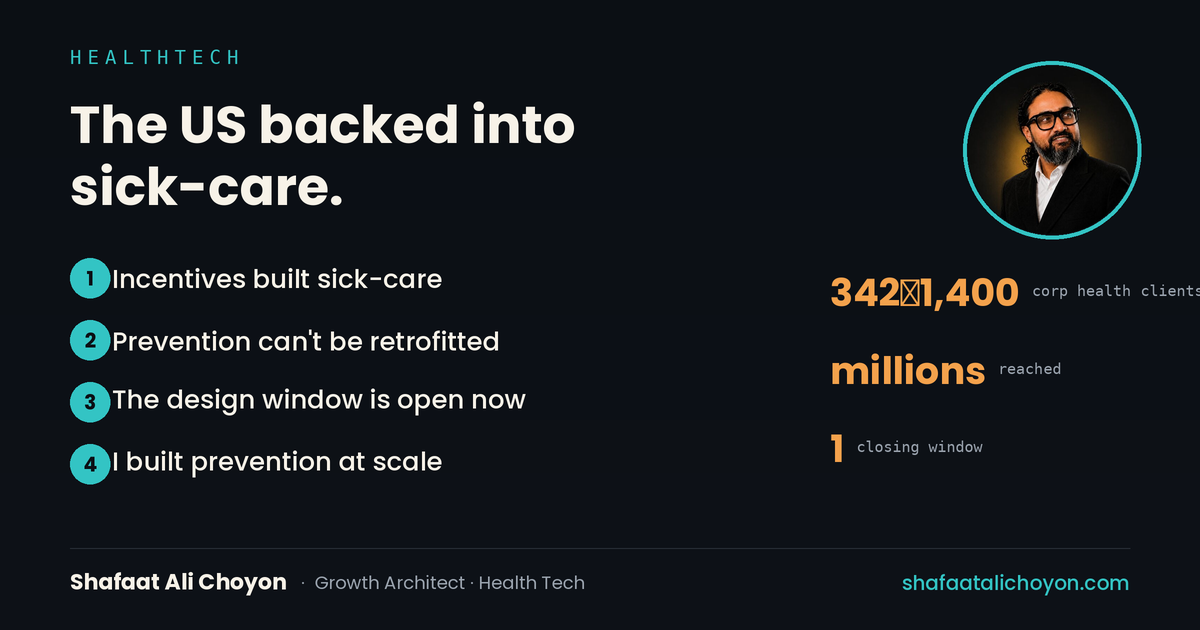
Sick-care is a structure, not a choice
No one designed American healthcare to ignore prevention; the incentives did it quietly. When reimbursement pays for the intervention and not the avoidance, every rational actor optimizes toward treating illness once it's expensive and advanced. The result feels like a values failure but is really a structural one — and structures are far harder to reverse than intentions.
Prevention-first is a window that closes
Here's the part builders in emerging markets should hear clearly: prevention is nearly impossible to retrofit once the cost curve and incentives lock in, but it's designable while a system is still forming. That window — where you can build screening, early detection, and population health into the model before the sick-care incentives calcify — is open now in places it's already closed in the US. Windows like that don't stay open.
I've built prevention at scale
This isn't abstract for me. At Praava we ran corporate health programs that grew from 342 to ~1,400 clients, alongside wellness, screening, and the Lifebuoy population-scale access that put basic care in millions of hands — prevention and early detection delivered as a business, not a grant. It works when you design the system to value keeping people well, and it compounds, because a healthier population is a cheaper one to serve.
The dual-market read
Bangladesh can leapfrog to a prevention-first system the way it leapfrogged to mobile money — by not inheriting the incumbent's mistakes. The US, meanwhile, is spending enormous effort trying to retrofit prevention through employers and value-based care, against the grain of its own incentives. One market gets to design it in; the other has to fight it in. That asymmetry is the opportunity.
The short version
- The US didn't choose sick-care; its reimbursement incentives produced it structurally.
- Prevention can't be retrofitted once incentives lock in — but it's designable while a system forms.
- I've built prevention as a business: Praava corporate health 342→~1,400 clients, plus population-scale access.
- Bangladesh can leapfrog to prevention-first; the US is stuck retrofitting it against its own grain.
If you were designing a health system from scratch today, what would you pay for — treating disease, or preventing it — and does your current model actually do that?
Md Shafaat Ali Choyon (MPH, CHES®, MBA, MCIM) is a growth, marketing and public-health strategist who builds and runs AI in production, with 16+ years across telecom, fintech, e-commerce, consumer tech and healthcare in the US and Bangladesh. See the essays or the portfolio.