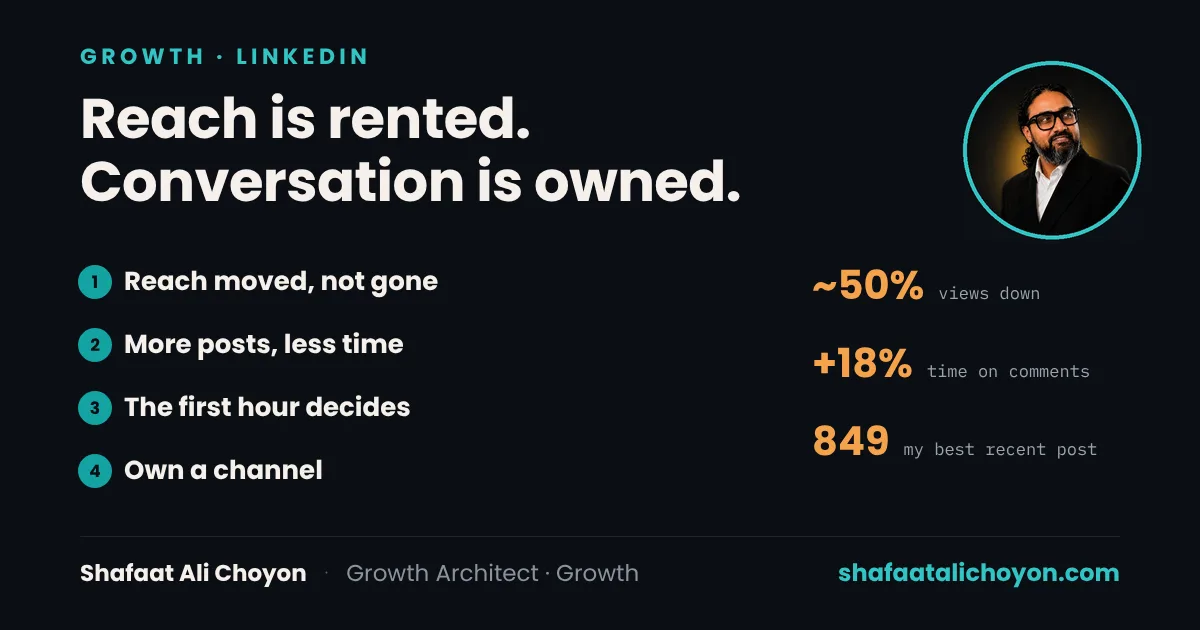
My best recent post on LinkedIn drew 849 impressions. That is roughly what the platform now gives a careful writer with a modest network. Third-party analyses put LinkedIn views down about 50%2 in a year. Richard van der Blom, who studies the platform for a living, says active creators have lost about 60%1 of their reach over two years. None of this is LinkedIn's own data. But anyone who posts there has felt it.
Is LinkedIn reach really down?
For people who post often, yes. Van der Blom's latest dataset covers 1.3 million posts from 50,000 creators. He says engagement fell less than reach, about 20 to 25%, and that people who post only now and then actually saw reach rise by about 10 to 15%. Reach did not vanish. It moved.
LinkedIn tells a different story, and its numbers are real too. In its July 2026 results, LinkedIn said time spent on content grew 10%3 in a year, knowledge-oriented posts grew 24%, and time spent reading comments rose 18%.
Put those side by side and the puzzle solves itself. If the number of serious posts grows 24% and the time people spend reading grows 10%, the average post gets a thinner slice. That is arithmetic, not a penalty. The feed is more crowded, and the platform is getting pickier about who gets the slice.
The feed stopped counting likes and started reading
In March 2026, LinkedIn described a rebuilt feed that uses large language models to understand what a post is actually about and match it to what a member cares about now. It said it would filter out engagement bait, so the feed is "not a popularity contest", and that relevant posts gaining traction would be seen "within minutes, not hours"4.
That changes what a good reaction is worth. A like is cheap. A save says "I will need this again", and one widely shared estimate, from a Forbes columnist citing a marketing tool's analysis with no published method, puts a save at about five times5 the reach of a like. Treat the exact multiple with care. The direction is consistent with what LinkedIn says it rewards: posts people find useful, not posts people tap past.
I covered why saves beat likes in Saves, not likes. The new part is speed. Because the feed tests a post within minutes, the first hour now decides most of its life.
The comment section is now the post
That 18% rise in time spent reading comments is the most useful number LinkedIn has published this year. People are reading the conversation under a post, not just the post.
Van der Blom's advice is to publish only when you have time to reply, and to "nurture" a post in its first hour. A secondary summary of his 2026 research reports about 64%6 more comments when authors reply within 30 minutes. He also warns that about 80% of the 20 to 30 comments he gets in the first five minutes are written by AI, often from the same accounts.
I build and run AI agents in production, and I use AI to draft and reuse my own writing. That is not the problem. The problem is fake conversation. LinkedIn has said it is fine to use AI to help you write, as long as your posts and comments represent your voice. Use AI to make your thinking travel further. Do not use it to pretend people are talking to you.
Bangladesh never had reach to lose
In Bangladesh, LinkedIn is still a growing room. DataReportal counts 12.0 million7 registered LinkedIn members there in late 2025, up 29% in a year. Those are registrations, not active users, and Facebook's ad reach is far larger at 64 million. But a Dhaka professional is writing into a room that is filling up, while a US creator is writing into a room that is overflowing.
The deeper lesson runs the other way. Bangladeshi business has always traveled through trust, not broadcast. At Ekhanei, we built the country's number one motorbike category from zero in about 2.5 months, and a big part of it was Bike Bazaar, an offline trade play designed for trust. We did not wait for online reach. We went where the conversation already was.
That is the flip. US creators are discovering that feed reach was always rented. Markets like Bangladesh never assumed otherwise. They built on referrals, forwards, direct messages and rooms where people actually talk.
What still travels, and what I am doing about it
Van der Blom now suggests 2 to 4 posts a week, down from 5 or 6, and says newsletters are back: about 80% of his LinkedIn-related conversions come from them. Here is what I take from all of this:
- Post less, finish more. Two or three posts a week, each one worth saving: a framework, a number, a checklist.
- Block the first hour. Publish when you can reply. Answer every real comment with something that adds to it.
- Write for the specific reader. The feed matches topics to interests now. A clear subject beats a broad one.
- Own one channel. A newsletter, an email list or your own website keeps the audience when the feed changes. I rebuilt my site to be read by AI for the same reason.
- Reuse, do not repeat. One strong idea can become a post, a carousel, a newsletter section and a site essay.
My free engagement rate calculator shows whether a smaller audience is reacting more deeply, and my free content reuse planner turns one idea into a month of formats. My 849 impressions are a small number. The question is how many of those people saved it, replied, or came back.
The short version
- Third-party analyses put LinkedIn views down about 50%, and van der Blom says active creators lost about 60% of reach over two years.
- LinkedIn says time on content rose 10%, while knowledge posts rose 24%, so each post gets a thinner slice.
- The feed now reads posts with AI and filters engagement bait; saves and real replies matter more than likes.
- Time reading comments rose 18%, so the first hour of conversation decides a post's life.
- Own a channel and reuse your best ideas, the way markets like Bangladesh always built on trust, not broadcast.
If your LinkedIn reach halved again next year, which part of your audience would you still be able to reach?
Frequently asked questions
Why has my LinkedIn reach dropped in 2026?
Third-party analyses put views down about 50%, and van der Blom says active creators lost about 60% of reach over two years. LinkedIn reports that knowledge-oriented posts grew 24% while time spent on content grew 10%, so more posts are competing for attention, and its rebuilt feed filters out engagement bait.
What gets the most reach on LinkedIn now?
Posts people find useful enough to save, and posts with real conversation in the first hour. One widely shared estimate puts a save at about five times the reach of a like, though its method is not published, and LinkedIn says time spent reading comments rose 18%.
Is LinkedIn reach data official?
Mostly not. The reach decline figures come from independent analysts such as Richard van der Blom, whose latest dataset covers 1.3 million posts. LinkedIn's own published figures cover time spent on content, knowledge-oriented posts and time spent reading comments.
Sources
- Creator Science podcast, Episode 307: Richard van der Blom, The state of LinkedIn in 2026 (based on data from 1.3 million posts) (2 June 2026). creatorscience.com ↗
- Dataslayer, LinkedIn Algorithm 2026: Document Posts Get 3x Higher Engagement (February 2026), citing Richard van der Blom's Algorithm Insights report. dataslayer.ai ↗
- LinkedIn, Q4 Earnings and Business Highlights (29 July 2026). news.linkedin.com ↗
- Social Media Today, LinkedIn updates its feed algorithm (12 March 2026). socialmediatoday.com ↗
- Forbes (Jodie Cook), 5 LinkedIn Content Moves LinkedIn Started Punishing In 2026 (23 July 2026). forbes.com ↗
- All In, LinkedIn fall 2026 algorithm changes (2026). media-all.in ↗
- DataReportal (Kepios), Digital 2026: Bangladesh (8 November 2025). datareportal.com ↗
Md Shafaat Ali Choyon (MPH, CHES®, MBA, MCIM) is a growth, marketing and public-health strategist who builds and runs AI in production, with 17 years across telecom, fintech, e-commerce, consumer tech and healthcare in the US and Bangladesh. See the essays or the portfolio.