The most wasteful thing in content isn't a bad idea. It's a good one you published once, watched scroll away in a day, and never used again. Most teams respond to falling reach by making *more* — more posts, more topics, more scramble. The higher-leverage move is the opposite: make the same durable idea more ways.
Reach is falling, and volume is the wrong answer
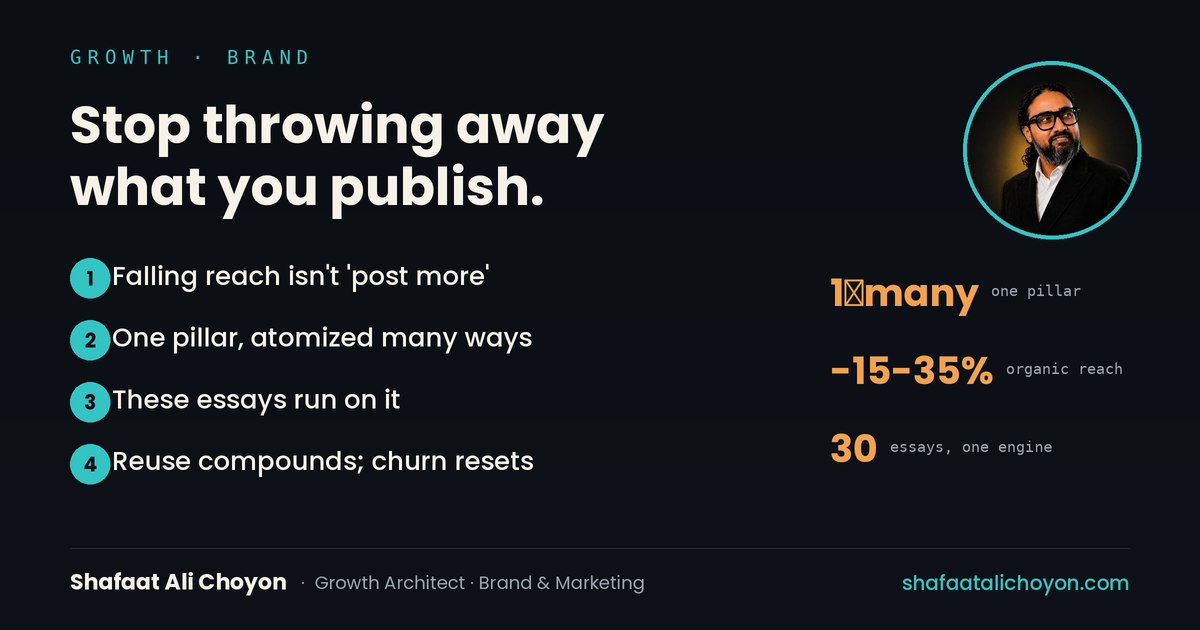
Organic reach is down an estimated 15–35% as feeds fill with AI-generated noise. The instinct — post more to compensate — burns the team out and dilutes quality. The move that actually works is to stop treating each post as disposable and start treating one strong idea as raw material for a dozen.
The hub-and-spoke engine I run on
Research once, write one canonical pillar, then atomize it into a LinkedIn series, a carousel, a short video, a newsletter — each linking back to the pillar. This isn't theory for me: the essays you're reading run on exactly this engine, generated from a single source and designed so each one seeds many posts. One deep asset does the work of twenty shallow ones, and it keeps doing it long after a one-off post is dead.
Compounding beats churning
A disposable post spikes and dies in twenty-four hours. A pillar you own, link to, and repurpose keeps earning — it gets found, cited, and reused for months. Content is one of the few places where discipline literally compounds: every reuse makes the asset more valuable, while every scramble just resets the clock.
Why this matters more outside the US
A small team in Dhaka can't out-*produce* a big Western brand — but it can out-*reuse* one. Atomization is the great equalizer: it lets a two-person operation get the reach of a twenty-person content department by refusing to waste anything it makes. In a market where every hour counts, throwing away a good idea is a luxury nobody can afford.
The short version
- Falling reach tempts teams to post more; the answer is to publish the same durable idea more ways.
- Hub-and-spoke: one canonical pillar, atomized into many formats that all link back.
- These essays run on that engine — one source seeds many posts, and keeps earning.
- Reuse compounds; churn resets. A small team wins by out-reusing, not out-producing.
Look at your best post from last quarter — how many more pieces could it still become, and why haven't they been made?
Md Shafaat Ali Choyon (MPH, CHES®, MBA, MCIM) is a growth, marketing and public-health strategist who builds and runs AI in production, with 16+ years across telecom, fintech, e-commerce, consumer tech and healthcare in the US and Bangladesh. See the essays or the portfolio.