A year ago I rebuilt my own website around a question most sites still aren't asking: what happens when your reader isn't a person scrolling Google, but an AI writing the answer for them? I've spent sixteen years watching marketing channels rise and die — search, social, email, each in turn — so I recognize the pattern when a new one arrives. This is one.
The click is disappearing
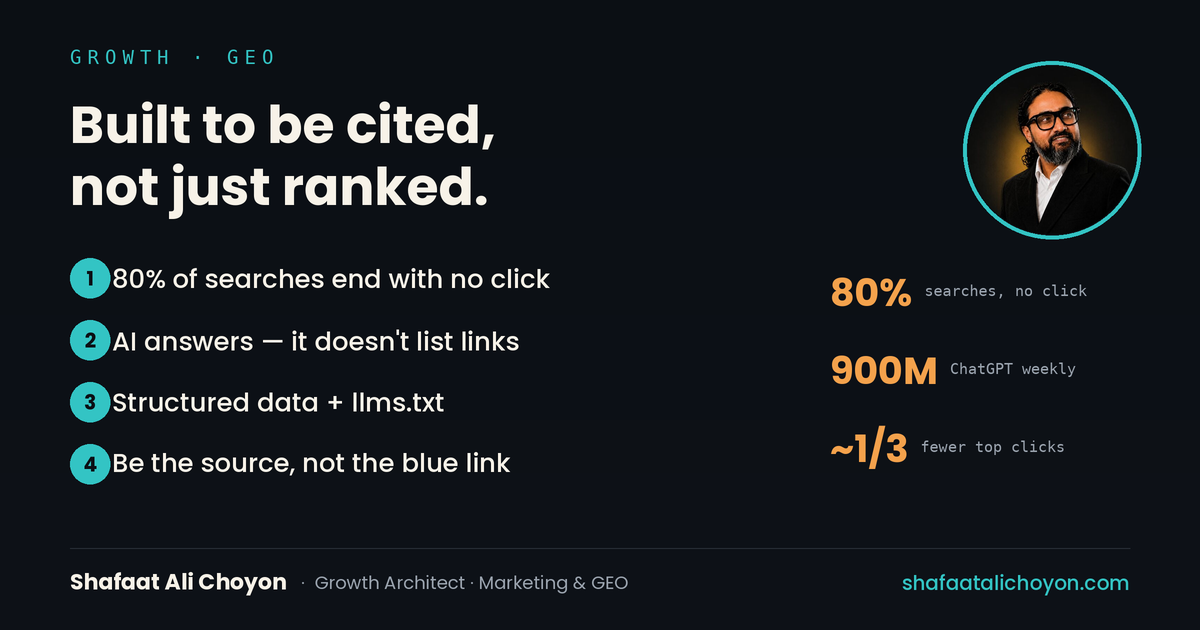
The numbers are stark. Something like 80% of Google searches now end without a single click. AI Overviews have cut clicks to the top result by roughly a third. ChatGPT alone fields hundreds of millions of questions a week. People increasingly get the answer, not the list of links — which means "rank #1" is quietly becoming the wrong goal. In sixteen years of buying and earning attention, I've learned to spot a channel whose economics are inverting. This is that moment for search.
Optimizing to be the source, not the result
So I built for the machine that answers. Concretely, on my own site that meant: JSON-LD structured data describing who I am, what I've done, and every article I've published, in a form models can parse; an llms.txt file that greets AI crawlers and tells them what matters; a robots file that explicitly welcomes GPTBot, ClaudeBot and PerplexityBot instead of blocking them; and prose written to be quotable — clear claims, one idea at a time, easy to lift into an answer. The whole site now runs through the same discipline I'd sell a client.
The dual-market angle nobody's pricing in
Here's where it gets interesting for anyone outside the US. English content dominates what these models learned, so being the clear, well-structured source in an underserved space — a market, a language, a niche the giants ignore — is wide-open ground. It's the same opening I wrote about with Bangla-first AI: the model's blind spots are a marketer's opportunity. The move that helps a personal site get cited is exactly the move that lets a Bangladeshi brand become the answer in a category no one has claimed yet.
The specifics are the tell
None of this games anything — and that's the point. The pages that get cited are the ones that make a checkable, specific claim a model can trust and reuse. "We help businesses grow" gets ignored; "took a used-motorbike category to No. 1 in two and a half months" gets quoted, because it's concrete and attributable. Answer engines reward the same thing skeptical humans do: specificity backed by a name.
This isn't a hack — it's a discipline
Be clear, be structured, be genuinely useful, and make it easy to quote you. That worked for search engines. It works even harder for answer engines, because a model has to *choose* your sentence over everyone else's. The brands and people who win the next five years will be the ones who understood, early, that they were writing for a reader who never scrolls.
The short version
- ~80% of searches now end with no click; AI answers instead of listing links.
- Optimize to be cited: structured data, llms.txt, crawler-friendly, quotable, specific prose.
- Underserved markets and languages are open ground to become the answer first.
- Specificity backed by a name is what both AI and skeptical humans actually trust.
When an AI answers a question in your field, whose words is it using — and could they be yours?
Md Shafaat Ali Choyon (MPH, CHES®, MBA, MCIM) is a growth, marketing and public-health strategist who builds and runs AI in production, with 16+ years across telecom, fintech, e-commerce, consumer tech and healthcare in the US and Bangladesh. See the essays or the portfolio.