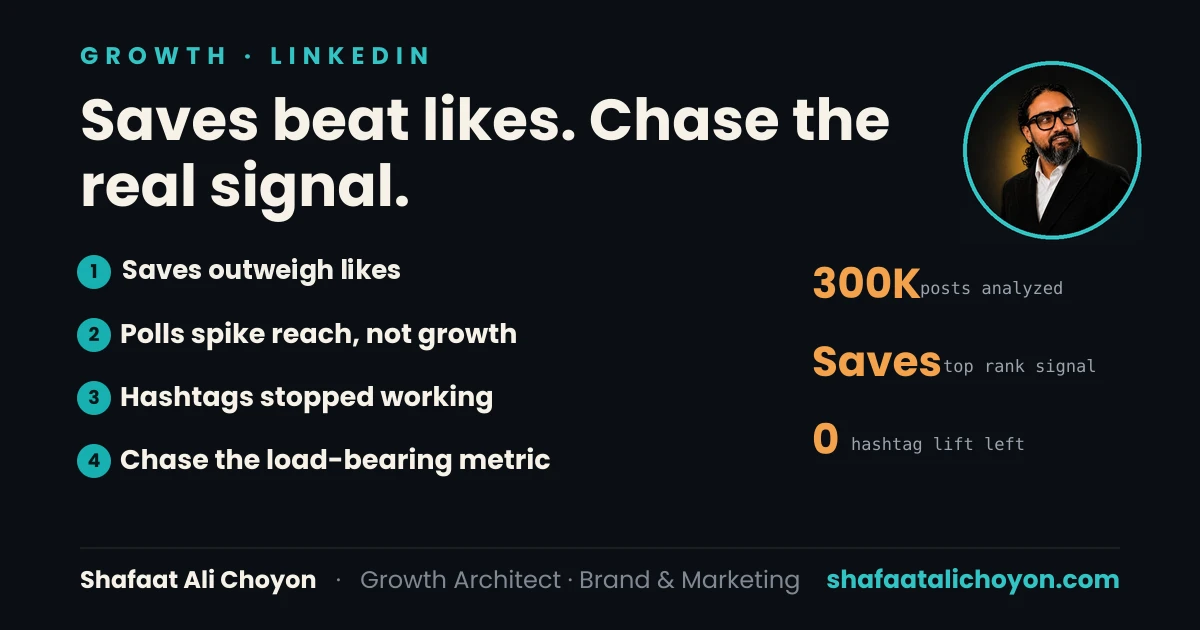
A January 2026 report by creator coach Chris Donnelly, based on 300,0001 LinkedIn posts and covered by Forbes, tested three things creators have been arguing about for years, and settled all three the same way: intuition lost. Saves carry more weight than likes, polls rank top for reach but very low for follower growth, and hashtags, in Donnelly's own words, "haven't worked in years."1
Which LinkedIn growth beliefs does the data disprove?
Likes feel like the obvious signal because they're the most visible one, big numbers, public validation. The data says otherwise: saves outweigh likes in LinkedIn's distribution ranking, because a save is a stronger behavioral signal of genuine value than a reflexive tap. Polls look like a growth hack because they spike engagement and reach, but the same report found they rank very low for follower growth, likely because poll engagement doesn't convert into the kind of relationship that makes someone hit "follow." And hashtags, the oldest piece of LinkedIn folk wisdom, simply stopped mattering years before most creators noticed.
Every one of these myths persisted because it was measurable in the wrong metric, reach or vanity engagement, while the metric that mattered, followers and saves, moved in the opposite direction the whole time.
The used-motorbike lesson: ignore what looks right, find what the mechanism rewards
I took a used-motorbike marketplace to the #1 category position in 2.5 months, and the obvious move at the start, the one everyone on the team assumed would work, was heavier generic paid acquisition. It looked right. It moved the top-of-funnel number everyone was watching. It wasn't what the category-ranking mechanism actually rewarded. The real lever was elsewhere in the funnel, and finding it meant setting aside the intuitive tactic and testing what the system's actual scoring logic responded to instead.
The LinkedIn mythbusting data is the same discipline applied to a different platform. Likes, polls, and hashtags are the paid-acquisition equivalent here, the moves that look like growth because they produce a visible number, while the actual mechanism (saves, follower conversion, algorithmic trust) is being optimized somewhere else entirely.
Optimize for the metric that's actually load-bearing
None of this means stop engaging people, it means stop measuring success with the metric that feels good instead of the one that's structurally tied to distribution and growth. Saves signal that content was worth returning to. That's a harder bar than a like, and it's exactly why it's the stronger ranking input.
Chase the metric the system actually weighs, not the one that lights up first on your notifications.
The short version
- Chris Donnelly's 300,000-post report, covered by Forbes, found saves carry more weight than likes in LinkedIn's ranking.
- Polls rank top for reach but very low for follower growth, engagement and growth are not the same outcome.
- Hashtags "haven't worked in years," per the same 2026 report, retire the habit.
- The used-motorbike marketplace hit #1 in category by ignoring the intuitive tactic and finding what the ranking mechanism actually rewarded, same discipline applies here.
Which of your current tactics is producing a number that feels good but isn't the number the system is actually scoring you on?
Frequently asked questions
Do saves matter more than likes on LinkedIn?
Yes. Chris Donnelly's January 2026 report on 300,000 LinkedIn posts, covered by Forbes, found saves carry more weight than likes, because a save is a stronger behavioral signal of genuine value than a reflexive tap.
Do polls and hashtags help LinkedIn reach?
Polls rank top for reach but very low for follower growth, and hashtags, in the report author's words, "haven't worked in years."
Sources
- Forbes (Jodie Cook, contributor), reporting Chris Donnelly's 300,000-post LinkedIn report, 12 Jan 2026. forbes.com ↗
Md Shafaat Ali Choyon (MPH, CHES®, MBA, MCIM) is a growth, marketing and public-health strategist who builds and runs AI in production, with 17 years across telecom, fintech, e-commerce, consumer tech and healthcare in the US and Bangladesh. See the essays or the portfolio.