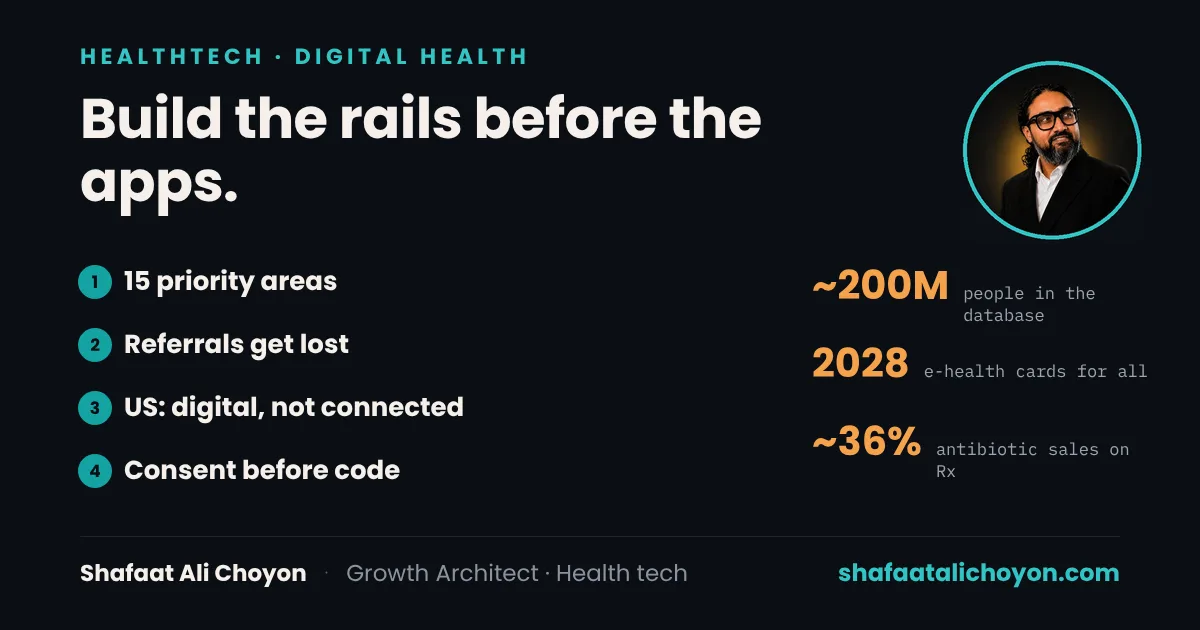
On 18 October, Bangladesh's health ministry launched a national e-health hackathon in Dhaka. Organisers listed 15 priority areas, including diagnosis backlogs, prescriptions nobody can verify and patients lost between facilities. Alongside it, the state minister for health described a national health database covering nearly 200 million people, fed by doctor visits, pharmacy purchases and lab tests. The list is honest. It names the real bottlenecks. But read it closely and almost none of them is an app problem. They are rail problems, and a hackathon is good at apps.
What is Bangladesh's e-health hackathon trying to fix?
The goal is to bring young innovators, including those outside Dhaka, into the digital transformation of the health system. Registration runs for a month. A screening committee narrows the field from 50 teams to 25 and then to a top five at a three-day bootcamp in Dhaka in December. The ministry may take the best prototypes forward as foundations for official national e-health solutions.
The priorities the ministry described include app-based hospital appointments to end the queues that form before the gates open at 8am2, QR codes and digital tracking to stop medicines meant for government hospitals being sold illegally, and one integrated system connecting government health departments. It sits next to a promise made in parliament in June: e-health cards for every citizen by 20283, with AI-based national e-prescriptions and prescription audits.
The three bottlenecks are rail problems
Take lost referrals. In May, during the measles outbreak, The Daily Star followed an eight-month-old who was treated for three days at Gazipur Sadar Hospital, referred to Dhaka, and then taken by his family to three Dhaka hospitals before finding a mattress near a staircase. At one Dhaka hospital, 73%4 of measles admissions in a single day came from outside the city. The health directorate later added 464 suspected deaths it had not recorded, after checking with medical college hospitals. A referral that does not travel with the patient is not a referral. It is a hope.
Take prescriptions. In a 2024 observation of 2465 private pharmacies in Dhaka, only about 36%5 of antibiotic sales were based on a prescription, and a registered pharmacist was present in fewer than one in ten of them. You cannot audit a prescription you cannot verify, and you cannot verify one without a prescriber ID and a patient ID that every system recognises. I wrote about the medicine side of this in Trust in the pill.
No app fixes either problem on its own. Both need shared identity, shared standards and a handshake between facilities. Those are rails.
The US digitized first and connected later
The US is the warning. American hospitals went digital long ago, yet in 2023 only 43%6 were routinely interoperable across all four basics: sending, receiving, finding and integrating patient records. Just 42%6 said their clinicians routinely use outside information when treating patients. The records exist. They just do not move, or nobody trusts them enough to use them.
That is what happens when every hospital buys its own system and connection is an afterthought. Bangladesh is starting from the other end, with a national card, a national database and a stated goal of interoperability across departments. If it sets the standards before thousands of apps are built, it can skip a decade of American plumbing work. That is the flip: the country with fewer systems can design connection in from day one.
One database for 200 million needs consent before code
The ministry said global companies are interested in using this data for AI and machine learning, and the minister stressed sovereignty, privacy and security. Both points are right, and the order matters. A database built before people trust it becomes a liability. Bangladesh now has a Personal Data Protection Act 2026 that requires explicit consent for sensitive data7. The rails need to put that law into the software: who can see a record, who gave permission, and a log of every access. I argued in The consent problem that consent, not the model, is health AI's real bottleneck. A national database is where that argument gets tested.
Trust is also a business decision. At Praava Health, most patients paid out of pocket, and replacing referral kickbacks with transparent pricing lifted lab margins from about 30% to 50%. People rewarded the provider they could trust. Citizens will do the same with a national health system that shows them who touched their data.
What I would build in the hackathon
If I were mentoring a team, I would point them at the rails, not another booking app. My free AI use-case risk triage helps sort which ideas touch decisions that need safeguards, and you can ask Ask Shafaat to pressure-test an idea.
- A referral ticket. A digital slip that travels with the patient, shows the receiving hospital's beds, and closes the loop when the patient arrives.
- A verifiable prescription. A QR code linking prescriber registration, patient ID and the drug, readable by any pharmacy phone.
- A consent ledger. A record, visible to the patient, of who opened their file and why.
- Open standards first. Publish the data formats and APIs before the apps, so every winner plugs into the same rails.
- Measure the handoffs. Count referrals that arrive, prescriptions verified and duplicate tests avoided, not downloads.
When I digitized operations at Laser Treat with ERP and BI, the gains, about $0.5M lower operating cost and 13% better patient retention, came from connecting what already existed, not from a flashy front end. National health is the same problem at a bigger scale.
The short version
- Bangladesh launched a national e-health hackathon on 18 October 2026 with 15 priority areas1, including diagnosis backlogs, unverifiable prescriptions and lost referrals.
- A national health database for nearly 200 million people2 and e-health cards for all citizens by 2028 are planned.
- Lost referrals and unverifiable prescriptions are rail problems: they need shared IDs, standards and handoffs, not more apps.
- The US went digital without connecting: only 43% of hospitals were routinely interoperable in 2023.
- Consent and access logs must come before the database, or trust will stall adoption.
If the best hackathon app launched tomorrow, which rail would it need that does not exist yet?
Frequently asked questions
What is the Bangladesh e-health hackathon 2026?
It is a national competition launched by Bangladesh's health ministry in Dhaka on 18 October 2026 to find digital solutions for the health system, drawing in young innovators from inside and outside Dhaka. Registration runs for one month, and shortlisted teams attend a three-day bootcamp in Dhaka in December, narrowing from 50 teams1 to 25 to a top five.
What problems does the Bangladesh e-health hackathon target?
Organisers listed 15 priority areas, including diagnosis backlogs, unverifiable prescriptions and lost referrals between facilities. The ministry also described app-based hospital appointments, QR tracking of medicines supplied to government hospitals and an integrated system connecting health departments.
Is Bangladesh building a national health database?
Yes. The government says it is developing a health database covering nearly 200 million people, fed by doctor visits, pharmacy purchases and lab tests. It has set a target of e-health cards for every citizen by 2028.
Sources
- Lanka Business News, E-Health Hackathon 2026 launches to build AI and digital solutions for Bangladesh's health system (19 October 2026). lankabusinessnews.com ↗
- BSS, Muhit announces e-Hackathon on digital transformation of healthcare system (18 October 2026). bssnews.net ↗
- BSS, Every citizen to get e-health cards by 2028: Health Minister (10 June 2026). bssnews.net ↗
- The Daily Star, Care gaps push patients to crowd Dhaka hospitals (11 May 2026). epfs.thedailystar.net ↗
- Atencion Primaria, Inappropriate dispensing of antibiotics in urban and rural pharmacies in Dhaka: a cross-sectional observation (January 2026). elsevier.es ↗
- ONC (ASTP), Interoperable Exchange of Patient Health Information Among U.S. Hospitals: 2023, Data Brief No. 71 (May 2024). healthit.gov ↗
- The Daily Star, The need to protect our data (2 July 2026). thedailystar.net ↗
Md Shafaat Ali Choyon (MPH, CHES®, MBA, MCIM) is a growth, marketing and public-health strategist who builds and runs AI in production, with 17 years across telecom, fintech, e-commerce, consumer tech and healthcare in the US and Bangladesh. See the essays or the portfolio.