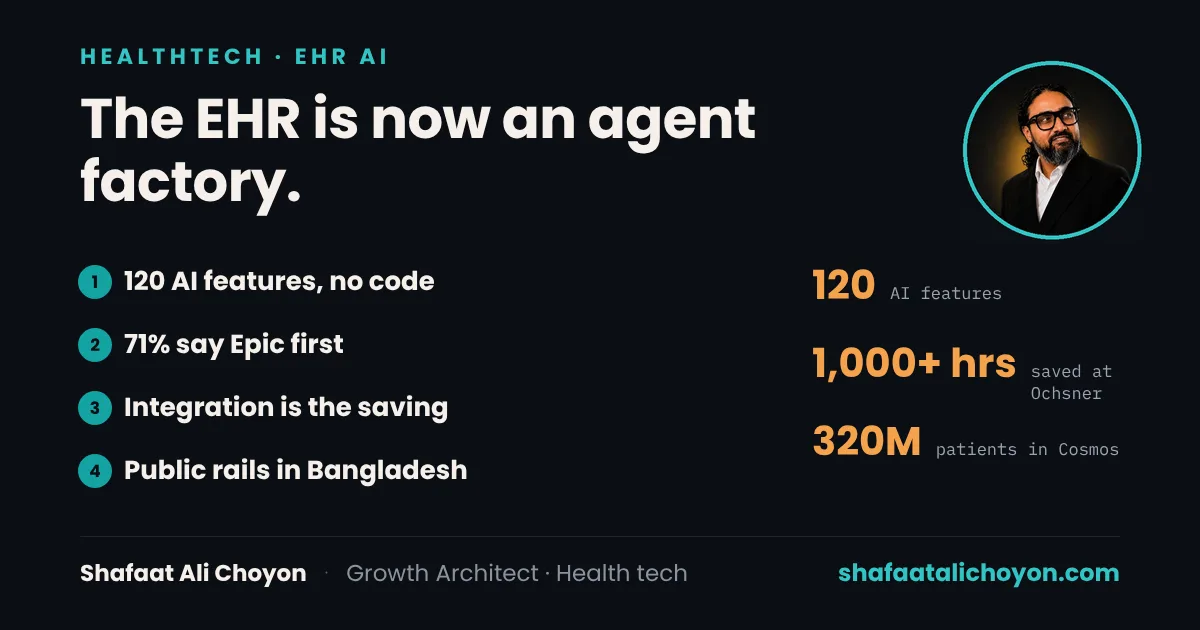
At its users' meeting in August, Epic showed health systems how to build their own AI agents without writing code. Agent Factory sits on top of what Judy Faulkner called 1201 AI features available out of the box. Early adopters are using it now, and Epic says it will be widely available in 2027. Ochsner Health reported that Epic's patient assistant saved its call-center staff more than 1,0001 hours in 10 months. The electronic health record used to be the system every AI tool had to plug into. It is becoming the place where the AI gets made.
The record owns the context, so it owns the agent
An AI agent needs two things to be useful in a hospital: context and permission to act. Context means the patient's history, orders, coverage and schedule. Permission means the right to write back, book the slot, send the request. Both live in the record.
Epic has both at scale. Its research database, Cosmos, covers more than 320 million1 patients. Its real-time prior authorization tool is live at four health systems, built with UnitedHealthcare, Network Health and Aetna, and Epic is testing the same connection with 16 more payers. An outside startup that wants to automate prior authorization has to borrow the context and ask for the permission. Epic already has both.
And the market keeps consolidating. According to KLAS, Epic was the only electronic record vendor that large health systems, those with more than 10 hospitals4, selected in 2025.
Will Epic's AI replace health tech startups?
Not all of them, but it moves the bar. In a Redesign Health survey of 112 senior leaders at Epic-based health systems, 71%2 described their organizations as "Epic-first". Not one respondent said they prefer outside vendors by default. About half said an outside vendor must show significantly higher return than Epic to win.
That last number is the squeeze. "Good enough and already inside" now beats "better but outside". The startups most at risk are the middle ones: a feature that does one workflow step a little better than the record does. If Epic ships it in the box in 2027, the buyer's question becomes why pay twice. The squeeze I described in the middle is disappearing now has a mechanism.
There is still room. The same leaders put about 43%3 of their clinical and administrative software budgets with outside vendors, and 64% said they were likely to buy from a new startup. But the startup has to win where the record is thin, or plug into the factory instead of competing with it.
The savings were in the integration, not the tools
I learned this as chief operating officer of Laser Treat, a multi-entity clinical group in Bangladesh, where I ran customer service, clinical operations, business functions and finance. We digitized operations with an ERP and business intelligence. The result was about $0.5 million lower operating cost and about 13% better patient retention.
The money did not come from one clever tool. It came from putting operations, finance and customer service on the same rails, so we could see a patient's journey end to end instead of in pieces. A standalone app that did one step well could not have shown us that, because it could not see the steps on either side.
That is the logic behind Agent Factory. Ochsner's 1,000 hours did not come from a smarter standalone chatbot. They came from an assistant built into the record it works on. When the agent lives inside the system of record, the boring integration work is already done, and that is where most of the value was hiding all along.
Bangladesh is building the platform as public rails
Here is the flip. In the US, the platform is a private vendor, and health systems decide which vendor's factory to build in. Bangladesh has no Epic. It is trying to build the shared layer as public infrastructure.
In March 2026 the government directed a national rollout of an e-Health Card, giving every citizen a health identity linked to the national ID, and set June 20265 as the target. The plan aims to connect public and private hospitals through shareable health records. A Bangladesh Health Watch researcher, writing in The Business Standard, argued that private clinics and diagnostic centers should be required to use standard APIs to sync with the national system.
I have seen public rails work. At SureCash, we delivered a government stipend to about 10 million beneficiaries on mobile money, because the payment rails were shared and anyone who met the standard could connect. If Bangladesh's health record works the same way, any company that meets the standard could build agents on it. That would be a more open market than the one US startups face today, and a lesson the US has mostly learned too late: whoever owns the rails decides who gets to build.
What to do if you buy or sell health AI
- Buyers: check the box before you buy. Before signing with a point solution, ask whether the feature is in Epic's 120 or on its 2027 path. If it is, the vendor must clearly beat it.
- Sellers: build where the record is thin. The home, the phone line, the payer gap, care outside Epic sites, imaging. Or build as an agent inside the factory and sell the outcome, not the app.
- Count hours and dollars. Ochsner's 1,000 hours is the right kind of claim. My free AI agent vs human cost calculator turns hours saved and volume into a monthly figure you can defend to a CFO.
- Integrate before you automate. Map the patient journey across the systems you already run. The leak you find there is usually worth more than any new tool.
- In Bangladesh, insist on open standards now. The e-Health Card should publish its APIs before it scales, so agents can be built by many companies, not one.
The short version
- Epic's Agent Factory lets health systems build agents without code on 120 AI features, with wide release in 2027.
- The record owns context and permission to act: Cosmos covers 320 million patients, and real-time prior authorization is live at four systems.
- 71% of surveyed Epic health system leaders are "Epic-first", and about half demand significantly higher return from outside vendors.
- The savings are in integration: at Laser Treat, connecting operations cut about $0.5 million in cost and lifted retention about 13%.
- Bangladesh is building the health record as public rails. Open standards would make its agent market more open than America's.
If the feature you sell or buy ships inside the record in 2027, what is your plan on the day it does?
Frequently asked questions
What is Epic's Agent Factory?
It is Epic's no-code platform for building, running and monitoring AI agents inside its electronic health record. Health systems can start from Epic's 120 ready-made AI features. Early adopters are using it now, and Epic says it will be widely available in 2027.
How much time has Epic's AI saved health systems?
Ochsner Health reported that Epic's patient assistant saved its call-center staff more than 1,000 hours over 10 months. Epic's real-time prior authorization tool is live at four health systems.
Do health systems prefer Epic's AI over startups?
Mostly. In a Redesign Health survey of 112 senior leaders at Epic-based health systems, 71% called their organizations Epic-first, and about half said outside vendors must show significantly higher return. They still spend about 43% of these software budgets with outside vendors.
Sources
- Fierce Healthcare, Epic expands AI ambitions with agent platform, Cosmos-powered predictions and deeper workflow (19 August 2026). fiercehealthcare.com ↗
- Redesign Health, The Epic Effect: How 112 Health System Executives Are Navigating AI Purchasing (July 2026). epicsurvey.redesignhealth.com ↗
- Fierce Healthcare, The AI boom could boost Epic's position, health system execs say (7 August 2026). fiercehealthcare.com ↗
- HIT Consultant, KLAS 2026 EHR market share report (14 May 2026). hitconsultant.net ↗
- The Business Standard, Bangladesh's e-Health Card needs to move beyond data to delivery (10 April 2026). tbsnews.net ↗
Md Shafaat Ali Choyon (MPH, CHES®, MBA, MCIM) is a growth, marketing and public-health strategist who builds and runs AI in production, with 17 years across telecom, fintech, e-commerce, consumer tech and healthcare in the US and Bangladesh. See the essays or the portfolio.