Every debate about health AI fixates on accuracy — is the model right often enough to be safe? It's the wrong obsession. The thing that actually stalls health AI in the real world isn't usually a wrong answer. It's an unanswered question: does the person know, and agree to, what's happening with their data? Accuracy is necessary. It has never been sufficient.
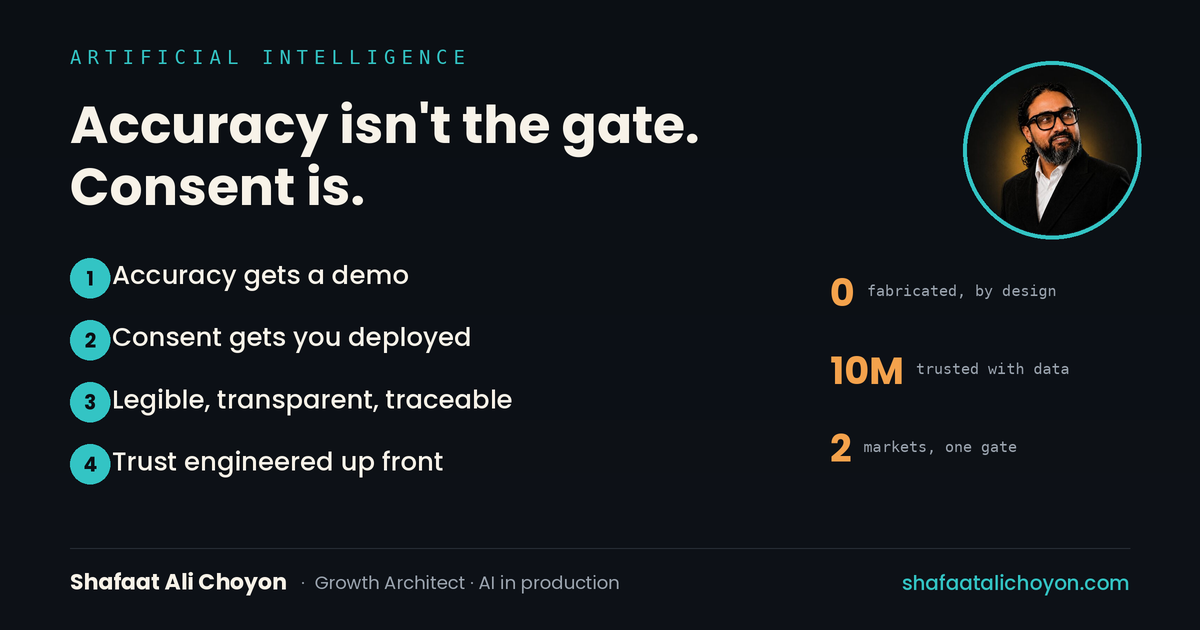
Accuracy gets you a demo; consent gets you deployed
A model can be brilliant and still be dead on arrival if patients, clinicians, or regulators don't trust what it does with information. The gate isn't "is it correct" — it's "who saw this, why, and with whose permission." That's a governance and design problem, not a modeling one, and it's exactly the part teams skip because it doesn't produce an impressive benchmark.
Consent and provenance are the product, not the paperwork
Real consent isn't a checkbox buried in an onboarding flow; it's a design commitment — the system is legible about what it collects, transparent about how it's used, and able to show where a given answer came from. I build AI in production with verification engineered in for exactly this reason: my systems ran 155 sessions with zero fabricated facts by design, because in anything touching health, an untraceable answer is a liability whether or not it's correct.
I've handled trust at scale with sensitive data
This is my lane. At SureCash we moved a government stipend to roughly 10 million people — deeply sensitive financial data at national scale, where a single breach of trust would have collapsed adoption. You learn quickly that people don't hand over their money, or their health, to a system that feels opaque, no matter how clever it is. Trust is engineered up front or it's absent.
The dual-market shape
In the US, the risk is *consent theater* — heavy formal frameworks (HIPAA and the rest) that produce compliance without actually earning trust. In Bangladesh, formal frameworks are thinner but trust is intensely relational, so a system that mishandles data loses adoption instantly and by word of mouth. Different failure modes, same rule: design for real consent and provenance, or the smartest health AI in the room never gets used.
The short version
- Health AI stalls on consent and governance, not on accuracy — accuracy is necessary, not sufficient.
- Real consent is a design commitment: legible collection, transparent use, traceable answers.
- I engineer trust in: verification by design (0 fabricated), and sensitive data at scale (SureCash, ~10M).
- US risk is consent theater; BD risk is relational trust lost instantly — both demand trust by design.
Would your users still use your AI if they fully understood what it does with their data — and if not, is that an accuracy problem or a consent one?
Md Shafaat Ali Choyon (MPH, CHES®, MBA, MCIM) is a growth, marketing and public-health strategist who builds and runs AI in production, with 16+ years across telecom, fintech, e-commerce, consumer tech and healthcare in the US and Bangladesh. See the essays or the portfolio.