Today, 24 November 2026, was supposed to be the day Bangladesh left the UN's group of least developed countries. On 29 October the General Assembly moved it to 24 November 20291. For the pharmaceutical industry, that is not three years of rest. It is a registration window, and the slowest part of the system decides how much of it gets used.
Why is this a registration window?
As an LDC, Bangladesh does not have to apply full patent protection to medicines under the WTO's TRIPS agreement, so local firms can make drugs still patented elsewhere. Local companies supply about 98%2 of the medicines the country uses. After graduation, that flexibility ends for new products. The industry's own argument, made repeatedly in 20253, is that generics and biosimilars registered before graduation are the ones that can stay affordable afterwards.
So the useful question for the next three years is simple: how many applications can the regulator move from submitted to approved? Every month of delay is a month of the window gone.
Where is the bottleneck?
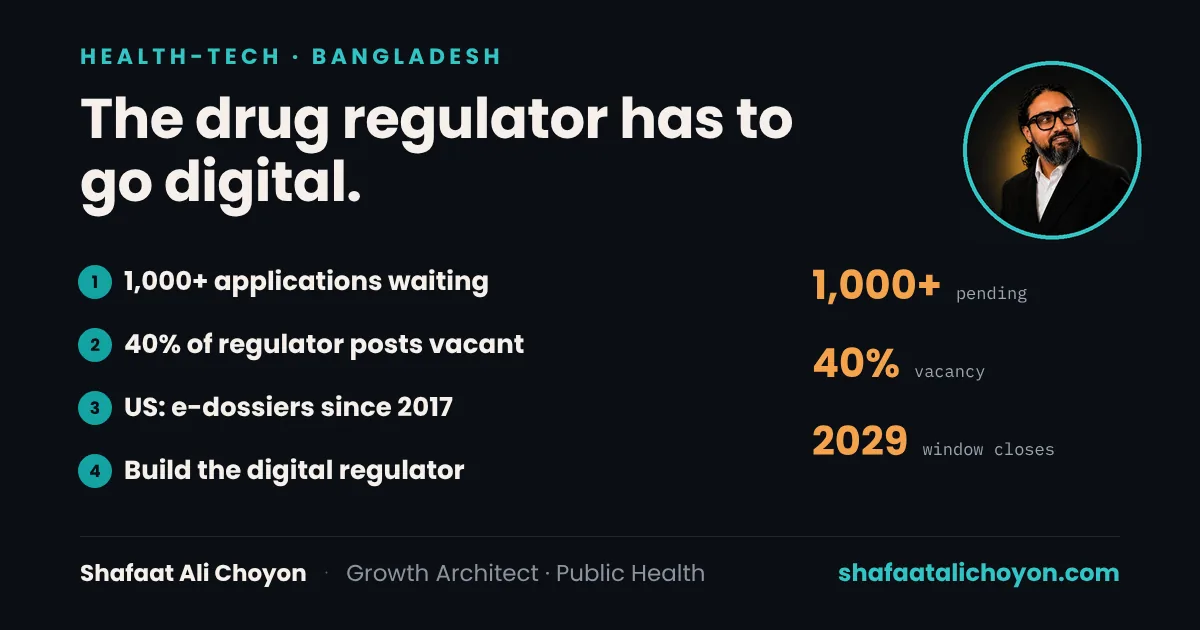
In August 2025, The Business Standard reported more than 1,0004 applications for generic and biosimilar drugs, including cancer medicines, pending for nearly two and a half years. In July 2026, the same paper reported that the Drug Control Committee had still not been fully reconstituted, that a deadlock over price fixing was stalling new medicines as well, and quoted an industry executive saying almost no new medicines had reached the market in two years.5
The factories are not the constraint. Medicine exports rose about 12% to $238.5 million6 in FY26, and grew about 40% again from July to September 2026. The industry can make and sell. What it cannot do is get products through the gate quickly enough.
Why is this a digital problem, not only a people problem?
A May 2024 Asian Development Bank brief on Bangladesh's regulatory system found that Pharmadex, the electronic registration system launched in 2017, had seen slow uptake because of limited capacity building and training. It found that application forms do not fully follow the Common Technical Document format the rest of the world uses, and that the Directorate General of Drug Administration had a 40%7 job vacancy rate.
Put those together. With 40% of posts empty, the regulator cannot hire its way through 1,000 files in three years. The only way to review more is to make each review lighter: dossiers that arrive in a standard structure, checked for completeness by software before a person opens them, tracked on a queue everyone can see.
I learned the value of that shift outside government. As chief operating officer of Laser Treat, a multi-entity clinical group, I ran its ERP, BI and CRM systems. Digitizing the operation cut operating costs by about $0.5 million a year and lifted patient retention 13%. The gain did not come from working harder. It came from not redoing work the system should have caught.
What does the US regulator already run on?
The US Food and Drug Administration has required generic drug applications to be submitted in the electronic Common Technical Document format since 5 May 20178. On 2 June 2025 it launched Elsa, a generative AI tool built to help its staff work faster, including on scientific reviews9.
The order matters. AI helps a reviewer only when the dossier is structured and machine-readable in the first place. The US built the standard format first and added AI on top. For Bangladesh, the lesson is not to buy an AI reviewer. It is to make every submission structured, so that any tool, today's or the next one, has something clean to work on.
What does a digital regulator look like?
Bangladesh has shown it can build regulatory capacity. In July 2026, WHO said the regulator is on the threshold of Maturity Level 3 for vaccine regulation, the level of a stable, well-functioning system, with a target of 202710. WHO also said that milestone would lay the foundation for extending the same maturity to essential medicines. The three years are the time to do that.
I have built systems like this under time pressure. At Praava Health, we set up six-hour COVID test results for travelers from scratch, because a result that arrived after the flight was worth nothing. A registration decision that arrives after the window closes is worth nothing too.
The build list is short:
- Structured e-submission aligned to the Common Technical Document, so dossiers arrive in a form software can check.
- Automatic completeness checks before a human reviewer is assigned.
- A public queue tracker showing applications by stage and age, so the backlog is visible and owned.
- Digital review and inspection records, so decisions and reasons are searchable.
- Electronic pharmacovigilance, so safety reports flow in as data rather than paper.
For health-tech builders in both countries, this is the opening. Regulatory technology is unglamorous, and it decides whether a country's medicines reach patients and export markets.
The short version
- Graduation is now 24 November 2029. For medicines, the extra time is a registration window.
- The bottleneck is the gate: over 1,000 generic and biosimilar applications pending for nearly two and a half years (2025), and a committee still not fully rebuilt in July 2026.
- The fix is digital: Pharmadex since 2017 with slow uptake, forms not fully in the global format, a 40% vacancy rate (ADB, 2024).
- The US built structure first: electronic dossiers required since 2017, AI review support since 2025.
- Build the digital regulator now: structured submission, completeness checks, a public queue, digital records, electronic safety reporting.
If you could fix one step between a drug maker's submission and an approval, which would free up the most reviewer time?
Frequently asked questions
Why does LDC graduation matter for medicines in Bangladesh?
As an LDC, Bangladesh can make medicines that are still patented elsewhere without full patent protection under the WTO's TRIPS agreement. After graduation on 24 November 2029, new patented medicines will need licences or royalties. The industry argues that generics registered before graduation are the ones likely to stay affordable.
What is slowing drug registration in Bangladesh?
In 2025 more than 1,000 generic and biosimilar applications had been pending for nearly two and a half years. A 2024 ADB brief found slow uptake of the electronic registration system, forms not fully in the Common Technical Document format, and a 40% vacancy rate at the regulator.
What would a digital drug regulator change?
Structured electronic submissions, automatic completeness checks, a public queue tracker, digital review records and electronic safety reporting let a short-staffed regulator review more applications without lowering standards.
Sources
- The Business Standard, Bangladesh gets 3 more years before LDC graduation (30 October 2026). tbsnews.net ↗
- The Daily Star, The end of exemption? (1 August 2025). thedailystar.net ↗
- The Daily Star, Local pharmas may miss the window for 15 costly drugs (26 July 2025). thedailystar.net ↗
- The Business Standard, 1,000 drug registrations stuck as Bangladesh risks losing TRIPS waiver (31 August 2025). tbsnews.net ↗
- The Business Standard, Drug pricing deadlock stalls hundreds of new medicines (20 July 2026). tbsnews.net ↗
- bdnews24.com, Pharma exports $238.5 million in FY26 (4 October 2026). bdnews24.com ↗
- Asian Development Bank, Brief 302: regulatory ecosystem for vaccines in Bangladesh (May 2024). adb.org ↗
- US FDA, eCTD submission requirements: what you need to know (2017). fda.gov ↗
- US FDA, FDA launches agency-wide AI tool (2 June 2025). fda.gov ↗
- WHO Bangladesh, Maturity Level 3 for vaccine regulation (21 July 2026). who.int ↗
Md Shafaat Ali Choyon (MPH, CHES®, MBA, MCIM) is a growth, marketing and public-health strategist who builds and runs AI in production, with 17 years across telecom, fintech, e-commerce, consumer tech and healthcare in the US and Bangladesh. See the essays or the portfolio.