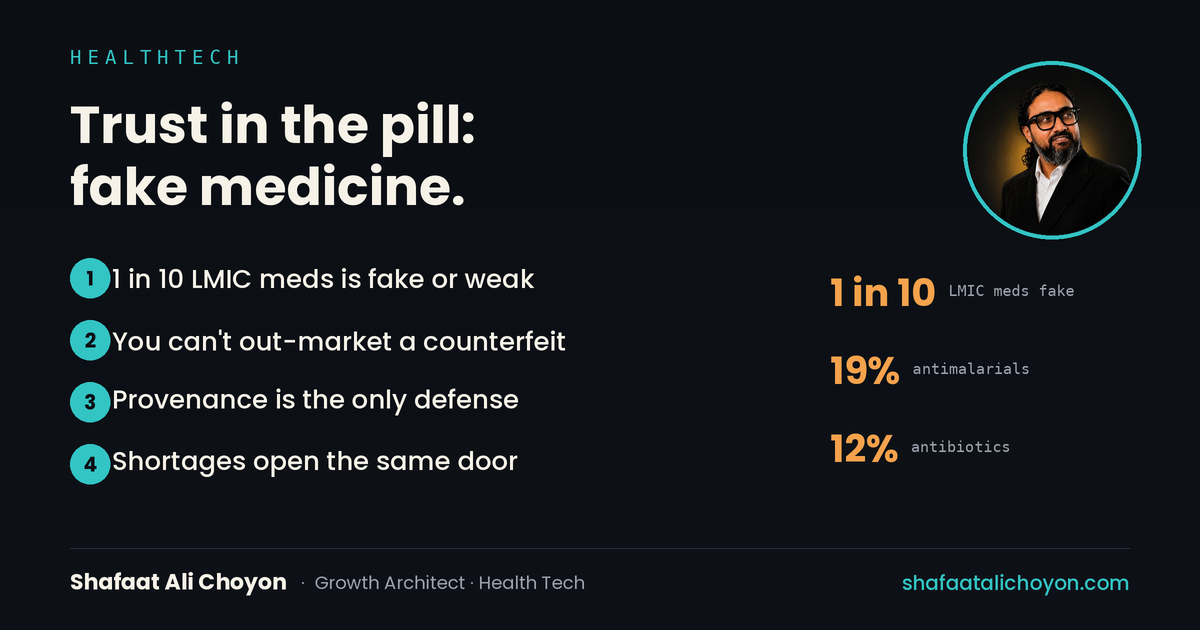
You can build the best clinic in the world, and it means nothing if the pill the patient swallows is fake. In much of the world, that's not a hypothetical. The World Health Organization has estimated that roughly one in ten medicines in low- and middle-income countries is substandard or falsified — and independent reviews put the figure even higher, around 13.6%, with antibiotics near 12% and antimalarials near 19%. This is the quietest, deadliest trust problem in health, and you cannot out-market your way past it.
Fake medicine is a trust collapse, not a branding gap
When people can't be sure the drug they're buying is real, something worse than an individual harm happens: the whole system loses credibility. Patients under-dose, switch to unregulated sellers, or stop trusting formal care entirely — and every counterfeit antibiotic quietly feeds resistance on top of it. You can't fix that with a nicer package or a louder campaign, because the counterfeiters can copy the package and borrow the campaign. Trust in a physical product has to be built into the product's provenance — where it came from, that it's real, verifiable at the point of sale. Anything short of that is decoration.
The rich world is cracking the same door open
Americans assume this is someone else's problem. It's becoming theirs. As drug shortages drag on and supply routes strain, gaps get filled by unfamiliar substitutes, gray-market sourcing, and cross-border online pharmacies of uncertain origin. Every gap in a trusted supply is an opening for an untrusted one. The mechanism is identical to Bangladesh's, just earlier on the curve: scarcity and opacity are exactly the conditions in which fake and substandard product thrives.
This sits on a thread I've spent a career on
My work has circled the same idea from different angles: trust is engineered, not assumed. At SureCash, moving money for roughly 10 million people meant that one breach of trust would have collapsed adoption, so verification was built in from the start. At Praava, a diagnostics business lives or dies on whether people believe the result. Authenticating a medicine is the same discipline pointed at a physical object: make provenance checkable, make the real thing easy to verify and the fake thing hard to pass. A convincing fake is far more dangerous than an obvious one, and the defensible product is the one that lets a patient prove what's real before they swallow it.
Make it verifiable
The tooling to fix this is finally cheap and dual-market: serialization and track-and-trace, simple scan-to-verify at the pharmacy counter, tamper-evident supply chains, and quality surveillance that flags bad batches fast. Bangladesh needs it to protect a formal system from counterfeits; the US increasingly needs it to protect a stressed one from opaque substitutes. Whoever makes "is this medicine real?" a one-second, trustworthy check isn't adding a feature — they're restoring the foundation the entire system rests on.
The short version
- Roughly 1 in 10 medicines in LMICs is substandard or falsified (some estimates ~13.6%); it's a trust collapse, not a branding gap.
- You can't out-market a fake — trust in a physical product has to be built into verifiable provenance.
- The US is cracking the same door: multi-year shortages invite unfamiliar substitutes and gray-market sourcing.
- It sits on my core thread — trust engineered in — from SureCash's ~10M-person rail to Praava diagnostics.
In your system, what does a customer have to simply take on faith is real — and what would it take to let them verify it in one second?
Md Shafaat Ali Choyon (MPH, CHES®, MBA, MCIM) is a growth, marketing and public-health strategist who builds and runs AI in production, with 16+ years across telecom, fintech, e-commerce, consumer tech and healthcare in the US and Bangladesh. See the essays or the portfolio.