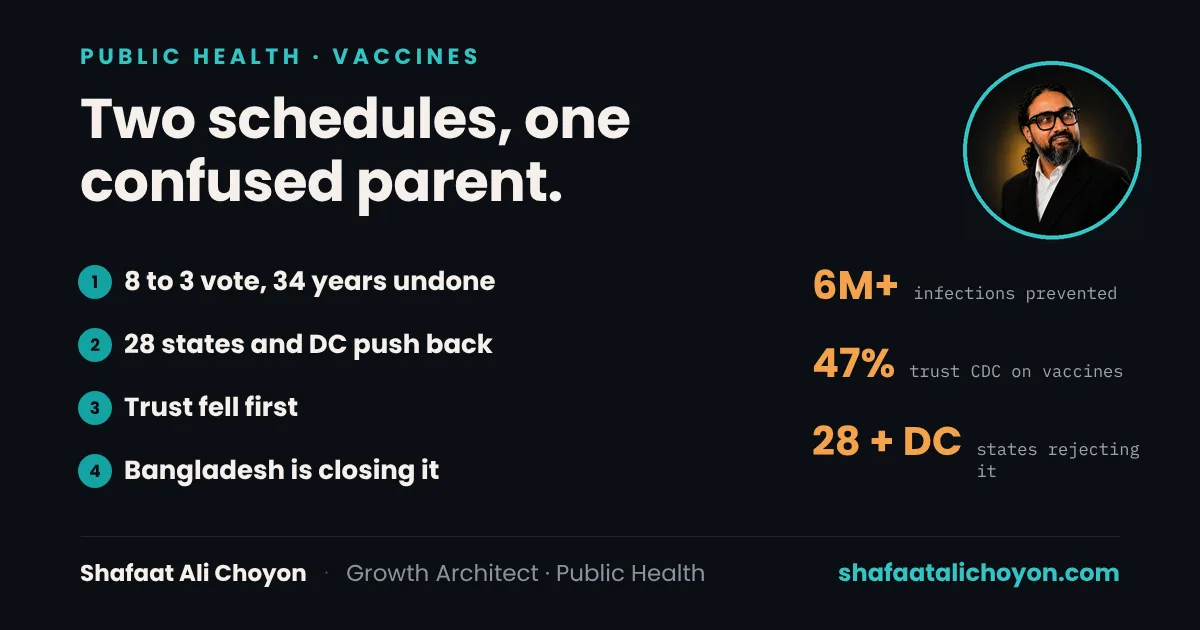
For 34 years, the US recommended a hepatitis B shot for every newborn, given before the baby went home. On 5 December 2025, CDC's vaccine advisers voted 8-31 to end that for babies whose mothers test negative, leaving it to parents and suggesting the first dose wait until two months. A CDC study credits the old schedule with preventing more than 6 million infections. A month later, CDC cut the list of diseases it targets for routine vaccination of every child to 11. Ten months on, the US has two schedules, and parents are left to work out which one their doctor follows.
Is the hepatitis B birth dose still recommended?
It depends on who you ask, and that is the problem. The federal schedule now calls it an individual decision for babies of mothers who test negative. The American Academy of Pediatrics says its advice has not changed: a dose within 24 hours of birth for every baby. At least 28 states2 and Washington DC have said they will not follow some or all of the new federal schedule. Michigan, where I live, is one of them. Alaska and Mississippi kept the universal birth dose on their own.
So a family in Detroit and a family in a state that follows the new federal schedule can get different answers to the same question on the same day. The vaccine did not change. The message did.
The bill for a split arrives as confusion first
The science on this shot is not close. About 90% of babies infected with hepatitis B develop a lifelong infection, against under 5% of adults. Between 12% and 18%3 of pregnant women in the US are never tested, which is exactly why the birth dose was given to everyone: it catches the babies the screening misses. Pediatric cases fell 99% after universal vaccination began.
The cost of the split shows up in stages. First, trust. In January, KFF found only 47%4 of adults trusted CDC for reliable vaccine information, the lowest since the pandemic began, and 53% of those who knew about the schedule changes said it made them trust federal health agencies less. Second, uptake. A JAMA study of more than 12 million newborns found the share vaccinated within 30 days of birth fell from 83.5% in early 2023 to 73.2%5 by August 2025, before the vote even happened. The debate alone moved behavior.
Third, infections. Modeling in JAMA Pediatrics found that delaying the first dose to two months, even with perfect follow-through, would add about 90 acute infections and 296 deaths per birth cohort, and $16.4 million in costs. If fewer babies of untested mothers get the shot, the toll rises fast.
Bangladesh shows what the missing dose costs
Bangladesh is a useful mirror because it is trying to close the gap the US is now opening. Its national program has given hepatitis B vaccine since 2003, and 98%7 of infants got all three doses in 2023. By 2018, prevalence in children under five had fallen to about 0.15%. That is a public health success built on one schedule, delivered the same way everywhere.
But the birth dose is the weak link. Bangladesh adopted it on paper, yet delivery is poor and uneven, and mother-to-child transmission is a major source of new infections. Screening in pregnancy is not free, and mothers who give birth at home are often never told about it. Its national hepatitis elimination profile recommends putting the birth dose firmly into the schedule. Global health has spent years pushing low-income countries toward a dose within 24 hours of birth, the WHO standard since 2009.
That is the flip. Bangladesh, with far less money, knows exactly which dose it is missing and why it matters. The US had that dose, in every hospital, and chose to make it optional. Only someone reading both systems sees how odd that is.
In a split, the clinic becomes the message
When the national voice splits, people do not read the policy. They ask the person in front of them. That puts the pediatrician, the nurse in the maternity ward and the pharmacist at the center of the system.
I have seen this work. At Praava Health, the Lifebuoy hotline we set up took about 3,000 calls a day, because people act on advice from a channel they already trust. When we ran 6-hour COVID testing for travelers flying from Bangladesh to the US, the product was not only the test. It was a clear instruction a traveler could act on before the flight. A maternity ward in 2026 has the same job: turn two schedules into one plain answer, every shift, for every parent.
What I would put in place this month
Every hospital, health system and state health department needs a house position and a script. Here is the playbook:
- Decide your schedule and say it out loud. Federal or AAP, pick the one you follow and put it in writing, so every nurse gives the same answer.
- Write a one-page parent sheet. What the shot does, why it is given at birth, what happens if you wait. My free health message readability checker tells you if it reads at a sixth-grade level.
- Script the hard question. "The CDC says it's optional, why are you offering it?" deserves a calm, 30-second answer, practiced, not improvised.
- Close the screening gap. If 12% to 18% of mothers are untested, the birth dose is the backstop. Track testing and treat unknown status as unknown.
- Track the birth-dose rate weekly. It is the early signal. My free risk communication calculator helps size the outreach when it slips.
I argued that clarity is an intervention, not polish. A split schedule is that idea under pressure.
The short version
- CDC advisers voted 8-3 in December 2025 to end the universal hepatitis B birth dose, recommended since 1991, and CDC cut its routine list to 11 diseases.
- At least 28 states and DC rejected some or all of the new schedule; the AAP still recommends a dose within 24 hours of birth.
- Trust and uptake fell first: 47% trust CDC for vaccine information, and newborn vaccination within 30 days dropped to 73.2%.
- Bangladesh is working to close the birth-dose gap the US is opening, after reaching 98% coverage for three doses.
- The clinic is now the message: pick a position, script it, write it plainly, and track the rate weekly.
If a new parent in your hospital asked tonight whether the birth dose is still recommended, would every nurse on shift give the same answer?
Frequently asked questions
Is the hepatitis B vaccine still given at birth in the US?
It depends on who you follow. Since December 2025, the federal schedule treats the birth dose as an individual decision for babies of mothers who test negative. The American Academy of Pediatrics still recommends a dose within 24 hours of birth for all babies, and at least 28 states and DC have said they will not follow some or all of the new federal schedule.
Why is the hepatitis B vaccine given to newborns?
About 90% of babies infected with hepatitis B develop a lifelong infection, against under 5% of adults. Between 12% and 18% of pregnant women in the US are never tested, so a dose at birth protects babies whose mothers' status is unknown.
What did the ACIP vote change?
In December 2025, CDC's vaccine advisers voted 8-3 to make the hepatitis B birth dose an individual decision for babies of mothers who test negative, suggesting the first dose wait until at least two months. In January 2026, CDC also cut the list of diseases it targets for routine vaccination of every child to 11.
Sources
- CIDRAP, CDC advisers drop decades-old universal hepatitis B birth dose recommendation (December 2025). cidrap.umn.edu ↗
- CIDRAP, States, health organizations reject new CDC vaccine guidance (updated 2 April 2026). cidrap.umn.edu ↗
- American Academy of Pediatrics, Hepatitis B vaccine frequently asked questions (updated 2 January 2026). aap.org ↗
- KFF, Tracking Poll on Health Information and Trust: Trust in the CDC and views of federal childhood vaccine schedule changes (6 February 2026). kff.org ↗
- Contemporary Pediatrics, Newborn hepatitis B vaccination rates decline amid policy shifts (JAMA study, 27 February 2026). contemporarypediatrics.com ↗
- CIDRAP, End of universal birth-dose hep B vaccination will drive up infections, deaths, costs (JAMA Pediatrics studies, 2026). cidrap.umn.edu ↗
- CDA Foundation Polaris, Bangladesh National Hepatitis Elimination Profile (27 June 2025). globalhep.org ↗
Md Shafaat Ali Choyon (MPH, CHES®, MBA, MCIM) is a growth, marketing and public-health strategist who builds and runs AI in production, with 17 years across telecom, fintech, e-commerce, consumer tech and healthcare in the US and Bangladesh. See the essays or the portfolio.