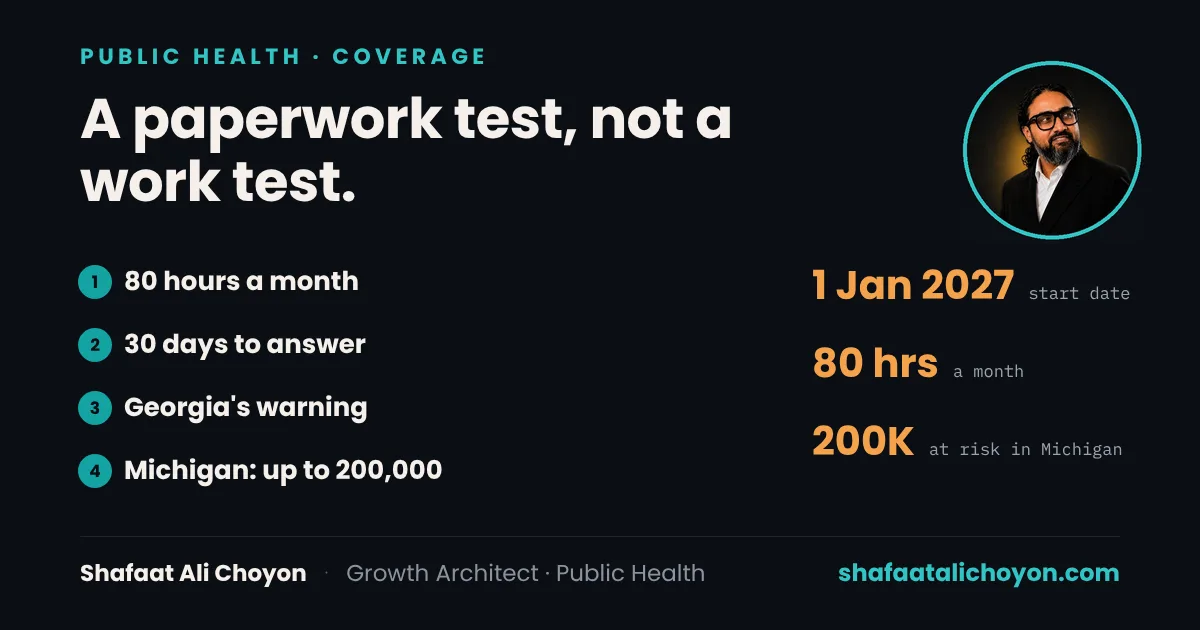
From 1 January 2027, adults covered by Medicaid expansion in 43 states and Washington DC1 will have to show 80 hours a month of work, community service, a work program or half-time study to keep their coverage. Most of them already do one of those things, or are exempt. The people who lose coverage will mostly lose it the way people lost it in Arkansas and Georgia: not by failing to work, but by failing to prove it in time.
What do the new Medicaid work requirements require?
The federal rule, issued on 1 June 2026, applies to adults aged 19 to 64 in the expansion group. They meet it with 80 hours a month of qualifying activity, or monthly income of at least 80 hours at the federal minimum wage, which is $5801 in 2026. New applicants must show it for at least one month before they apply; current enrollees must show it between renewals.
There are long lists of exemptions: pregnant and postpartum women, parents and caregivers of children under 14 or of a disabled person, people who are medically frail, veterans with a total disability rating, people in addiction treatment, and others. When a state cannot confirm someone qualifies, it sends a notice, and the person has 30 calendar days1 to respond before losing coverage.
Who loses coverage, and why?
Federal budget analysts estimated that an earlier version of the law would leave 5.2 million fewer adults on Medicaid by 2034 and 4.8 million more uninsured, and the work requirement is the largest single source of the law's Medicaid savings, about $326 billion2 over ten years. The savings come from people leaving the program.
The pilots show how they leave. Arkansas tried a work requirement and 18,0002 people lost coverage. Georgia's Pathways program, the only one running before this law, had about 8,0773 people enrolled two years in, against 25,000 it had projected for the first year. The state spent more than $54 million3 on administration and about $26 million on care, and it eventually loosened its checks from monthly to yearly because it could not verify informal work such as cleaning houses or landscaping.
Michigan shows the scale
I live and work in Michigan, where nearly 700,0004 people are on the Healthy Michigan Plan. The state estimates that up to 200,000 could lose coverage, including people who are eligible but do not send in every document. Reviews move from once a year to twice a year, and the first group must submit paperwork by 31 March 20274.
Two hundred thousand people is not a rounding error in a health system. It is emergency rooms absorbing unpaid care, prescriptions dropped mid-treatment, and clinics that lose paying patients, in a state that chose to expand coverage because it worked.
Outreach is the intervention
This is a health communication problem with a deadline, and that is work I know. The lesson I took from delivering a government stipend to about 10 million people at SureCash is that at national scale every extra step you ask of a person becomes thousands of people who drop out. The lesson from the Lifebuoy hotline we set up at Praava, about 3,000 calls a day, is that people act on information that reaches them through a channel they already trust. And my MPH capstone showed that fixing the measurement up front made a campaign's reach about 3x larger.
Put together, the playbook for a state, a health plan or a clinic before January looks like this. My free renewal outreach planner sizes the team it takes:
- Check before you ask. Use payroll, unemployment, SNAP and school records the state already holds, so most people never have to send anything.
- Find the exempt first. Parents, caregivers and people with serious conditions are protected, but only if they are flagged. Clinics can flag them from records they already keep.
- Write the notice for a sixth-grade reader. One page, one action, one deadline, in English, Spanish and Arabic in Michigan, and in the languages of each community.
- Use trusted messengers. Pharmacists, clinic front desks, community health workers and employers see these people every week. Give them a script and a number to call.
- Count the people who respond, not the letters sent. Track replies within the 30 days by zip code, and send help to the places where replies are low.
The short version
- From 1 January 2027, expansion adults in 43 states and DC must show 80 hours a month of work, study or service, or $580 of monthly income, at application and renewal.
- Most already qualify or are exempt; the risk is failing to prove it within 30 days of a notice.
- Georgia spent more than twice as much on administration as on care and enrolled a fraction of its target.
- Michigan expects up to 200,000 people could lose coverage, including eligible people who miss paperwork.
- The fix is outreach: check data first, flag exemptions, plain notices, trusted messengers, and track replies.
If your patients or members got a Medicaid notice tomorrow, who would they ask for help, and does that person know what to tell them?
Frequently asked questions
When do Medicaid work requirements start?
States must start them no later than 1 January 2027, under a federal rule issued on 1 June 2026. States can start earlier, and some may get a good-faith extension, no later than 31 December 2028.
Who has to meet the Medicaid work requirement?
Adults aged 19 to 64 covered through Medicaid expansion in 43 states and Washington DC, unless they are exempt. Exemptions include pregnant and postpartum women, parents and caregivers of children under 14 or of a disabled person, medically frail people, veterans with a total disability rating and people in addiction treatment.
How many hours do you need for Medicaid work requirements?
80 hours a month of work, community service, a work program or half-time education, or a combination. Monthly income of at least 80 times the federal minimum wage, $580 in 2026, also counts. If a state cannot verify it, it must send a notice and give 30 calendar days to respond.
Sources
- CMS, Medicaid community engagement requirement interim final rule fact sheet (1 June 2026). cms.gov ↗
- KFF, A closer look at the work requirement provisions in the 2025 budget law. kff.org ↗
- Emory Rollins School of Public Health, What three years of Georgia's Medicaid work requirement show (29 July 2026). sph.emory.edu ↗
- Bridge Michigan, New rules will mean more paperwork, proof to keep Michigan's Medicaid (updated 20 July 2026). bridgemi.com ↗
Md Shafaat Ali Choyon (MPH, CHES®, MBA, MCIM) is a growth, marketing and public-health strategist who builds and runs AI in production, with 17 years across telecom, fintech, e-commerce, consumer tech and healthcare in the US and Bangladesh. See the essays or the portfolio.