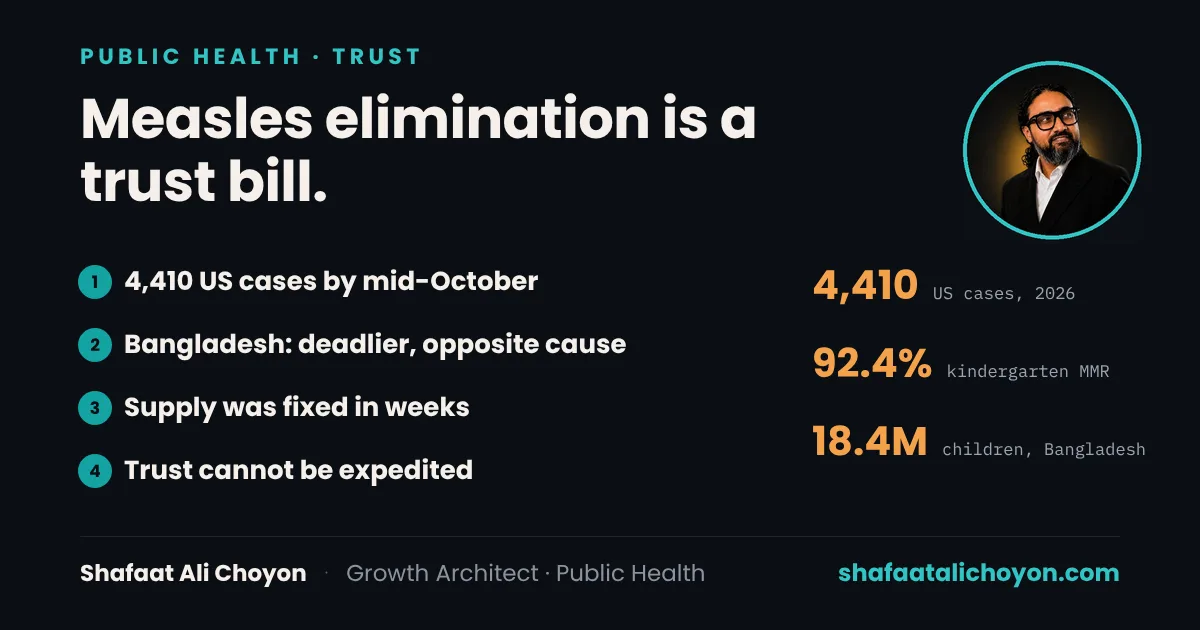
Sometime in November, a commission of the Pan American Health Organization will decide whether the United States is still a country that has eliminated measles. The US earned that status in 2000. By 15 October this year it had confirmed 4,4101 cases, almost double the 2,289 it recorded in all of 2025, and Canada already lost the same status last November2. Whatever the commission rules, the bill it describes was run up years ago.
What does losing measles elimination status actually mean?
Elimination does not mean zero cases. It means no chain of transmission survives inside the country for twelve months. Imported cases come and go; what the commission checks is whether one strain kept spreading at home for a full year. Investigators have tracked a single lineage, D8-91713, since the West Texas outbreak of January 2025, through Utah and South Carolina, and are using whole-genome sequencing to settle whether it is one unbroken chain.
Losing the status changes nothing about the vaccine. It changes the story: a country that once stopped measles becomes, officially, a country where measles lives again. Getting it back means proving a full year with no surviving chain, under the same scrutiny.
Two outbreaks in one year, for opposite reasons
The same spring, Bangladesh fought its own outbreak, and a far deadlier one. From mid-March to late June it logged more than 95,000 suspected cases and 5964 suspected deaths across all 64 districts, with 81% of cases in children under five. In the first month, a third of the cases were babies under nine months, too young for their first dose5.
The causes could not be more different. In the US, about 96% of this year's cases are in people who were unvaccinated or whose status is unknown1, and kindergarten MMR coverage has slid from 95.2% to 92.4%6 in five school years. The vaccine was on the shelf; people chose not to take it. In Bangladesh, the WHO points to a nationwide shortage of measles-rubella vaccine in 2024 and 2025, and no national catch-up campaign since 20205. Parents wanted the vaccine; for a stretch, the system could not give it to them.
In July I wrote that Bangladesh sustains coverage above 90% while the US slips. The routine figures said so. The shortage underneath them is the part I underweighted, and it makes the comparison sharper, not weaker.
Supply is fast to fix. Trust is not.
Watch what happened next. Bangladesh launched a targeted campaign on 5 April and went national on 20 April. By late June more than 18.4 million4 children had been vaccinated, 102% of the target, including 94% of the children in the Rohingya camps, and new cases were falling. That is what a supply failure looks like when trust is intact: once the doses arrived, mothers queued.
The US has the opposite problem, and there is no six-week fix for it. You can expedite a vaccine order. You cannot expedite belief. A parent who has decided the shot is the risk will not be moved by a faster supply chain, a louder press release or a better statistic.
Trust is built before the outbreak, not during it
Every campaign I have run that worked rode on a channel people already trusted, laid down before anyone needed it. In Bangladesh we printed a doctor hotline on the packaging of the market-leading soap, so help arrived through an object already in the home, and doctors on the line took roughly 3,000 calls a day. On a US campus, a year-long harm-reduction campaign on alcohol and cannabis worked because we chose messengers students respected and dropped the lecturing tone. For my MPH capstone, fixing the measurement up front documented about 3× the reach. In each case the trust was in place before the message that mattered went out.
In an outbreak, every message competes with fear, and when official voices disagree, people fall back on whoever they already believed. I wrote about that cost in a column, Mixed Messages, Real Costs. The US is now paying it, in cases.
What I would fund before the November ruling
The ruling is a verdict on the past. What follows it is a choice. If I were running the response in a US state, I would put the money in five places:
- Find the pockets. Coverage averages hide the schools and zip codes running far below 95%. Exemption rates by school show where the next chain will start.
- Pay the messengers. Pediatricians, pharmacists, faith leaders and parents who vaccinated their own children, given time and a fee, not a script.
- Make the dose easy. Evening and weekend walk-ins and school catch-up days, with no appointment needed.
- Keep a buffer. Bangladesh's lesson: a stockout can undo years of good routine coverage in one season. Hold enough vaccine for a catch-up campaign before you need one.
- Measure doses, not impressions. Count doses given in the low-coverage pockets every week. Reach is a vanity metric when the outcome is a vaccinated child.
The short version
- The US may lose its measles elimination status in November, with 4,410 cases by mid-October, nearly double all of 2025.
- Bangladesh's 2026 outbreak was deadlier but had the opposite cause: a vaccine shortage, not a trust gap.
- Once supply returned, Bangladesh vaccinated 18.4 million children in weeks, because trust held.
- Trust cannot be expedited, so it has to be built before an outbreak, through messengers people already believe.
- Fund the pockets, the messengers, easy doses, a vaccine buffer and measurement in doses, not impressions.
If your community lost its measles status tomorrow, who is the one person parents there would still believe, and is anyone paying them to talk?
Frequently asked questions
What does it mean if the US loses its measles elimination status?
It means one chain of measles transmission has kept spreading inside the country for at least twelve months. It does not change the vaccine. It means the country is officially one where measles circulates again, and getting the status back requires a full year with no surviving chain.
When will the US measles elimination status be decided?
A commission of the Pan American Health Organization reviews it in November 2026. By 15 October the US had confirmed 4,410 measles cases in 2026, almost double the 2,289 recorded in all of 2025. Canada lost its status in November 2025.
Why did Bangladesh have a measles outbreak in 2026?
The WHO points to a nationwide shortage of measles-rubella vaccine in 2024 and 2025 and no national catch-up campaign since 2020. From mid-March to late June there were more than 95,000 suspected cases and 596 suspected deaths. A national campaign then vaccinated more than 18.4 million children, 102% of its target.
Sources
- Contagion Live, CDC data as of 15 October 2026. contagionlive.com ↗
- Medical Daily, on the PAHO review and Canada's status. medicaldaily.com ↗
- Johns Hopkins Bloomberg School of Public Health. publichealth.jhu.edu ↗
- United Nations Bangladesh, measles situation report 5 (25 June 2026). bangladesh.un.org ↗
- World Health Organization, Disease Outbreak News (23 April 2026). who.int ↗
- ABC News, citing CDC kindergarten vaccination data. abcnews.com ↗
- Centers for Disease Control and Prevention, Measles Cases and Outbreaks (data as of 22 October 2026). cdc.gov ↗
- Pan American Health Organization, update on the review of measles elimination status (2 March 2026). paho.org ↗
Md Shafaat Ali Choyon (MPH, CHES®, MBA, MCIM) is a growth, marketing and public-health strategist who builds and runs AI in production, with 17 years across telecom, fintech, e-commerce, consumer tech and healthcare in the US and Bangladesh. See the essays or the portfolio.