We treat clarity as a nice-to-have in health communication — a matter of polish applied after the real work. It isn't. Confusing guidance has a body count and a price tag, and I've made this argument in print, not as a stylistic preference but as a public-health claim: clarity is itself an intervention.
Confusion is never neutral
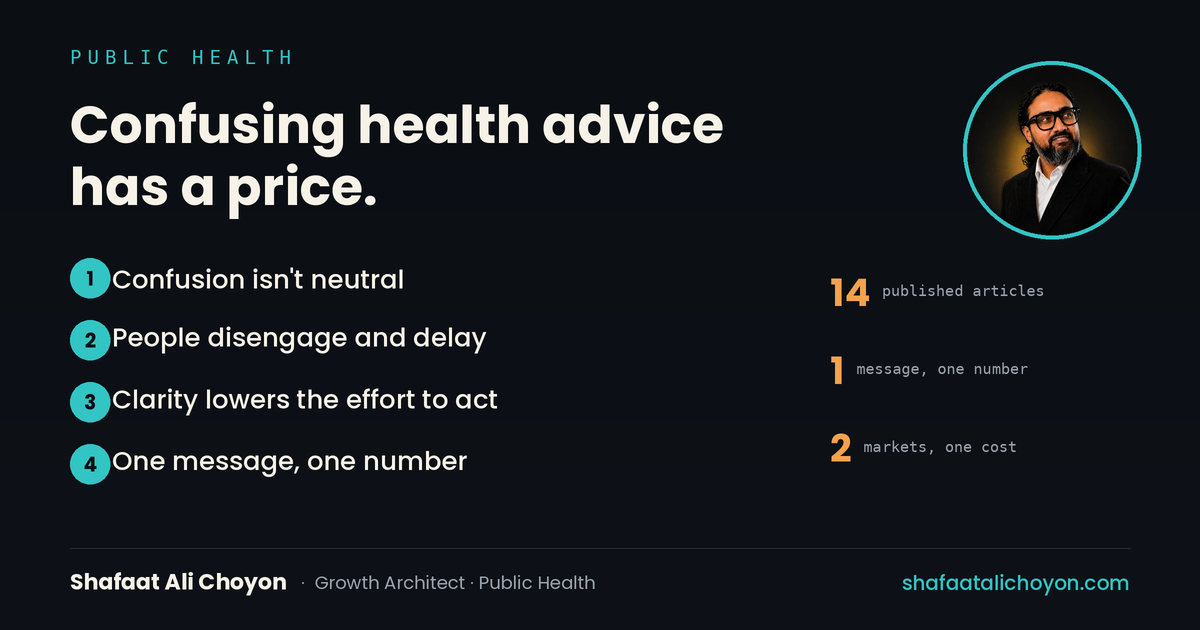
When health guidance contradicts itself — one authority says one thing, another says the opposite, the advice reverses every season — people don't split the difference and carry on. They disengage. They delay care, distrust the next message, and make worse decisions, and the cost lands later in both health outcomes and money. A confusing message isn't a failed message that does nothing; it's an active harm that erodes the trust every future message depends on.
I've argued this where it's published
This isn't a hunch. I've written it directly — in "Mixed Messages, Real Costs," on how confusing health communication makes people sicker and poorer, and across pieces on health literacy and misinformation. The consistent finding is unglamorous and powerful: the clearest, most consistent message usually wins, not because it's the loudest, but because clarity lowers the effort required to act, and people follow the path of least resistance.
Clarity is a design discipline, not a talent
Clear communication is engineered, not stumbled into. One message, one number, said the same way across every channel and every messenger. When guidance is simple, consistent, and repeated, it becomes easy to remember, easy to trust, and easy to act on — and each of those is a lever on real behavior. Complexity, contradiction, and hedging aren't sophistication; in health, they're friction, and friction is where good intentions go to die.
The dual-market cost
In the US, the visible failure is contradiction and misinformation — reversals and mixed signals that fuel disengagement (and, as I've written elsewhere, outbreaks). In Bangladesh, the failure is more often a literacy gap — guidance written for the sender, not the reader. Different mechanisms, identical result: when people can't easily understand what to do, they don't do it, and both the health system and the household pay for the confusion.
The short version
- Confusing guidance isn't neutral; it drives disengagement, delayed care, and real cost.
- I've argued this in print — "Mixed Messages, Real Costs" and pieces on health literacy and misinformation.
- Clarity is engineered: one message, one number, consistent across channels and messengers.
- US failure is contradiction; BD failure is a literacy gap — same result, people don't act.
Look at your last health message through a stranger's eyes — is it unmistakably clear what to do next, or is confusion quietly costing you the outcome?
Md Shafaat Ali Choyon (MPH, CHES®, MBA, MCIM) is a growth, marketing and public-health strategist who builds and runs AI in production, with 16+ years across telecom, fintech, e-commerce, consumer tech and healthcare in the US and Bangladesh. See the essays or the portfolio.