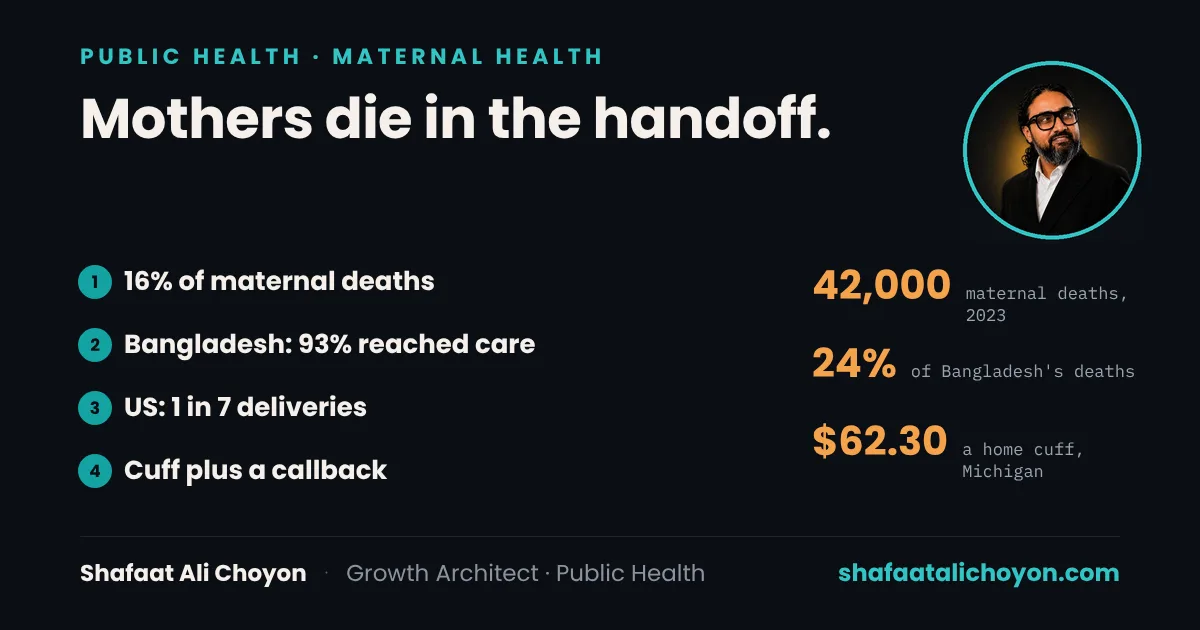
On 7 October, WHO launched a ten-year roadmap for one of the oldest killers in obstetrics. High blood pressure in pregnancy, mainly pre-eclampsia, causes about 16%1 of maternal deaths worldwide, about 42,000 women in 2023, and is linked to more than 500,000 stillbirths and newborn deaths. None of this needs a breakthrough to fix. A blood pressure cuff, a urine test, low-dose aspirin and magnesium sulfate have been around for decades. The mothers who die are mostly not missing a medicine. They are falling through a handoff.
What is pre-eclampsia, and why does it still kill?
Pre-eclampsia is high blood pressure that starts after 20 weeks of pregnancy, usually with protein in the urine. It affects roughly 3% to 8% of women who give birth. It can turn into eclampsia, which means seizures, and it can damage the kidneys, liver and brain. Some women feel nothing until it is severe. Others get warning signs: a bad headache, blurred vision, pain in the upper belly, swelling of the face and hands.
The tools are cheap. WHO says magnesium sulfate cuts the risk of seizures by more than half2 in women with pre-eclampsia. Low-dose aspirin, started by 20 weeks, helps prevent it in women at high risk. Calcium helps where diets are low in it. Yet WHO notes that deaths from these disorders have fallen too slowly over three decades, slower than some other causes of maternal death. When the cure is cheap and the deaths are stubborn, the problem is delivery, not discovery.
In Bangladesh, mothers reach care and die anyway
Bangladesh has unusually detailed data on where this fails. A national analysis by icddr,b researchers found pre-eclampsia and eclampsia caused 24%3 of maternal deaths in the 2016 maternal mortality survey, back to the level of 2001. Half of those deaths came during delivery or within 48 hours of birth.
Here is the part most people miss. About 93% of eclampsia deaths happened at a health facility or on the way to one. These women were not stuck at home. They reached the system. About a third of them were moved between facilities more than once, because the first place was not ready and the referral chain was weak. Before that, the warning signs were rarely taught: only about 40% of women who had antenatal care were told the signs of pregnancy complications, and half of women with raised blood pressure did not know they had it.
America's version happens after discharge
The US problem looks different and is just as stubborn. CDC found that hypertensive disorders showed up in 15.9%4 of delivery hospital stays by 2019, up from 13.3% in 2017. That is roughly one birth in six. Among women who died in hospital during their delivery stay, 31.6% had one of these disorders on their record. Rates were highest for Black women, at 20.9% of deliveries.
The US counted 6495 maternal deaths in 2024, a rate of 17.9 per 100,000 live births, and 44.8 for Black women. And the risk does not end at delivery. It follows the mother home, where no one is checking her pressure. Bangladesh fails at the hospital door. America fails at the front door of the house. Both are the same failure: nobody owns the gap between one point of care and the next.
The fix is small. At Massachusetts General Hospital, new mothers with these disorders who checked their blood pressure at home and had medicines adjusted remotely reached their target in 95%6 of cases by six weeks, against 78% in an earlier group without the program. The few readmissions for blood pressure all came in the first week home. When Michigan lawmakers looked at covering home cuffs for pregnant and postpartum women on Medicaid, state analysts priced one at $62.307. That is the hardware cost for one mother. The harder part is the person who reads the numbers.
A test is worth what happens after the result
I learned this running marketing and corporate sales at Praava Health in Dhaka, a diagnostics-led primary care company. A lab result is just a number until someone acts on it. The value we built came from what happened next: who calls the patient, who books the follow-up, who explains it in plain words. When we set up a Lifebuoy partnership hotline, doctors took about 3,000 calls a day, because people use help that is one phone call away.
Pre-eclampsia needs exactly that. A cuff at home with no one reading the numbers is a gadget. A cuff linked to a nurse who calls back within an hour is a safety net. The same goes for Bangladesh: a district hospital that can give the first dose of magnesium sulfate before referral, and phone ahead to the next facility, turns a chain of transfers into one planned move.
Measure the handoff, not the visit
My MPH capstone taught me that fixing the measurement up front made a campaign's reach about 3x larger. Most maternal programs count visits: antenatal checks done, deliveries in facilities. Those numbers rise while mothers keep dying, because they do not measure the gaps. Here is what I would build:
- Give every high-risk mother a cuff and a number to call. Send her home with a validated cuff, a one-page warning-sign card and a nurse line. My free coverage gap planner shows who falls through between pregnancy and postpartum coverage.
- Start aspirin by default. Screen every pregnant woman for risk at the first visit and make low-dose aspirin the default for those who qualify.
- Treat before you transfer. In Bangladesh, stock magnesium sulfate in every facility that sees births and give the first dose before referral, with a phone call ahead.
- Teach the signs to the family, not just the mother. Headache, blurred vision and upper belly pain mean go now. Write it for a sixth-grade reader.
- Count the gap. Track the share of high-risk mothers with a blood pressure reading in the first ten days after birth. My free prevention ROI calculator puts a value on each emergency avoided.
I wrote that the first 1,000 days are the highest-return window in health. This is the riskiest stretch of it, and the cheapest to protect.
The short version
- Pre-eclampsia and related disorders cause about 16% of maternal deaths, about 42,000 women in 2023, plus more than 500,000 stillbirths and newborn deaths.
- The tools are cheap and old: cuffs, urine tests, aspirin, calcium and magnesium sulfate.
- In Bangladesh, 93% of eclampsia deaths happen at a facility or in transit, often after several transfers.
- In the US, about one delivery in seven involves these disorders, and the danger often comes after discharge.
- The handoff is the intervention: home cuffs with a callback, aspirin by default, treat before transfer, and measure the gap.
If a mother in your system had a reading of 160 over 110 at home tonight, who would see it, and how fast would they call her?
Frequently asked questions
How many women die from pre-eclampsia each year?
WHO says hypertensive disorders of pregnancy, mainly pre-eclampsia, cause about 16% of maternal deaths worldwide, about 42,000 deaths in 2023. They are also linked to more than 500,000 stillbirths and newborn deaths.
What are the warning signs of pre-eclampsia?
A severe headache, blurred vision or seeing spots, pain in the upper belly, nausea or vomiting after the first trimester, and swelling of the hands and face. Some women have no symptoms, which is why regular blood pressure checks matter.
Can pre-eclampsia be prevented or treated?
Low-dose aspirin started by 20 weeks helps prevent it in women at high risk, and calcium helps where diets are low in calcium. Magnesium sulfate cuts the risk of seizures by more than half in women who already have pre-eclampsia.
Sources
- WHO, Director-General's opening remarks at the media briefing (7 October 2026). who.int ↗
- WHO, Pre-eclampsia fact sheet (6 October 2026). who.int ↗
- Journal of Global Health (icddr,b authors), Preeclampsia and eclampsia-specific maternal mortality in Bangladesh (14 July 2023). jogh.org ↗
- CDC MMWR, Hypertensive Disorders in Pregnancy and Mortality at Delivery Hospitalization, United States, 2017 to 2019 (April 2022). cdc.gov ↗
- CDC NCHS, Maternal Mortality Rates in the United States, 2024 (March 2026). cdc.gov ↗
- TechTarget Virtual Healthcare, Virtual BP Monitoring Lowers Readmissions Among Postpartum Patients (30 June 2023). techtarget.com ↗
- Michigan Senate Fiscal Agency, Blood Pressure Monitors; Medicaid, H.B. 5167 bill analysis (December 2024). capitol.legislature.mi.gov ↗
Md Shafaat Ali Choyon (MPH, CHES®, MBA, MCIM) is a growth, marketing and public-health strategist who builds and runs AI in production, with 17 years across telecom, fintech, e-commerce, consumer tech and healthcare in the US and Bangladesh. See the essays or the portfolio.