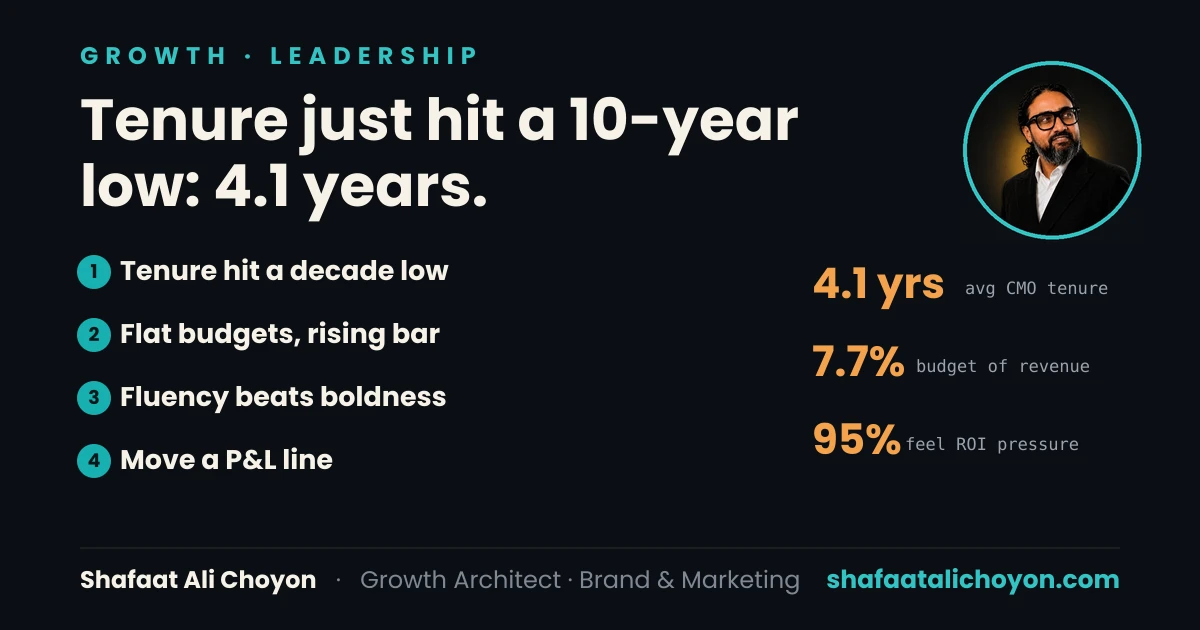
Marketing budgets just posted their flattest year in a decade, stuck at 7.7%1 of revenue, while 95%2 of CMOs say the pressure to prove ROI keeps climbing. The bill for that mismatch showed up in a single number: average CMO tenure fell to 4.1 years, the lowest Spencer Stuart3 has recorded in over ten years.
The tenure number nobody wanted
Four years and one month. That's how long the average Chief Marketing Officer now lasts in the seat, per Spencer Stuart's newest tenure tracking, cited in the CMO Survival Guide 2026. It isn't cyclical noise, it's the lowest figure the firm has recorded in more than a decade, and it lands exactly when marketing budgets have flatlined at 7.7% of revenue, essentially unchanged year over year. Flat budgets paired with rising expectations punish tenure rather than protect it. Boards that once tolerated an 18-month runway for brand investment to show results now want quarterly proof, and 95% of CMOs report the pressure to demonstrate ROI has intensified, not eased. The role hasn't gotten easier; it's gotten shorter.
What surviving the squeeze actually requires
I ran into this pressure directly, not from the marketing chair but from operations, as COO of a multi-entity clinical group under Laser Treat. The mandate wasn't growth for its own sake, it was margin and retention inside a fixed budget, the same trap now defining CMO tenure. Digitizing scheduling, intake, and reporting across every entity cut $0.5M in operating costs without a single announcement-worthy campaign, and patient retention rose 13% because the operational friction that used to lose patients between visits simply stopped existing. No one measured that work in brand lift, they measured it in whether the numbers held up next quarter, which is exactly the standard boards now apply to marketing. The lesson transfers directly: in a flat-budget, prove-it-now environment, the fastest path to credibility is removing the drag that's quietly costing money nobody's tracking, not launching a bigger campaign.
The job description that's actually changing
None of this means marketing has lost influence, it means the currency changed. The CMOs clearing four-plus years aren't the ones with the boldest campaigns, they're the ones fluent enough in the P&L to sit in the same room as the CFO and argue in the CFO's language. That's a skill shift, not a budget increase, and it's available to anyone willing to build it. 95% of CMOs feeling the ROI pressure means it's now the baseline condition of the job, not an occasional headwind. For a smaller firm the same pressure raises a plainer question: does the role need five days a week at all? My free fractional vs full-time cost calculator puts a number on it.
The short version
- CMO tenure hit 4.1 years, the lowest in over a decade of Spencer Stuart tracking.
- Budgets are flat at 7.7% of revenue while ROI pressure rises for 95% of CMOs.
- Operational fluency, not campaign boldness, is what survives a fixed-budget mandate.
- The winning move is a P&L line you moved, not an impression count you generated.
If your last three marketing wins can't be traced to a P&L line, how much runway do you actually have left?
Frequently asked questions
Why has average CMO tenure fallen to 4.1 years?
Because flat budgets and rising ROI pressure are punishing tenure instead of protecting it. Marketing budgets are stuck at 7.7% of revenue, essentially unchanged year over year, while 95% of CMOs report the pressure to demonstrate ROI has intensified, and Spencer Stuart's tracking puts average tenure at its lowest point in over a decade.
What actually helps a leader survive a flat-budget, prove-it-now environment?
Removing drag that's quietly costing money, not launching a bigger campaign. As COO of a multi-entity clinical group under Laser Treat, digitizing scheduling, intake, and reporting cut $0.5M in operating costs without an announcement-worthy campaign, and patient retention rose 13% because the operational friction that used to lose patients between visits simply stopped existing.
What skill separates CMOs who keep their seats from those who don't?
Fluency in the P&L, not bolder campaigns. The CMOs clearing four-plus years are the ones fluent enough in the P&L to sit in the same room as the CFO and argue in the CFO's language, showing a line they moved rather than an impression count they generated.
Sources
- Gartner. gartner.com ↗
- CMSWire. cmswire.com ↗
- Spencer Stuart. spencerstuart.com ↗
- Gartner, Gartner 2026 CMO Spend Survey Finds CMOs Allocate 15.3% of Marketing Budgets to AI (11 May 2026). gartner.com ↗
Md Shafaat Ali Choyon (MPH, CHES®, MBA, MCIM) is a growth, marketing and public-health strategist who builds and runs AI in production, with 17 years across telecom, fintech, e-commerce, consumer tech and healthcare in the US and Bangladesh. See the essays or the portfolio.