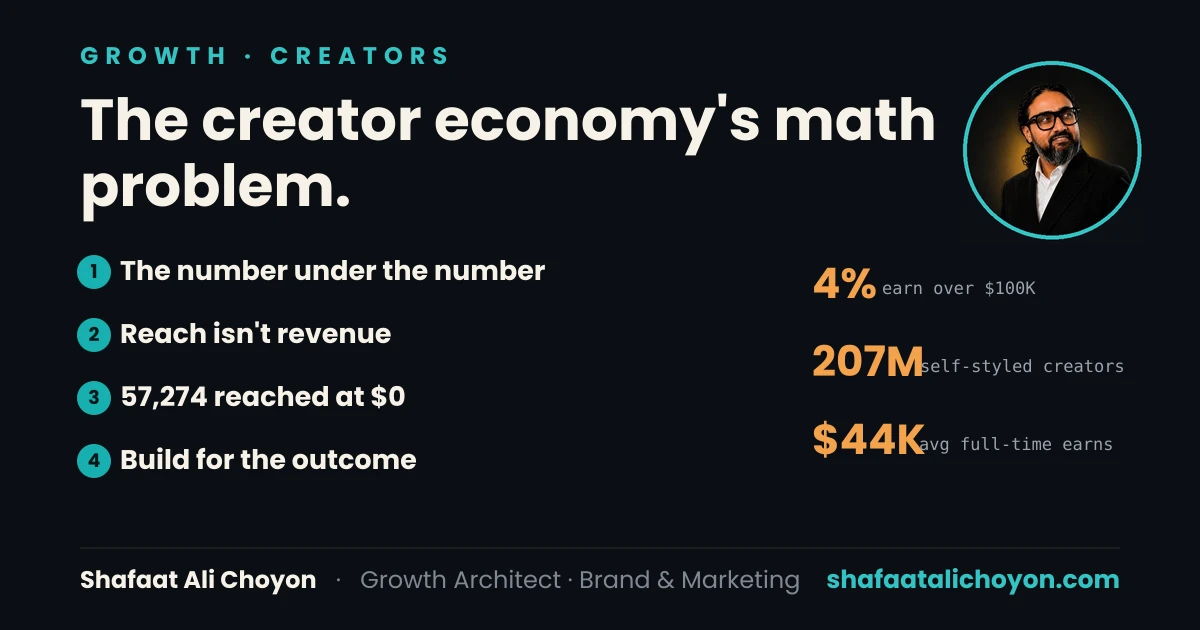
207 million1 people worldwide now call themselves creators, inside a market valued at $248.952B. Only 4% of them clear $100,0003 a year, and the average full-time creator earns $44,0004. That gap is the actual story, not the size of the market.
The number under the number
Every headline about the creator economy leads with the market size, $248.95B is a big, satisfying figure, and 207 million creators sounds like a career path with room for everyone. Neither number tells you what happens to any individual creator inside that market. Only 4% earn over $100,000 a year, and the average full-time creator, the ones doing this as their actual job, makes $44,000, before accounting for the platform cuts, production costs, and the unpaid hours spent on everything that isn't posting. The distribution is the real headline: a small number of creators capture most of the revenue, and the other 96% are running a volunteer operation with professional-grade time commitment. Reach scales differently than revenue does, and most people building an audience are optimizing the wrong curve without realizing it.
What 57,274 impressions at $0 taught me about the gap
I founded HSREP, a health initiative, and generated 57,274 views and impressions at $0 ad spend. By creator economy standards, that's real distribution, built entirely on organic distribution and message discipline. But reach was never the point of HSREP, the point was health behavior change at population scale, and I never confused the reach number with a revenue number because HSREP was never built to monetize an audience, it was built to move a public health outcome. That distinction is exactly what most creators miss. Reach is a resource you can direct toward outcomes, sales, behavior change, brand equity, but it isn't automatically convertible to any of them. The 96% of creators earning under $100,000 mostly have real reach and no deliberate mechanism turning it into revenue.
Build for the outcome, not the audience
The creator economy's math problem is really a strategy problem wearing a market-size headline. $44,000 average full-time earnings against a $248.95B total market means the money is concentrated somewhere specific, in creators who treated audience-building as the first half of a plan, not the whole plan. Everyone else is doing unpaid content marketing for platforms that capture the value.
The short version
- 207 million creators, $248.95B market, but only 4% earn over $100K a year.
- The average full-time creator makes $44,000, well below the market's headline size.
- Reach at $0 ad spend, like HSREP's 57,274, proves audience-building doesn't require budget.
- Reach only becomes revenue with a deliberate monetization mechanism attached to it.
Are you building an audience, or are you building the mechanism that turns that audience into an outcome?
Frequently asked questions
What is the creator economy's math problem?
207 million people worldwide call themselves creators inside a $248.95B market, but only 4% earn over $100,000 a year, and the average full-time creator makes $44,000. The gap between reach and revenue, not the size of the market, is the real story.
Why doesn't a large audience guarantee revenue?
Reach is a resource you can direct toward outcomes, sales, behavior change, brand equity, but it isn't automatically convertible to any of them. Most of the 96% of creators earning under $100,000 have real reach and no deliberate mechanism turning it into revenue.
What did HSREP teach about the reach-revenue gap?
I founded HSREP, a health initiative, and generated 57,274 platform-reported views and impressions at $0 ad spend through organic distribution and message discipline. HSREP was never built to monetize an audience, it was built to move a public health outcome, which is exactly why I never confused the reach number with a revenue number.
Sources
- DemandSage (via Behind the Scenes). behindthescenes.com ↗
- Coherent Market Insights. vdocipher.com ↗
- Goldman Sachs (via Inbeat). inbeat.agency ↗
- CreatorIQ (via Behind the Scenes / Inbeat). behindthescenes.com ↗
Md Shafaat Ali Choyon (MPH, CHES®, MBA, MCIM) is a growth, marketing and public-health strategist who builds and runs AI in production, with 17 years across telecom, fintech, e-commerce, consumer tech and healthcare in the US and Bangladesh. See the essays or the portfolio.