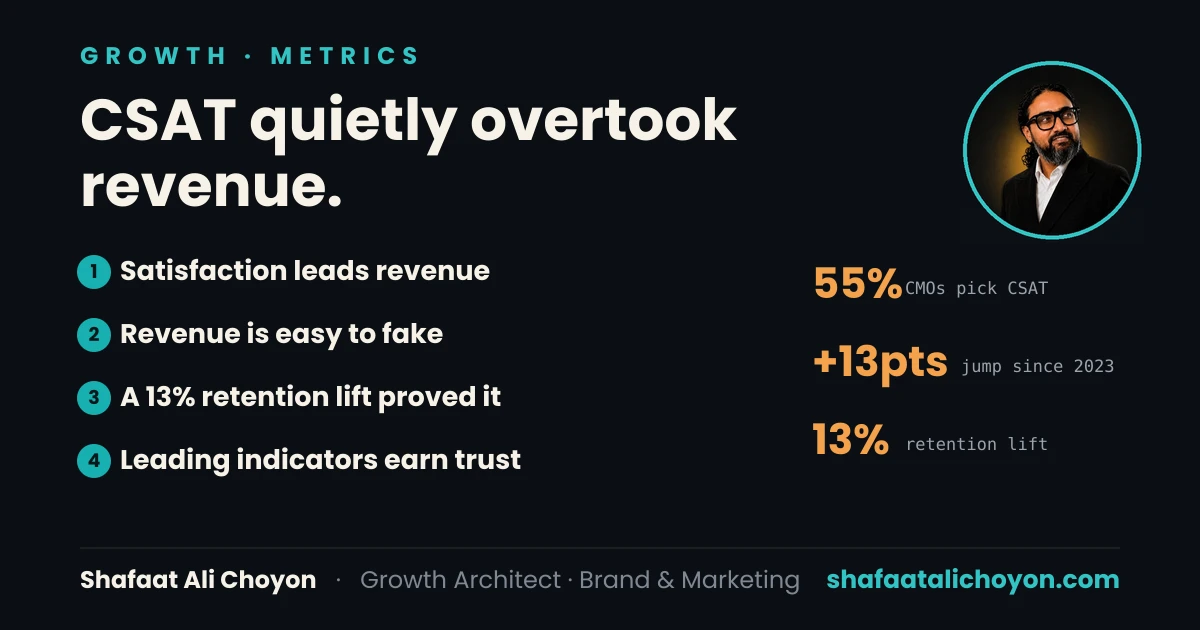
For the first time, more CMOs point to customer satisfaction than to revenue growth when asked what actually defines success. The CMO Survival Guide 20261 puts the number at 55%, up from 42% in 2023, a jump large enough to be a strategy shift rather than survey noise.
The metric that quietly took the lead
Revenue growth used to be the metric a CMO led with in the boardroom, the one number everyone agreed mattered most even when they disagreed about how to move it. That's no longer true. 55% of CMOs now name customer satisfaction, CSAT, as their primary success metric, a 13-point jump from 42% just three years earlier. It's not that revenue stopped mattering, it's that CMOs stopped trusting revenue as the leading indicator of whether the business is actually healthy. Revenue can rise for a quarter on discounting, on a one-time campaign spike, on a competitor's stumble, while satisfaction erodes underneath it. CSAT doesn't lie the same way. It's slower to move and harder to fake, which is exactly why marketers under tenure pressure are leaning on it, it's the metric that predicts next quarter's revenue rather than just reporting last quarter's.
The number that actually moved
As COO of a multi-entity clinical group, Laser Treat, I watched this play out in a real P&L. We weren't chasing a revenue target that quarter, we were fixing the operational friction, missed callbacks, slow intake, inconsistent follow-up, that was quietly costing us patients. Digitizing those workflows across every entity delivered $0.5M in operating cost reduction, but the number that mattered more was patient retention, which rose 13%. Retention is CSAT's closest cousin in a clinical setting, it's satisfaction measured by whether people come back. Revenue followed from that, but it followed, it didn't lead. If we'd optimized for a revenue number that quarter instead of the experience underneath it, we'd have hit a short-term target and missed the compounding one.
Why the leading indicator finally won
This shift makes sense once you connect it to the CMO tenure data: boards want proof that's durable, not proof that's flattering for one quarter. A satisfaction number that's climbing is a much stronger signal to a skeptical board than a revenue number that's climbing on borrowed time. 42% to 55% in three years isn't a fad, it's marketing catching up to what operations has known for a while, that the metric worth protecting is the one your customer actually feels.
The short version
- CSAT overtook revenue growth as CMOs' top success metric, 55% vs. 42% in 2023.
- Revenue can be manufactured for a quarter, satisfaction is much harder to fake.
- A 13% retention lift at Laser Treat proved satisfaction leads revenue, not the reverse.
- Leading indicators earn board trust that trailing ones can't.
If your board only ever sees the revenue number, do they actually know if your customers are still happy?
Frequently asked questions
Why are CMOs prioritizing CSAT over revenue growth?
The CMO Survival Guide 2026 found 55% of CMOs now name customer satisfaction as their primary success metric, up from 42% in 2023. Revenue can rise for a quarter on discounting or a one-time spike while satisfaction erodes underneath it, so CSAT is trusted as the better leading indicator.
What happened at Laser Treat when the focus shifted to customer experience?
As COO of a multi-entity clinical group, Laser Treat, digitizing workflows like callbacks, intake, and follow-up delivered $0.5M in operating cost reduction, and patient retention rose 13%. Revenue followed from the improved experience rather than being chased directly that quarter.
Is CSAT replacing revenue as a metric entirely?
No, revenue still matters, but CMOs stopped trusting it as the leading indicator of business health. CSAT is slower to move and harder to fake, which is why it predicts next quarter's revenue rather than just reporting last quarter's.
Sources
- CMSWire (covering the CMO Survival Guide 2026 report). cmswire.com ↗
Md Shafaat Ali Choyon (MPH, CHES®, MBA, MCIM) is a growth, marketing and public-health strategist who builds and runs AI in production, with 17 years across telecom, fintech, e-commerce, consumer tech and healthcare in the US and Bangladesh. See the essays or the portfolio.