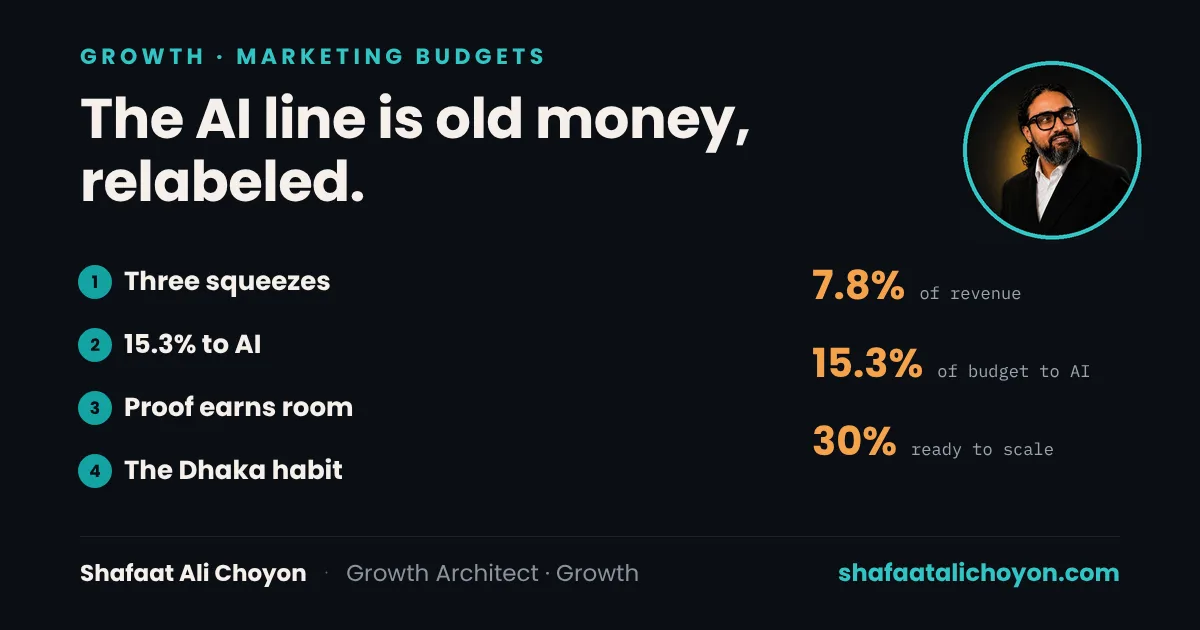
For every $100 a large company earns, marketing now gets about $7.801. Of that, roughly $1.19 goes to AI. Those are the averages from Gartner's 2026 CMO Spend Survey of 401 marketing leaders: budgets at 7.8% of revenue, and 15.3% of each marketing budget allocated to AI. The catch is in the same release. Only 30% of CMOs say their AI readiness is mature. Most are buying a new engine for a car whose wiring is not finished.
Three squeezes in three years
The first squeeze was the fall. In the four years before the pandemic, marketing budgets averaged 11%3 of revenue. By 2023 they were 9.1%. In 2024 they dropped to 7.7%, and Gartner's analyst called it an "era of less".
The second squeeze was the flat line. In 2025 budgets stayed at 7.7%, and 59% of CMOs said that was not enough to deliver their strategy. To cope, 39%2 planned to cut agency budgets and 39% planned to cut labor spending.
The third squeeze is the new one. The 2026 budget barely moved, to 7.8%, which Gartner calls "effectively flat". But a new line now takes more than a seventh of it. When the total does not grow and a new line appears, something old shrinks. Last year's survey already told us what: agencies and people. The AI line is not new money. It is old money with a new label.
How much of the marketing budget goes to AI in 2026?
On average, 15.3%. But the number that matters more is the readiness gap. Seventy percent of CMOs say becoming an AI leader is a critical goal this year, and 70% also say their internal processes are not mature enough to scale AI. Gartner's Ewan McIntyre named the risk plainly: CMOs may "invest in AI tools faster than they build the data foundations".
I have seen this pattern up close. In my MPH capstone, the biggest gain did not come from a new channel or a new tool. It came from fixing the measurement before we spent, which made the campaign's reach about 3x larger. AI works the same way. A tool fed with messy customer data, unclear goals and no baseline will produce a lot of content and no proof. Then the CFO asks what the 15.3% bought, and nobody can answer.
The leaders did not fund AI by cutting
Here is the detail most coverage skipped. The CMOs Gartner calls AI-ready put 21.3%1 of their budgets into AI, and their budgets are bigger: 8.9% of revenue, not 7.8%. Do the multiplication. The ready group spends about 1.9% of revenue on AI. The average spends about 1.2%. So the leaders are not just squeezing harder. They have more room.
The survey does not prove which came first. But it matches what I have seen in every growth job I have held. Money follows proof. When I built the digital practice at Asiatic to about $1M a month in billings within about seven months, clients did not move budget because digital was fashionable. They moved it because they could see what it returned, week by week. At Praava Health, corporate clients grew from about 342 to about 1,400 because the business case was in numbers a buyer could check.
A CMO who can show what AI returns will get a bigger budget. A CMO who cannot will keep funding AI by cutting the people who could have made it work.
Dhaka has run on a flat budget for years
Bangladesh never had the luxury of an 11% marketing budget. The whole national ad market is around Tk 40 billion4 a year, according to The Financial Express. TV still takes almost half, social platforms about a third, and about 36% of spending is managed in-house by the companies themselves. Lean is the default.
So AI arrived in Dhaka through the production budget, not as a strategy line. In 2024, one Dhaka agency head told The Daily Star that AI image tools cut costs by over 80%5 compared with traditional shoots. In July 2025, the agency behind Banglalink's "Beshi Beshi" commercial6 said it was fully created with generative AI tools. In August 2026, the advertising agencies' association ran a generative AI training session7 for its member agencies with a Google and TikTok partner.
That is the flip. In Bangladesh, every AI taka has to replace a cost someone can name: a shoot, an edit, a translation, a reporting hour. In the US, AI often sits on top of the plan as its own line, measured against hope. The Dhaka habit is the better one. If an AI dollar cannot point to the line it replaced or the revenue it added, it is not an investment. It is a subscription.
How to fund the AI line without starving growth
If I were walking into a CMO's budget review this quarter, I would ask for five things:
- Name the line each AI dollar replaces. Production, agency hours, reporting, translation. Write it next to the spend, and check it in six months.
- Fund the data plumbing first. Clean customer data, one source of truth for results, and a baseline before launch. This is the 70% gap, and no tool closes it for you.
- Protect the people who can judge the output. The 39% cutting labor are cutting the editors and analysts who make AI output safe and useful.
- Measure revenue, not volume. More posts, more ads and more variants are costs. Pipeline, retention and margin are results.
- Make the case for a bigger budget with proof. The AI-ready group runs 8.9% of revenue. You earn that with numbers, not slides.
My free marketing budget planner shows what your split looks like at 7.8% of revenue, and my free marketing ROI calculator tests whether each line is earning its place. I wrote about the role itself in The Shrinking CMO; this is what the money says a year later.
The short version
- Marketing budgets are 7.8% of revenue in 2026, effectively flat after falling from about 11% before the pandemic.
- CMOs put 15.3% of their budgets into AI, but only 30% report mature AI readiness.
- AI-ready leaders spend 21.3% of bigger budgets (8.9% of revenue) on AI, so proof seems to earn room, not just cuts.
- Bangladesh brought AI in through production costs, where every taka had to replace a named expense.
- Fund AI line by line: name what it replaces, fix the data first, keep the judges, and measure revenue.
If your CFO asked tomorrow what last quarter's AI spend returned, which number would you show?
Frequently asked questions
What percentage of revenue do companies spend on marketing in 2026?
Gartner's 2026 CMO Spend Survey of 401 marketing leaders found budgets average 7.8% of company revenue, up from 7.7% in 2025 and 2024. In the four years before the pandemic, the average was 11%.
How much of the marketing budget goes to AI?
CMOs allocate an average of 15.3% of their marketing budgets to AI, according to the same survey. AI-ready organizations allocate 21.3%, and their marketing budgets are larger, at 8.9% of revenue.
Are marketing teams ready to scale AI?
Mostly not yet. Only 30% of CMOs report mature AI readiness, and 70% say their internal marketing processes are not mature enough to implement and scale AI.
Sources
- Gartner, Gartner 2026 CMO Spend Survey Finds CMOs Allocate 15.3% of Marketing Budgets to AI, But Only 30% Are Ready to Scale AI Capabilities (11 May 2026). gartner.com ↗
- Gartner, Gartner 2025 CMO Spend Survey Reveals Marketing Budgets Have Flatlined at 7.7% of Overall Company Revenue (12 May 2025). gartner.com ↗
- Gartner, Gartner CMO Survey Reveals Marketing Budgets Have Dropped to 7.7% of Overall Company Revenue in 2024 (13 May 2024). gartner.com ↗
- The Financial Express, Local ad market shifting to digital media, traditional media getting marginalised (13 February 2025). thefinancialexpress.com.bd ↗
- The Daily Star, A trend on the rise: The phenomenon of AI-generated advertisements (28 March 2024). thedailystar.net ↗
- Ads of the World, Beshi Manei Banglalink: Beshi Beshi AI-generated TVC (July 2025). adsoftheworld.com ↗
- The Daily Observer, AAAB and official Google & TikTok partner Aleph host Gen AI creative learning session (17 August 2026). observerbd.com ↗
Md Shafaat Ali Choyon (MPH, CHES®, MBA, MCIM) is a growth, marketing and public-health strategist who builds and runs AI in production, with 17 years across telecom, fintech, e-commerce, consumer tech and healthcare in the US and Bangladesh. See the essays or the portfolio.