Every team measures something. The difference between teams that grow and teams that just feel busy is which number they choose to stare at — and the winning ones almost always pick the number they'd rather not look at.
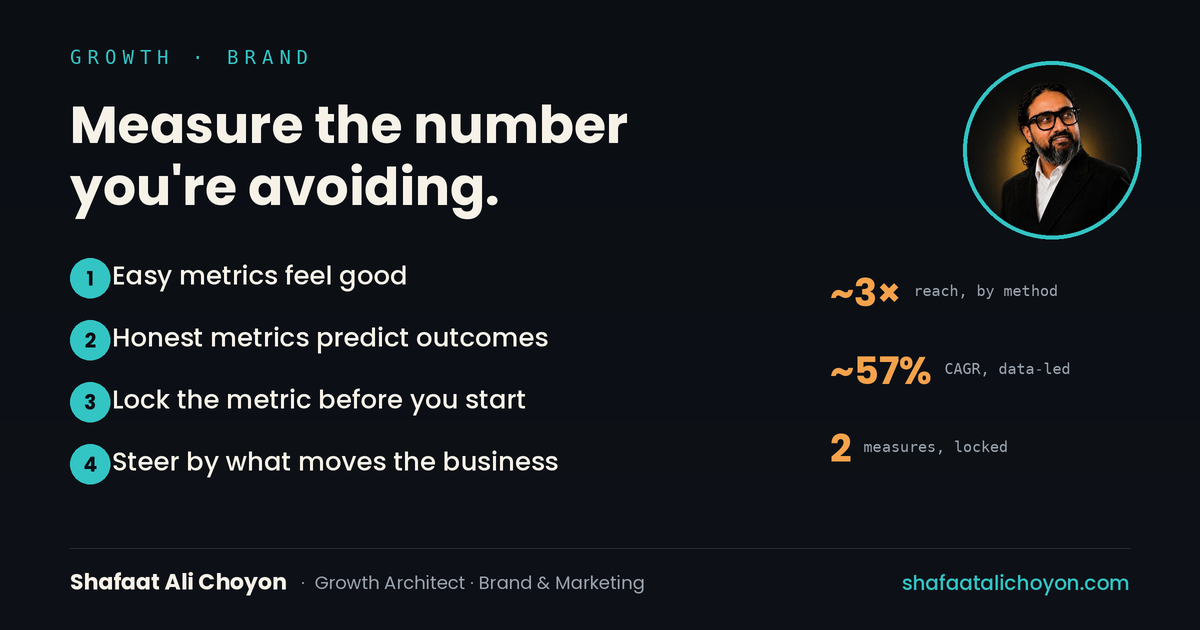
Easy metrics feel good; honest metrics predict outcomes
Reach, impressions, followers, sign-ups — these are easy to count and easy to feel good about, which is exactly why they mislead. They measure motion, not result. The number that actually predicts the outcome is usually the uncomfortable one: retention, cost to convert, behavior genuinely changed. Teams gravitate to the flattering metric and then wonder why the flattering chart never turns into a business.
I lock the metric before the campaign, not after
For my MPH capstone I refused to leave reach to luck. I set the measurement framework up front, reported on two independent measures, and used deliberate distribution — and documented a repeatable ~3× reach, not a lucky post. Deciding what you'll count before you start changes what you make: when you know the number you're accountable to, you write sharper, target tighter, and cut the work that only produces vanity.
Data as an operating discipline, not a dashboard
At Praava we built a data engine for product and growth decisions, and the value was never the dashboards — it was choosing the one metric that actually moved the business and steering by it, quarter after quarter, into roughly 57% B2C CAGR. Analytics isn't a reporting function bolted on at the end; it's the steering wheel, and the teams that treat it that way compound while the others admire their impressions.
The dual-market trap is the same
This trap is identical in both my markets. A Dhaka founder chasing GMV instead of repeat purchase, a US team chasing monthly active users instead of engaged ones — same avoidance, same flattering chart, same stall. The honest KPI is universal, and so is the discipline of naming it before you begin.
The short version
- Easy metrics measure motion; the number that predicts the outcome is usually the uncomfortable one.
- I lock the measurement framework before a campaign — a documented ~3× reach, not a lucky post.
- Data is a steering wheel, not a dashboard; at Praava it drove ~57% B2C CAGR.
- The vanity-metric trap is identical in Dhaka and the US — name the honest KPI before you start.
What's the one number your team quietly avoids — and what would change if you made it the headline metric tomorrow?
Md Shafaat Ali Choyon (MPH, CHES®, MBA, MCIM) is a growth, marketing and public-health strategist who builds and runs AI in production, with 16+ years across telecom, fintech, e-commerce, consumer tech and healthcare in the US and Bangladesh. See the essays or the portfolio.