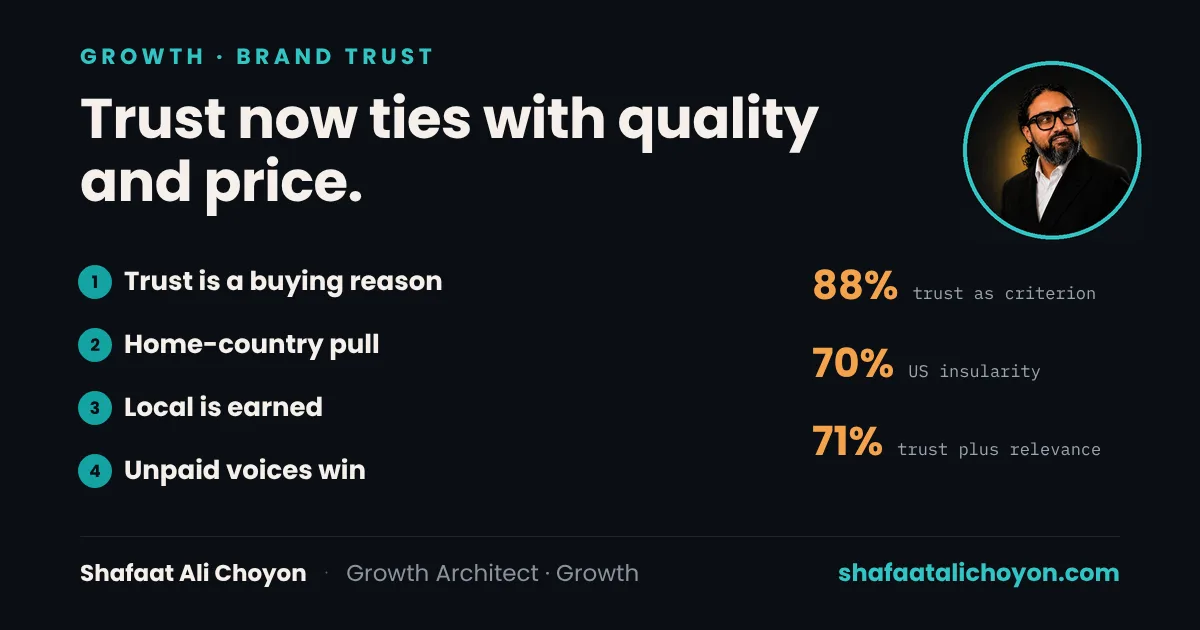
Edelman surveyed 17,688 people in 15 countries this spring and asked what makes them buy. 88%1 called trust an important or critical purchase criterion, level with quality at 89% and value at 88%. Trust is no longer the soft extra on top of a good product at a fair price. It is the third leg of the stool. The same survey found something sharper: more than two-thirds of consumers now say a brand being headquartered in their own country is an important or critical deal-breaker, up 5 points1 since 2023.
Why do buyers care where a brand is headquartered?
Because the address is a shortcut for "people like me". Edelman's January Trust Barometer, with nearly 34,000 respondents in 28 countries, found that seven in 10 people are unwilling or hesitant to trust someone with different values. In the US the figure is 70%2. Edelman calls this insularity: after years of grievance, people are pulling back into their own circles.
Its brand study shows what that does to shopping. Two-thirds of consumers are hesitant or unwilling to trust people with different core values. And 54%3 say they feel a connection to people who use the same brands they do, up 8 points in five years. Brands have become badges of belonging. A home-country headquarters is the easiest badge to read, so buyers use it, even when they cannot say what the company actually does differently.
I have argued before that trust is the growth strategy when nobody trusts anybody. The 2026 data adds a harder edge: trust is now sorted by group. The question is no longer only "do people trust you?" It is "do they think you are one of them?"
Bangladesh showed how fast a market can turn
In early 2024, amid consumer boycotts of some global brands, Bangladeshi shoppers moved away from global colas. The Dhaka Tribune reported that Mojo, a local cola made by Akij, grew its share of the cola market from 29% to 35% in the first three months of the year, and then to 39%4, by its maker's account. Coca-Cola, which said it had led the market in 2023, went on a public-relations offensive.
Mojo did not get cheaper or better in those months. It became "ours". In an insular market, share can move in a single quarter, and it moves on identity rather than taste or price. Any brand that sells across borders should treat that as a stress test it could face next.
Local is earned, not registered
Bangladesh also shows the other side. Unilever is a British company. It has made soap in Bangladesh since its Kalurghat factory opened in 1965, the Government of Bangladesh holds a 39.25%5 stake in the local company, and Unilever says it serves 9 in 10 Bangladeshi households every day. Its own history page is titled "how a British company became Bangladesh's very own". Very few people in Dhaka think of Lifebuoy as foreign.
I saw what that is worth. The Lifebuoy partnership hotline we set up at Praava took about 3,000 calls a day. People called a doctor through a soap brand, because that brand had been in their homes for generations. The head office was in London. The trust was local.
That is the lesson Bangladesh offers US brands. You cannot change where you are headquartered. You can change how local you are: who makes the product, who speaks for it, which communities see you show up, and for how long.
Earned voices travel, ads do not
Edelman's most useful finding for marketers: among insular consumers, unpaid voices are 5x3 more powerful than paid brand voices at building trust. 46% of the insular say unpaid voices have the biggest effect on whether they trust a brand. Friends and family are a trusted source for 82%, and "someone like me" for 76%.
Trust alone is also not enough to grow into new groups. When a brand has neither trust nor relevance, only 36% of people say they would keep using it as it reaches people unlike them. With trust alone that rises to 48%. With both trust and relevance it is 71%3.
At Praava Health, most patients paid out of pocket, so every patient judged us with their own money. We grew about 45% a year overall from 2021 to 2023, and corporate clients rose from about 342 to about 1,400. We earned that by doing things people could check, such as replacing referral kickbacks with transparent prices. That gave patients and clients something true to repeat.
How to build a brand for the insular buyer
- Measure trust by community, not on average. A good overall score can hide a group that has quietly left. My free NPS calculator works per segment, so run it for each one.
- Show local roots as proof, not slogans. Local staff, local suppliers, local partners and years in the community are facts people can verify.
- Make it easy for unpaid voices to speak. Reviews, referrals, community partners and staff who can explain what you do. Give them something true and simple to say.
- Earn relevance by being useful. Edelman found utility the most effective route to relevance, and pop culture fluency the least.
- Position on the job first, then the identity. My free brand positioning ladder climbs from what you do to why it matters to the people you serve.
The short version
- 88% of consumers call trust an important or critical purchase criterion, level with quality (89%) and value (88%), in Edelman's 2026 study.
- More than two-thirds want a home-country headquarters, up 5 points since 2023, because the address stands in for "people like me".
- Bangladesh showed share can move in a quarter: a local cola's maker said its share rose from 29% to 39% in early 2024.
- Local is earned: Unilever, a British company, became "Bangladesh's very own" through decades of local factories, ownership and presence.
- Unpaid voices are 5x more powerful than paid ones among insular buyers, and trust plus relevance lifts willingness to stay from 36% to 71%.
If your customers had to decide tomorrow whether you are "one of us", what evidence would they find?
Frequently asked questions
How important is trust when consumers decide what to buy?
In Edelman's 2026 brand study of 17,688 people in 15 countries, 88% called trust an important or critical purchase criterion. That is level with quality at 89% and value at 88%.
Do consumers prefer brands from their own country?
Increasingly, yes. More than two-thirds of consumers in Edelman's 2026 study said a brand being headquartered in their own country is an important or critical deal-breaker, up 5 points since 2023.
What builds brand trust among insular consumers?
Unpaid voices. Edelman found they are 5x more powerful than paid brand voices among insular consumers, and 46% of the insular say unpaid voices have the biggest effect. Brands with both trust and relevance keep 71% of people willing to stay as they grow, against 36% with neither.
Sources
- Edelman, 2026 Edelman Trust Barometer Special Report: Brand Growth in an Insular World (2026). edelman.com ↗
- Edelman, 2026 Edelman Trust Barometer: society slides into insularity (18 January 2026). edelman.com ↗
- Edelman, Richard Edelman, Trust and Relevance Together Unlock Brand Growth in an Insular World (20 June 2026). edelman.com ↗
- Dhaka Tribune, How bad was Coca-Cola's sales that they had to go on a PR offensive? (13 June 2024). dhakatribune.com ↗
- Unilever Bangladesh, Port Sunlight to Kalurghat: how a British company became Bangladesh's very own (22 September 2024). unilever.com.bd ↗
Md Shafaat Ali Choyon (MPH, CHES®, MBA, MCIM) is a growth, marketing and public-health strategist who builds and runs AI in production, with 17 years across telecom, fintech, e-commerce, consumer tech and healthcare in the US and Bangladesh. See the essays or the portfolio.