There's a kind of market where the usual growth playbook — awareness, funnels, offers — barely moves the needle, because the real obstacle isn't attention. It's disbelief. In low-trust categories, people don't need to be convinced your product is *good*; they need to be convinced it won't *burn them*. I've built growth in exactly those markets, and the lesson is blunt: trust isn't a brand value you add at the end. It's the entire engine.
Trust at national scale
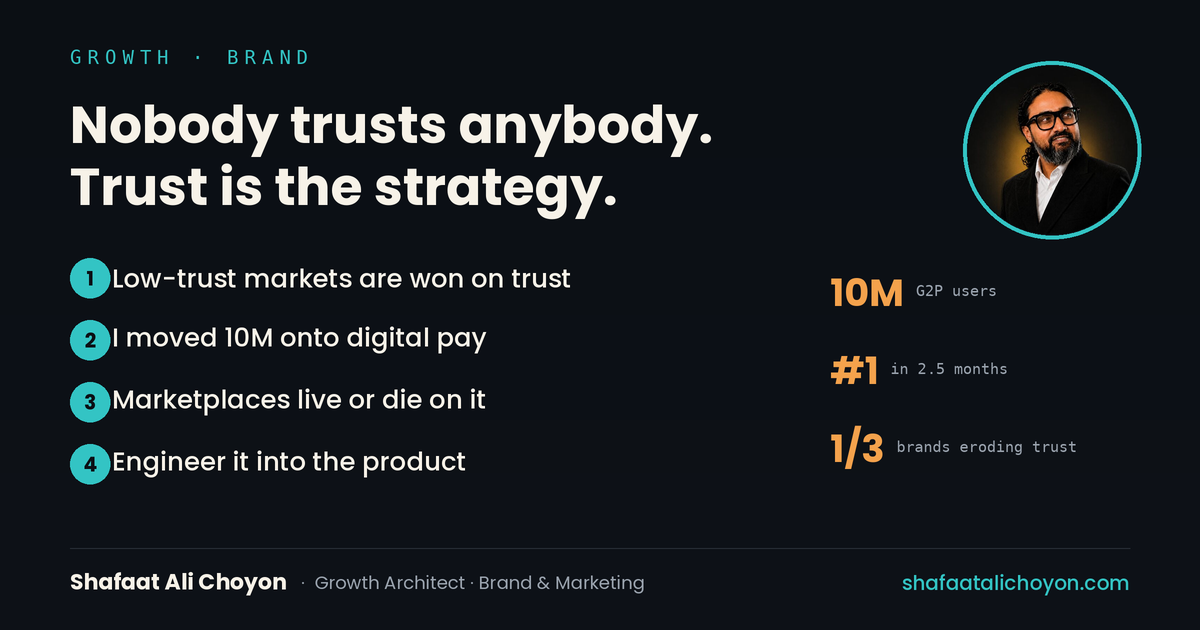
At SureCash we put a government stipend into the hands of roughly 10 million beneficiaries over mobile rails — many of them unbanked, first-time digital-money users with every reason to be suspicious of "your money is now on a phone." Growth there wasn't a marketing problem; it was a trust problem. Every point of adoption came from making the system feel safe, legible, and reliable — the cash arrives, the number is right, the help exists. Get that wrong once at scale and adoption collapses. Get it right and you move millions.
A marketplace is a pure trust machine
Then there's the used-goods marketplace, which is trust distilled: a stranger selling a stranger something neither can fully verify. Building the motorbike category on Ekhanei to No. 1 in two and a half months wasn't about clever ads; it was about engineering enough trust between buyer and seller that a transaction could happen at all — verification, presence, reputation, a credible venue. Liquidity follows trust, never the other way around.
The US is now walking into this problem
For years, Western brands could assume a baseline of institutional trust and spend their energy on differentiation. That baseline is eroding — Forrester expects roughly one in three brands to actively damage customer trust in 2026 through clumsy self-service AI, and consumers are getting warier as fast as adoption climbs. Which means US growth teams are quietly entering the market conditions I've operated in for years: trust-first, or nothing. The playbooks from high-trust environments are about to age badly.
How you actually engineer it
Trust isn't a slogan; it's a set of product decisions. Make the risky moment feel safe. Be legible about what happens to someone's money, data, or dignity. Show reliability before you ask for scale. Put a credible human or institution behind the promise. Do this and trust compounds — every honored transaction makes the next one easier — which is why, in these markets, trust isn't a cost center. It's the cheapest growth you'll ever buy.
The short version
- In low-trust categories the obstacle isn't attention — it's disbelief; trust is the growth engine.
- I moved ~10M people onto digital government payments by engineering safety, not by advertising.
- A marketplace is pure trust: Ekhanei's motorbike category hit No. 1 in 2.5 months on trust, not ads.
- US brands are entering trust-first conditions as ~1/3 erode trust via self-service AI — my home turf.
In your market, are you spending to be noticed — or to be believed? Because only one of them compounds.
Md Shafaat Ali Choyon (MPH, CHES®, MBA, MCIM) is a growth, marketing and public-health strategist who builds and runs AI in production, with 16+ years across telecom, fintech, e-commerce, consumer tech and healthcare in the US and Bangladesh. See the essays or the portfolio.