89%1 of Gen Z say a sense of purpose at work matters to their job satisfaction and well-being. In a 2023 Bupa survey of UK workers, two-thirds of Gen Z said they'd take a lower salary to work for a more ethical employer2. That's not a customer brand conversation, it's an employer brand conversation, and most companies are still having the wrong one.
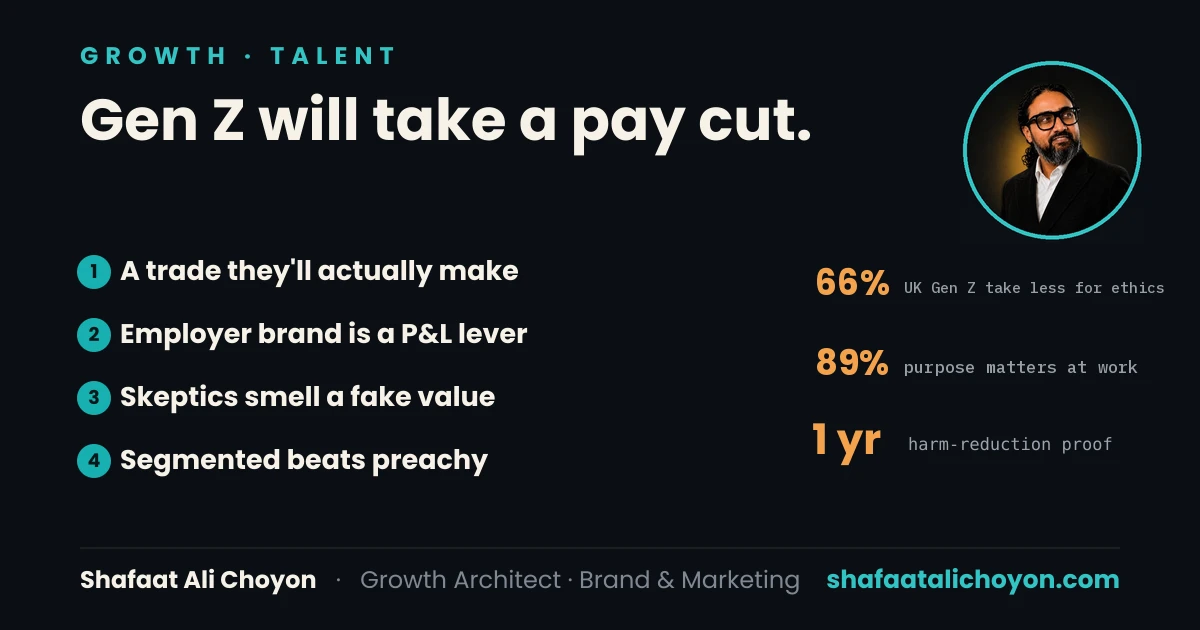
The trade Gen Z says they'll actually make
Every generation claims to care about values until the offer letter shows the number. Gen Z's data is different in scale: 89% say purpose at work matters to their job satisfaction and well-being, and in a UK survey two-thirds of Gen Z workers say they'd accept a lower salary specifically to work somewhere more ethical. That's a majority willing to trade compensation, the single most quantifiable thing an employer offers, for something qualitative and harder to fake. Employer brand teams have treated this as a nice-to-have message layered onto recruiting for a decade. The two-thirds figure says it's closer to a pricing lever, an ethical, credible employer can pay less for the same talent than a company with a murkier reputation, which means employer brand now sits on the cost side of the P&L, not just the marketing side.
What reaching a skeptical audience on values actually takes
I ran a year-long campus harm-reduction campaign aimed at exactly this kind of audience, young, skeptical of institutional messaging, and quick to detect anything that reads as preachy or performative. The approach that worked was non-judgmental, segmented messaging, different framing for different risk profiles and different starting points, delivered without moralizing. It worked because it respected the audience's intelligence instead of assuming compliance. That's the same posture employer brand needs with Gen Z candidates. An 89% purpose-driven audience can smell a values statement written by legal and approved by nobody who's ever lived the value. Segmented, credible, specific claims, not broad ethical positioning, are what convert skepticism into trust, the same lesson health communication learned before recruiting caught up.
Employer brand just became a growth function
Treating employer brand as HR's problem misses what the two-thirds number is actually saying: a credible ethical reputation lowers acquisition cost the same way a strong customer brand does. Companies still budgeting employer brand as a recruiting line item, rather than a growth and retention lever, are underpricing an asset that two-thirds of young UK workers in Bupa's survey say they'd pay for directly.
The short version
- 89% of Gen Z say purpose at work matters to their job satisfaction and well-being.
- Two-thirds of young UK workers would accept a lower salary to work for a more ethical employer (Bupa, 2023).
- Segmented, non-preachy messaging works on skeptical audiences, in health comms and hiring alike.
- A credible employer brand is a cost-of-talent lever, not just a recruiting nicety.
If two-thirds of young workers would trade pay for ethics, why is employer brand still funded like an afterthought?
Frequently asked questions
How much would Gen Z sacrifice for an ethical employer?
89% of Gen Z say purpose at work matters to their job satisfaction and well-being, and in a 2023 Bupa survey of UK workers, two-thirds of Gen Z said they'd accept a lower salary specifically to work for a more ethical employer. That's a majority willing to trade compensation, the most quantifiable thing an employer offers, for something qualitative and harder to fake.
Why does this make employer brand a P&L lever, not just HR?
If two-thirds of young workers in a UK survey would take less pay for an ethical employer, a credible ethical reputation lowers acquisition cost the same way a strong customer brand does. That puts employer brand on the cost side of the P&L, not just the marketing side.
What does effective messaging to a skeptical audience look like?
A year-long campus harm-reduction campaign aimed at a young, skeptical audience used non-judgmental, segmented messaging, different framing for different risk profiles, delivered without moralizing, and it worked because it respected the audience's intelligence. That same posture, segmented and credible rather than broadly preachy, is what converts Gen Z skepticism into trust.
Sources
- Deloitte 2025 Gen Z and Millennial Survey. deloitte.com ↗
- Bupa Wellbeing Index, 2023 (via The HR Director). thehrdirector.com ↗
Md Shafaat Ali Choyon (MPH, CHES®, MBA, MCIM) is a growth, marketing and public-health strategist who builds and runs AI in production, with 17 years across telecom, fintech, e-commerce, consumer tech and healthcare in the US and Bangladesh. See the essays or the portfolio.