On 29 October the UN General Assembly gave Bangladesh three more years before it leaves the group of least developed countries. The date is now 24 November 20291. Most of the commentary will be about garments and tariffs. I think the more useful question is what every other business in the country does with the time, because the part of LDC status that ends is the part that lets you win on price.
What is actually expiring?
Two price advantages. The first is preferential market access. UNCTAD has estimated that losing it could cut exports by more than $17.5 billion2, about a third. The second is cash support for exporters. Bangladesh already lowered the top export cash incentive from 20% to 10%3 in 2024, and WTO rules prohibit such subsidies once a country graduates, so the rest goes too4.
Both of those let a firm be a little slower, a little less consistent or a little more expensive and still win the order. Three years from now, the order goes to whoever delivers on time, at the agreed quality, with the paperwork right. That is not a marketing capability. It is an operating one.
Why is diversification an operations problem?
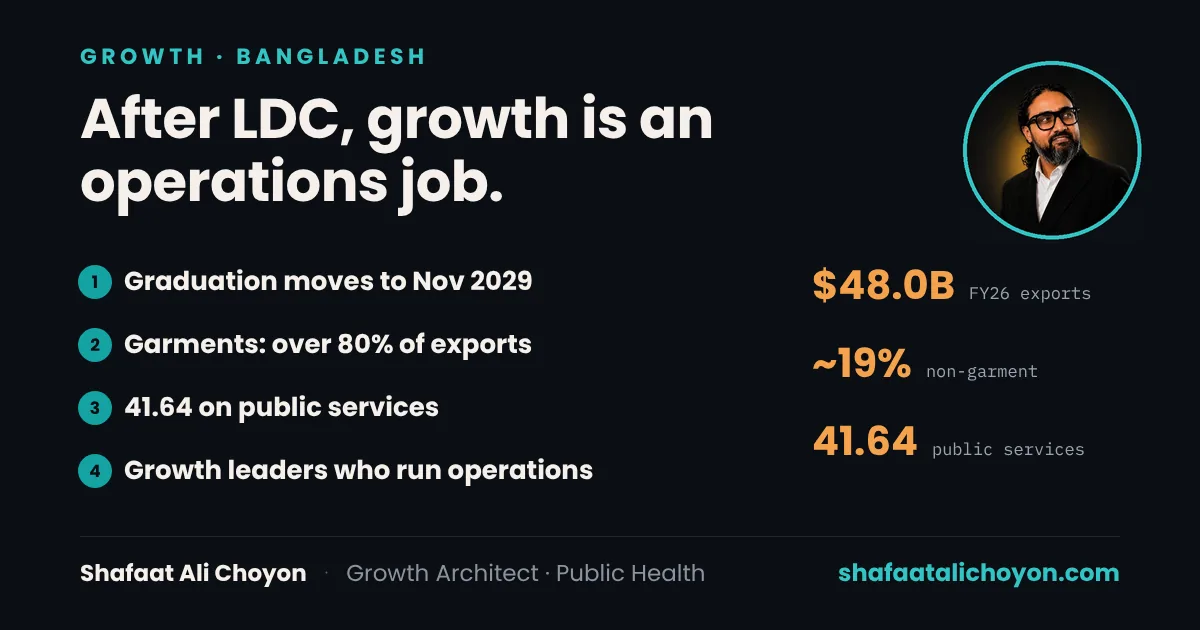
Garments still earn more than 80% of Bangladesh's $48.0 billion5 in exports for FY26. Everything else together is about 19%6, a share that has stayed virtually unchanged for five years. Between FY22 and FY26, leather, home textiles, jute, agro products and engineering goods all earned less, not more.
The usual answer is more trade fairs and more promotion. I don't think demand is the binding constraint. A buyer who tries a new supplier once and gets a late shipment or an uneven batch does not come back, however good the pitch was. Diversification fails at the factory gate, not at the trade fair.
There are early signs of movement. From July to September 2026, pharmaceutical exports grew about 40%7, light engineering 16.5% and leather 14.7%, from small bases. Those are the firms to watch, and the ones that will need operations to keep up with their own sales.
What does the ecosystem have to fix?
The World Bank's B-READY 2024 report is revealing for what it separates. Bangladesh scored 56.99 on its regulatory framework and 70.49 on operational efficiency, how easily firms get through those rules in practice, but only 41.648 on public services, the public systems and digital services firms depend on. The weakest link is not the rulebook. It is the infrastructure around the firm.
The environment shows up as days and dollars. Average container import dwell time at Chattogram rose from 7.8 days in 2023 to 8.3 days9 in 2024, according to World Bank logistics data cited in the trade press. Foreign direct investment was $1.78 billion in 2025, up 45%, against India's $38.9 billion10. Investors bring capability as well as capital, and they go where operations are predictable.
The door-openers are arriving. Bangladesh and Japan signed an Economic Partnership Agreement on 6 February 202611. A trade deal is only worth what a firm can prove and deliver under it: rules of origin, standards, certification, lead times. Three years is enough to build that capability if firms start now, and not enough if they wait for 2029.
Why does the growth leader have to understand operations?
I learned this in my own career, in a sequence I did not plan. At Samsung, the Galaxy Note9 launch in Bangladesh grew 1.54 times year on year and was recognized No. 1 globally for growth. The marketing mattered, but the reason it worked was that supply and distribution were locked in before the marketing started, and prices and offers were made easy for the channel to sell.
At Ekhanei, we took a category to No. 1 in two and a half months. The work behind that was a roughly 60-person operation that acquired supply offline and checked listing quality in real time. Demand followed the quality.
Then, as chief operating officer of Laser Treat, a multi-entity clinical group, I ran the operation itself. Digitizing its workflows and connecting its data cut operating costs by about $0.5 million a year and lifted patient retention 13%. Growth that the operation could keep was worth more than growth we had to buy again every month.
That is the case for a chief growth officer who understands operations. In the next three years, a growth leader who owns only demand will spend the money buying orders the operation cannot keep. The one who owns cost-to-serve, lead time, quality and compliance alongside demand builds the business that survives graduation.
What do US readers already know about this?
Bangladesh has sold to its largest single market without LDC-style duty-free access for years. The US announced in June 2013 that it would end Bangladesh's GSP eligibility over worker rights12. In 2025, Bangladesh was still the third-largest supplier of US apparel imports, with 10.53%13 of the market, and since 24 July 2026 its goods face a 10% Section 301 tariff14.
For US companies that source from or invest in Bangladesh, that is the useful signal: the suppliers who held their place without a discount did it with operations. For Bangladeshi firms, it is proof that competing without preferences is possible. The US market is where it already happens.
What should a business do with the three years?
My list for any Bangladeshi firm outside garments, and for the garment firms that want to be more than one thing:
- Measure cost-to-serve per customer and per market. You cannot price without preferences if you do not know what each order costs you to deliver.
- Put lead time and quality on the growth dashboard, next to revenue. Buyers will.
- Build the compliance file before the buyer asks: certifications, testing, traceability, origin.
- Digitize the operation before you scale the sales team. Data that connects order, production and delivery is what lets you promise a date and keep it.
- Hire or develop growth leadership that has run operations. The next three years reward people who can move a number across the whole chain.
The short version
- Graduation is now 24 November 2029. What ends is the price advantage: preferences and export cash incentives.
- Concentration is the risk: garments are above 80% of $48.0 billion; everything else has been about 19% for five years.
- Public systems are the weak link: 41.64 on public services against 70.49 on operational efficiency (B-READY 2024).
- Trade deals open doors only for firms that can prove origin, quality and delivery.
- The next growth leader owns operations too: cost-to-serve, lead time, quality and compliance next to demand.
If your firm lost its price advantage tomorrow, which promise to a buyer would your operation struggle to keep?
Frequently asked questions
When will Bangladesh graduate from LDC status?
On 24 November 2029. The UN General Assembly granted a three-year extension on 29 October 2026; graduation had been set for 24 November 2026.
What changes for Bangladeshi businesses after LDC graduation?
Preferential market access becomes conditional on new trade deals and stricter rules, and export cash incentives must end because WTO rules prohibit them for graduated countries. Firms will compete more on delivery, quality, compliance and cost than on price advantages.
What is a chief growth officer who understands operations?
A growth leader who owns not only demand and marketing but also the operating levers that decide whether a customer stays: cost-to-serve, lead time, quality, compliance and the data that connects them.
Sources
- The Business Standard, Bangladesh gets 3 more years before LDC graduation (30 October 2026). tbsnews.net ↗
- The Daily Star, LDC graduation could cost Bangladesh $17.5b in exports: UNCTAD (2026). thedailystar.net ↗
- The Daily Star, Bangladesh cuts cash incentive for exporters further (2024). thedailystar.net ↗
- The Financial Express, Further cut in export cash incentive before LDC graduation unlikely (8 August 2025). thefinancialexpress.com.bd ↗
- The Business Standard, FY26 merchandise exports $48 billion (2 July 2026). tbsnews.net ↗
- The Financial Express, Diversification hope fades as non-RMG exports stagnate (9 July 2026). thefinancialexpress.com.bd ↗
- UNB citing EPB, Merchandise exports rise 6.34% to $13.09b in Q1 FY27 (1 October 2026). unb.com.bd ↗
- The Business Standard, World Bank B-READY 2024 scores for Bangladesh. tbsnews.net ↗
- Maritime Gateway, Chattogram port dwell time (28 July 2026). maritimegateway.com ↗
- The Daily Star, Bangladesh FDI rises 45%, still trails major regional peers (8 July 2026). thedailystar.net ↗
- METI Japan, Japan-Bangladesh Economic Partnership Agreement signed (6 February 2026). meti.go.jp ↗
- The White House, Technical trade message to Congress regarding Bangladesh (27 June 2013). obamawhitehouse.archives.gov ↗
- The Daily Star citing OTEXA, Bangladesh's share of US apparel market rises to 10.53% (2026). thedailystar.net ↗
- The Daily Star, What the new US 10% tariff means for Bangladesh (27 July 2026). thedailystar.net ↗
Md Shafaat Ali Choyon (MPH, CHES®, MBA, MCIM) is a growth, marketing and public-health strategist who builds and runs AI in production, with 17 years across telecom, fintech, e-commerce, consumer tech and healthcare in the US and Bangladesh. See the essays or the portfolio.