Marketers spend months on logos, taglines, and brand decks, then set the price in an afternoon with a spreadsheet. That's backwards. Your price is the single loudest signal your brand sends — it tells the customer what you think you're worth, who you're for, and whether you respect them. Long before anyone reads your copy, they've read your number.
In a cash market, price can't hide
I learned this where there's nowhere to hide. In a reimbursement market, a third party pays, price gets abstracted, and products bloat with features that bill well but nobody chose. In a cash-pay market, every taka is felt at the moment of care. That's brutal and clarifying: your price is judged instantly, in full, by the person paying it. You quickly learn that a confusing or padded price doesn't read as premium — it reads as a reason not to trust you.
Margin is a design problem, not a markup
The instinct when margins are thin is to raise the price. Usually the real fix is to redesign the thing underneath it. At Praava, part of the diagnostics story was moving the lab's margin from roughly 30% to about 50% — not by charging patients more, but by fixing a broken kickback model and taking cost out of the system. The customer saw the same transparent price; the business simply kept more of it, honestly. That's what good pricing work looks like: better economics that don't come out of the customer's trust.
Transparency is a positioning weapon
In low-trust categories — which is most of health, and increasingly most of everything — a clear, honest, defensible price is a competitive weapon. It says: no games, no surprise bill, no fine print. That's why transparent pricing travels so well across markets. In the US, the entire cash-ward drift — high deductibles, DTC clinics, out-of-pocket everything — is really consumers demanding to see and trust the number before they commit. Same instinct as a Dhaka patient. The brands that win price like they have nothing to hide.
The short version
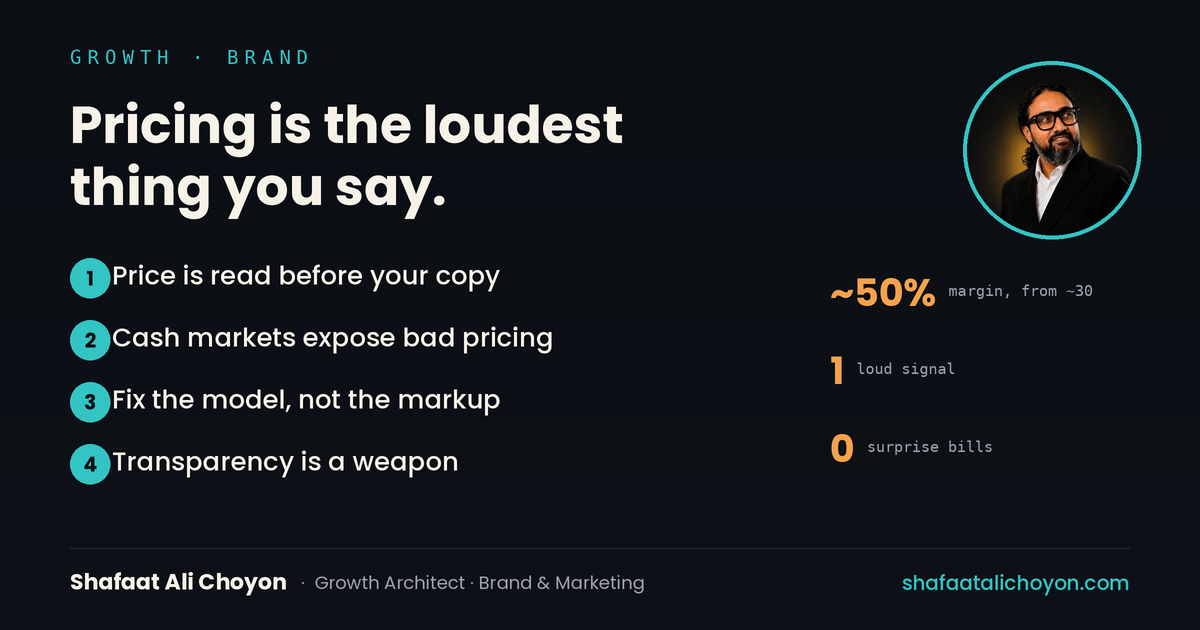
- Price is the loudest thing your brand says — set it before the tagline, not after.
- Cash markets expose bad pricing instantly; every unit is felt in full at the point of purchase.
- Thin margins are usually a model problem: I moved a lab margin ~30% to ~50% by fixing the system, not the price.
- Transparent, defensible pricing is a positioning weapon in any low-trust category, US or Bangladesh.
Look at your price the way a first-time customer does — what does it say about who you're for, before they read a single word of your copy?
Md Shafaat Ali Choyon (MPH, CHES®, MBA, MCIM) is a growth, marketing and public-health strategist who builds and runs AI in production, with 16+ years across telecom, fintech, e-commerce, consumer tech and healthcare in the US and Bangladesh. See the essays or the portfolio.