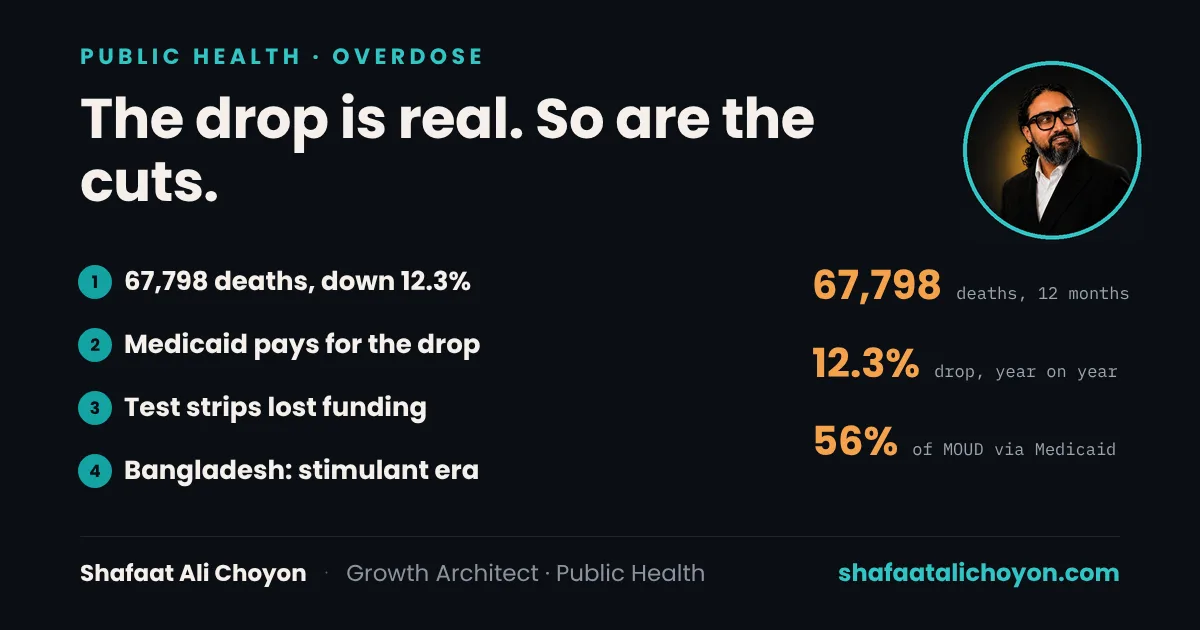
CDC's latest count says 67,7981 Americans died of drug overdoses in the 12 months to March 2026, down 12.3% from a year before. Deaths peaked at nearly 110,0002 in 2022. That is one of the biggest public health turnarounds of my lifetime, and it is easy to read as a problem solving itself. It is not. The drop rests on a safety net of treatment and harm reduction, and that net is being cut at the moment the drug supply is changing.
Why are overdose deaths falling?
There is no single reason, which is the point. Part of it is supply: reporting points to weaker fentanyl3, linked to tighter controls on the chemicals used to make it. Part of it, I would argue, is the work: naloxone in more hands, more people on medication for opioid use disorder, more outreach. AP reported that deaths fell across fentanyl, cocaine and methamphetamine in 2025.
But the pace is slowing. Deaths fell more slowly in 2025 than in 2024, and seven states saw increases, with Arizona, Colorado and New Mexico up 10% or more. One researcher points to fentanyl mixed with methamphetamine. Brandon Marshall of Brown University put it simply: if deaths can fall quickly, they can rise just as quickly if we take our foot off the gas.
The drop runs on Medicaid
The quiet engine under the decline is insurance. KFF found that Medicaid covers 47%4 of non-elderly adults with opioid use disorder and 56% of adults who receive medication for it. In 2021, about 900,000 Medicaid enrollees with a diagnosis, 61% of the total, were covered through Medicaid expansion.
That is the group facing new work requirements from 1 January 2027. People in addiction treatment are exempt on paper, but as I wrote about the Medicaid work rules, exemptions only protect people who are flagged in time. A person between treatment episodes, or one who misses a 30-day notice, can lose coverage and with it the daily medication that keeps them alive.
Harm reduction just lost its funding line
In late April, SAMHSA told grantees that federal money could no longer pay to hand out drug test strips to the public, or fund clean-needle programs, or a hotline people can call while using. Federal funds can still buy strips for police, EMTs and health workers, and HHS says it wants to focus on naloxone. Nonprofits can still hand out strips, but must find the money elsewhere.
Baltimore shows what is at stake. Its overdose deaths have dropped more than 40%5 since 2023, but the city had three mass overdose events in three months in 2025. Test strips are how people learn that a new, stronger additive is in the local supply before it kills them. AP reported that one new synthetic opioid, cychlorphine, said to be up to 10 times stronger than fentanyl, is already being cut into drugs without buyers knowing.
Bangladesh shows what the next wave looks like
Here is the view from the other market I know. Bangladesh's narcotics department estimates about 8.3 million6 people use drugs. The most used are cannabis, at about 6.1 million users, and yaba, a methamphetamine pill, at about 2.3 million. Heroin users number about 320,000. This is mainly a cannabis and stimulant problem, not an opioid one, and there is no naloxone for a stimulant overdose and no approved medication like buprenorphine for meth addiction.
The treatment system is tiny. Government centers have about 1997 beds, against 6,190 in private centers. In 2025, government and private centers together treated 39,641 people, under half of one percent of the estimated users. And government treatment fell from 13,024 people in 2024 to 7,159 in 2025, while private treatment grew. When public treatment shrinks, care does not disappear. It moves to private centers, open to families who can pay.
That is the flip. The US decline leaned on opioid tools: naloxone and medication. In the states where deaths are rising, researchers suspect a stimulant problem layered on top. Bangladesh has lived with that problem for years, and its lesson is blunt: without a rescue drug, the only tools are contact and trust. Someone has to reach people early, keep them in touch and get them to care before the crisis.
What I would build to keep the drop
I ran a campus harm-reduction campaign at Eastern Michigan University during my MPH, segmented by audience and evaluated, not just broadcast. What it taught me is that a harm-reduction message has to be practical and fit the person, and that you measure who acted, not who saw the poster. My MPH capstone taught the same thing at larger scale: fixing measurement up front made a campaign's reach about 3x larger. And at SureCash, paying a stipend to about 10 million people taught me that every extra step costs you people.
Applied to the next 18 months, that means:
- Protect treatment through renewals. Flag every patient on medication for opioid use disorder for exemption before the first Medicaid check. My free renewal outreach planner sizes the team.
- Fund strips from other money. Opioid settlement funds and local budgets can cover what federal grants no longer will.
- Build stimulant-aware messages. Naloxone still matters when fentanyl is in the mix, but people using meth need messages about mixed supplies, not just opioids.
- Count contact, not just deaths. Track how many people stay in treatment and in touch with outreach each month. Deaths lag; contact leads.
- Price the prevention. Put a dollar value on each avoided overdose admission before the budget meeting. My free prevention ROI calculator shows the math.
I called nicotine the quiet epidemic. Overdose is now the quiet success, and quiet successes are the first to lose funding.
The short version
- Predicted overdose deaths fell to 67,798 in the 12 months to March 2026, down 12.3% and far below the 2022 peak of nearly 110,000.
- The decline is slowing, and seven states saw increases in 2025, linked to fentanyl mixed with meth.
- Medicaid covers 56% of adults on medication for opioid use disorder, and expansion adults face work rules from January 2027.
- SAMHSA stopped funding test strips for the public, clean-needle programs and use hotlines.
- Bangladesh shows a stimulant-heavy future: 8.3 million users, about 199 government beds, and treatment that has shifted to private centers.
If your community's overdose deaths started rising again next spring, which part of your safety net would you wish you had protected this fall?
Frequently asked questions
How many people died of drug overdoses in the US in 2026?
CDC's provisional data predicts 67,798 overdose deaths in the 12 months ending March 2026, a 12.3% decline from the year before. Deaths peaked at nearly 110,000 in 2022.
Why are overdose deaths going down?
There are several reasons: weaker fentanyl in the supply, more naloxone, and more people on medication for opioid use disorder, much of it paid for by Medicaid. The decline slowed in 2025, and seven states saw increases.
What happened to fentanyl test strip funding?
In late April 2026, SAMHSA said federal grants could no longer pay for test strips handed out to the public, clean-needle programs or hotlines for people using drugs. Federal money can still buy strips for police, EMTs and health workers.
Sources
- CDC, CDC Launches New Overdose Prevention Data Channel (31 August 2026). cdc.gov ↗
- Fortune (Associated Press), American overdose deaths decline for third straight year to 2019 levels (13 May 2026). fortune.com ↗
- Medical Daily, Drug Overdose Deaths Fell 13.2% in One Year, but Policy Shifts Could Reverse the Gains (20 July 2026). medicaldaily.com ↗
- KFF, Implications of Potential Federal Medicaid Reductions for Addressing the Opioid Epidemic (2025). kff.org ↗
- Michigan Public (NPR, WYPR, KFF Health News), Federal funds can't be used to give test strips to drug users, raising overdose fears (8 August 2026). michiganpublic.org ↗
- Prothom Alo, Drug addicts stand at 8.3 million in Bangladesh (26 June 2025). en.prothomalo.com ↗
- Asia News Network (The Daily Star), Bangladesh government rehabs not built for women, adolescents (27 August 2026). asianews.network ↗
Md Shafaat Ali Choyon (MPH, CHES®, MBA, MCIM) is a growth, marketing and public-health strategist who builds and runs AI in production, with 17 years across telecom, fintech, e-commerce, consumer tech and healthcare in the US and Bangladesh. See the essays or the portfolio.