Some epidemics announce themselves. Tobacco just keeps quietly killing, decade after decade, so routine that it barely makes news. It's one of the largest preventable causes of death on earth, and the industry behind it has spent a century getting very good at the one thing public health is worst at — behavior. Which is exactly why I find it worth writing about: it's the addiction economy, and beating it is a design problem, not a moral one.
Two faces of the same addiction
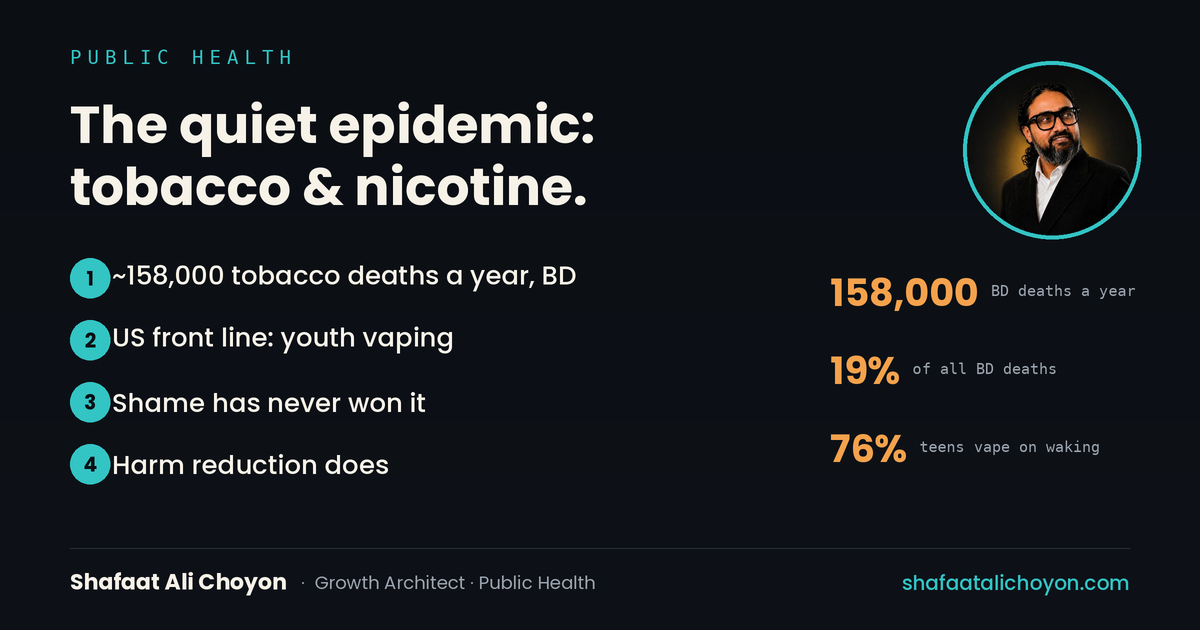
In Bangladesh, tobacco is a mass killer hiding in plain sight: smoking prevalence among men runs near 32% (by some measures far higher), and tobacco causes on the order of 158,000 deaths a year — roughly 19% of all deaths in the country. It's combustible, cheap, and culturally entrenched. In the US, the front line has moved to nicotine's newer form: youth vaping. Even as overall use has fallen since 2022, around 2 million middle- and high-schoolers still use a tobacco product, and among teens who vape, about 76% reach for it within 30 minutes of waking — the signature of real dependence. Different products, same underlying business: hook people young, keep them chemically. It's one epidemic wearing two faces.
Shame has never won this fight
Addiction has its own rule, and tobacco control keeps breaking it: you do not scold people off nicotine. Shame just moves the habit out of sight. Nicotine is a chemical dependency, not a character flaw — which means the exit has to be made easier and less humiliating than the habit, through cessation support and access, not sermons. I've run harm reduction at scale — a year-long campus campaign built on respect rather than lectures — and the asymmetry here is what stands out: the industry spends billions making the product feel normal, so public health has to spend its effort making quitting feel possible. You outspend the shame with support.
The dual-market playbook
The two markets have opposite lessons to trade. Bangladesh needs the demand-side muscle the US built over decades — taxation, cessation support, denormalization, and relentless behavior campaigns that made smoking uncool. The US needs vigilance Bangladesh understands instinctively — that a profitable industry will always find the next product and the next generation, so the fight is never "won," only managed. Both need the same core competence: population-scale behavior change delivered with respect instead of contempt. That's the discipline, and it's the one I've built.
The winnable fight
This is tractable and unglamorous. Cessation delivered by phone and app, nicotine-dependence screening, targeted youth campaigns on the platforms kids actually use, and policy paired with support rather than pure prohibition — all buildable now, in both markets. The quiet epidemic stays quiet precisely because it's boring and hard and moral-panic-adjacent. Treat it instead as a behavior-design problem, and it becomes one of the highest-impact, most winnable fights in public health.
The short version
- Tobacco kills ~158,000 a year in Bangladesh (~19% of deaths); the US front line has moved to youth nicotine and vaping.
- Same addiction economy, two faces: hook people young, keep them chemically dependent.
- Shaming never wins it — harm reduction does, the exact playbook behind my year-long campus campaign.
- The markets can trade lessons; both need respectful, population-scale behavior change — a winnable, under-fought battle.
Where is your field still trying to shame people into changing — when meeting them with respect and an easier exit would actually work?
Md Shafaat Ali Choyon (MPH, CHES®, MBA, MCIM) is a growth, marketing and public-health strategist who builds and runs AI in production, with 16+ years across telecom, fintech, e-commerce, consumer tech and healthcare in the US and Bangladesh. See the essays or the portfolio.