A measles outbreak in 2026 America is not a story about a missing vaccine. The vaccine has existed, cheaply, for sixty years. It's a story about trust — and it's one I've spent a career on, in campaigns on two continents, not in op-eds.
The numbers that should stop us
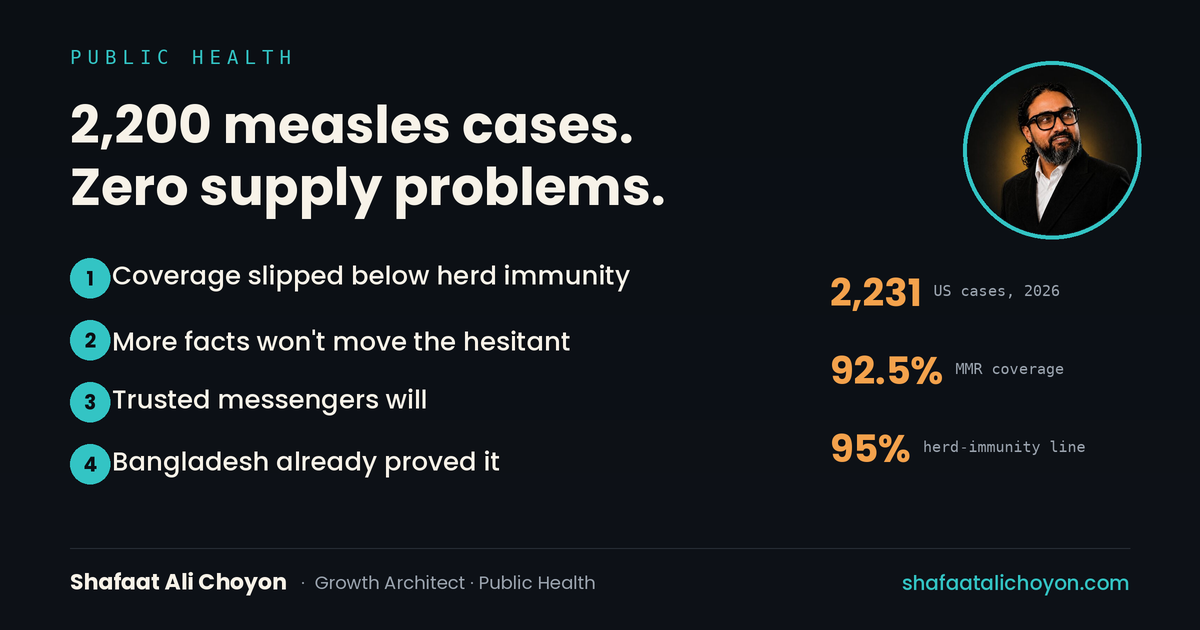
By early July 2026 the US had confirmed more than 2,200 measles cases, on track to blow past the 2025 total. The reason isn't supply. Kindergarten MMR coverage has slipped to about 92.5%, under the roughly 95% needed for herd immunity, and the overwhelming majority of cases are in the unvaccinated. When enough people opt out, a disease we had nearly eliminated comes back — not because we ran out of doses, but because we ran out of trust.
Facts don't change the hesitant
Sixteen years of building health campaigns taught me something most vaccine debates ignore: a hesitant parent has usually already heard the facts. Repeating them louder reads as contempt, and contempt hardens people. What actually moves someone is who is saying it, in a place they already are, in a tone that treats them as reasonable. Treat hesitancy as an information deficit and you lose. Treat it as a relationship and you have a chance.
I've built the alternative — twice
Two of my own campaigns ran on exactly this principle. In Bangladesh, we printed a health hotline on the packaging of the market-leading soap and put it in millions of homes; doctors on the line took roughly 3,000 calls a day. That reach didn't come from a better argument — it came from delivering trusted help through an object already in people's hands. On a US campus, I ran a year-long harm-reduction campaign on alcohol and cannabis where a finger-wagging tone would have backfired instantly; we segmented the audience, chose messengers and channels they respected, and kept them engaged long enough for the message to land. For my MPH capstone I locked the measurement up front and documented a repeatable ~3× reach. None of it was about having better facts. It was about earning enough trust to be heard.
What Bangladesh already figured out
Here's the dual-market twist that should make policymakers uncomfortable. Bangladesh — poorer, denser, far harder to reach — runs one of the most respected immunization programs in the world, with coverage sustained well above 90% for years. The engine isn't slicker advertising; it's an army of community health workers who live in the neighborhoods they serve, backed by mothers' groups and local leaders. Trust gets built face to face first; vaccination follows. A country the US often frames as "behind" solved the exact problem the US is now failing.
The fix is a communication strategy
Rebuilding coverage looks less like a new drug and more like a campaign I'd actually run: segment the hesitant, meet them on the channels they use, recruit messengers they respect, and drop the shaming tone that only entrenches opposition. That isn't soft work around the edges of public health. It is the intervention — and it's the work I've done, at population scale, before.
The short version
- Measles is surging because coverage fell below herd immunity — a trust failure, not a supply one.
- More facts don't move hesitancy; trusted messengers, right channels, and a respectful tone do.
- I've proven it: a ~3,000-calls/day soap-packet hotline, a year-long campus campaign, a ~3× reach capstone.
- Bangladesh sustains 90%+ coverage through community health workers — a model the US could borrow.
If you were rebuilding vaccine confidence in your own community, who is the one messenger people would actually believe — and are we resourcing them?
Md Shafaat Ali Choyon (MPH, CHES®, MBA, MCIM) is a growth, marketing and public-health strategist who builds and runs AI in production, with 16+ years across telecom, fintech, e-commerce, consumer tech and healthcare in the US and Bangladesh. See the essays or the portfolio.