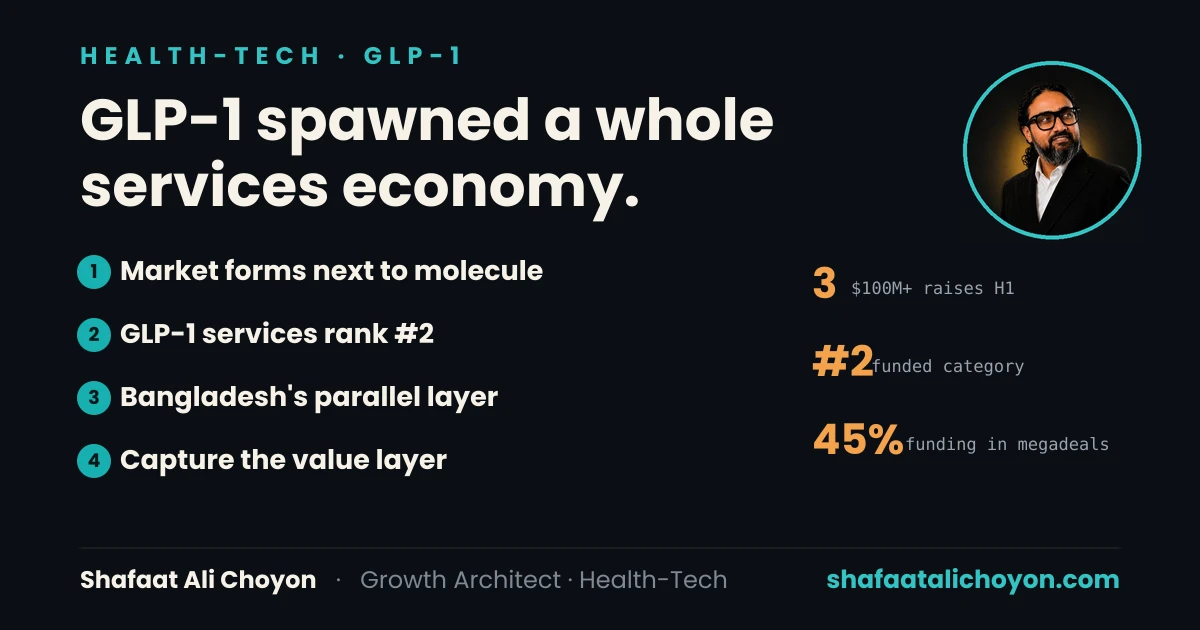
Three separate $1001M-plus raises landed in the same category in the first half of 2026 alone: eMed at $2001M, Nourish at $1001M, Midi at $1001M. None of them manufacture a GLP-1 drug. All three are betting on everything built around the drug, and Rock Health's H1 2026 Funding Overview now ranks GLP-1 and weight management as the second-most-funded clinical category in digital health, trailing only mental health.
A market forming next to the molecule, not inside it
Follow the funding, not the prescription volume, and a different picture of this category appears. This is not the adherence conversation. That conversation, why most people quit GLP-1s, why only around 12%2 of Americans ever start one, is a real and separate problem I've written about elsewhere. This is a different question entirely: who profits from everything orbiting the drug once the drug itself is commoditized. A "peptide economy" is forming around GLP-1s, coaching, monitoring, compounding-adjacent services, and adjacent compound formulations, and it's attracting capital at a pace that has nothing to do with who manufactures the actual injection.
That migration is the actual story investors are underwriting. Manufacturing margin belongs to two or three pharma giants and isn't up for grabs. Services margin, coaching adherence, monitoring outcomes, managing supply, personalizing dosing protocols, is still wide open, fragmented, and nobody has built the category-defining platform yet. That's exactly the kind of gap that draws three $100M rounds in six months, from three different investor syndicates, each betting a different piece of the wrapper becomes the piece that matters most once the category consolidates.
A different market answering the same question: Bangladesh's generic pharma sector
The US services wrapper is one answer to "who captures value once a drug is commoditized." Bangladesh's pharmaceutical industry is quietly building another. Bangladesh manufactures the vast majority of its own medicines domestically and exports generics to well over a hundred countries4, and as GLP-1 patents begin to face pressure and biosimilar pathways open up, that manufacturing base, serving a domestic market of roughly 170 million3 people plus a substantial export footprint, is positioned to do to GLP-1 access what it has already done to countless other drug classes: make a therapy that is prohibitively expensive in the US affordable at population scale elsewhere. That's not the same wrapper eMed, Nourish, and Midi are building. It's a parallel value-capture layer, built on manufacturing and access economics instead of coaching and monitoring, and it deserves the same investor attention the US services story is getting.
The margin lesson from a category I actually fixed
I've seen this exact structural move before, just in a different clinical business. At Praava Health, lab testing ran on a kickback-driven referral model that fixed margin at roughly 30%, the classic trap of a clinical service treating itself as a commodity pass-through instead of building the value layer around the core service. Ending that model and rebuilding the value proposition around it pushed lab margin from 30% to 50%. The clinical test itself barely changed. What changed was who captured the value sitting around it.
That's precisely the bet eMed, Nourish, and Midi are making on GLP-1 in the US, and it's the same bet Bangladesh's generic manufacturers are making on GLP-1 access globally. The drug is the commodity; the value-capture layer is the coaching, monitoring, and personalization wrapped around delivering it well in one market, and the manufacturing and distribution economics that make it reachable at all in another. Whoever builds the sturdiest wrapper, not the sturdiest molecule, takes the disproportionate share of the economics, the same way it played out in lab diagnostics once someone stopped treating the test as interchangeable.
Where this goes next
Mega-deals of $100M-plus now make up 45% of all digital health funding in H1 2026, up from 22% in 2024, capital concentrating into fewer, larger bets across the sector generally, and GLP-1 services are one of the clearest examples of where that concentration is landing. Three companies, three hundred million dollars, one underlying thesis: the services wrapper is worth building even when you don't control the drug.
Watch what happens next in this category, not the adherence rate, that's already a known, slow-moving problem. Watch which of these three, or the next cohort behind them, actually builds a durable services moat versus which one is just riding category heat with capital that arrived faster than the operating model did. A raise proves investor conviction. It doesn't prove the wrapper is defensible yet, that proof only shows up eighteen months later, in retention numbers and unit economics nobody can see from a funding headline.
The short version
- Three $100M+ raises hit GLP-1 services in H1 2026 alone, eMed, Nourish, and Midi, none of them make the drug.
- GLP-1 is now the #2 most-funded digital health clinical category, behind only mental health.
- Bangladesh's generic pharma sector, serving ~170 million people domestically plus major export markets, is a parallel value-capture layer built on manufacturing access, not coaching.
- Praava Health's lab margin move, 30% to 50%, is the same playbook: capture the value layer, not just the commodity.
Who's building the wrapper around your category's commodity, and is it you?
Frequently asked questions
What is the "peptide economy" forming around GLP-1 drugs?
It's the services layer forming next to the drug itself, coaching, monitoring, compounding-adjacent services, and adjacent compound formulations, rather than manufacturing. Three separate $100M-plus raises landed in this category in H1 2026 alone: eMed at $200M, Nourish at $100M, and Midi at $100M.
How does Bangladesh fit into the GLP-1 story?
Bangladesh's pharmaceutical industry manufactures the vast majority of its own medicines domestically and exports generics to well over a hundred countries. As GLP-1 patents face pressure and biosimilar pathways open up, that manufacturing base, serving roughly 170 million people domestically plus a substantial export footprint, is positioned to make GLP-1 access affordable at population scale, a parallel value-capture layer built on manufacturing rather than coaching.
Why does the Praava Health lab margin example matter here?
At Praava Health, lab testing ran on a kickback-driven referral model fixed at roughly 30% margin, the classic trap of treating a clinical service as a commodity pass-through. Ending that model and rebuilding the value proposition around it pushed margin from 30% to 50%, the same structural move eMed, Nourish, and Midi are betting on with GLP-1: the value layer around a commodity usually captures the margin, not the commodity itself.
Sources
- Rock Health. rockhealth.com ↗
- KFF. kff.org ↗
- World Bank. data.worldbank.org ↗
- Government of Bangladesh (investbangladesh.gov.bd). investbangladesh.gov.bd ↗
Md Shafaat Ali Choyon (MPH, CHES®, MBA, MCIM) is a growth, marketing and public-health strategist who builds and runs AI in production, with 17 years across telecom, fintech, e-commerce, consumer tech and healthcare in the US and Bangladesh. See the essays or the portfolio.