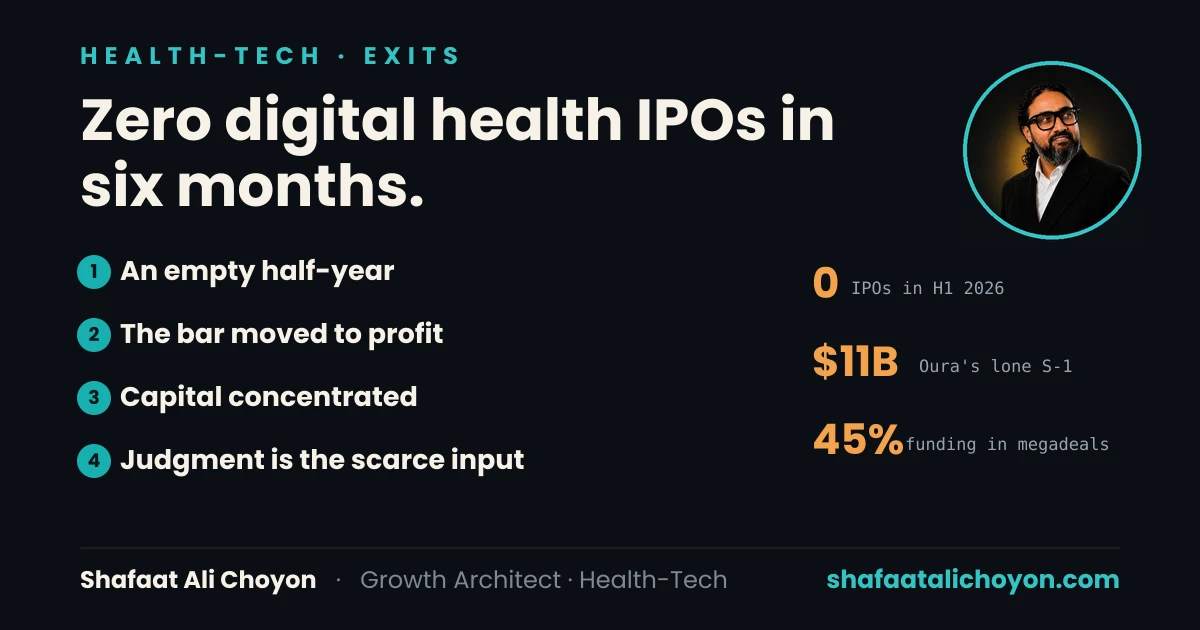
Six months. Zero digital health IPOs. Not a slow quarter, a completely empty one, across the entire first half of 20261, according to Rock Health's H1 2026 Funding and Market Overview. The one S-1 that showed up in the sector belonged to Oura, filing at an $112B valuation. Everyone else stayed private, and staying private stopped looking optional.
The bar moved, and it moved to profit
Hinge Health's stock doubled after it went public3, and it didn't double because it told a good growth story. It doubled because it cleared the "Rule of 404", growth rate plus profit margin adding up to at least 40, a benchmark investors have used for SaaS for years and are now applying to digital health with the same discipline. A company hitting Rule of 40 gets rewarded twice: once for growing, once for proving the growth doesn't require burning cash to sustain it. That's a different company than the one investors funded in 2019 through 2021, when growth alone was the entire pitch.
Meanwhile GoHealth and Vicarious Surgical got delisted5 in the same stretch. Two very different businesses, one shared outcome: public markets stopped extending patience to companies that couldn't demonstrate the math working, regardless of the mission behind the product or how compelling the original raise once sounded to the room that funded it. A delisting and a doubled valuation happening in the same six months, in the same sector, is the clearest signal the market can send that the criteria changed underneath every company at once, whether they'd updated their pitch deck to reflect it or not.
Where the money actually went instead
The IPO freeze didn't mean funding dried up, it moved. Mega-deals of $1001M or more captured 45% of all H1 2026 digital health funding, up from just 22% in 2024. 8%1 of deals now account for nearly half the money raised in the entire sector. Capital didn't leave digital health. It concentrated into fewer, larger bets on companies investors already believe can clear the Rule of 40 bar before they ever have to file an S-1, the exit thesis got underwritten years earlier than the exit itself.
This mirrors something I watched happen inside a category I helped take from nowhere to the #1 position within 2.5 months: a used-motorbike marketplace, competing against incumbents who had a head start measured in years, not months. The category didn't reward the company that raised the most noise first. It rewarded the one that could show unit economics working at scale fast enough to earn the next round of confidence before the market's patience ran out, concentration follows proof, not the other way around, and proof has always been scarcer than capital.
Both stories share the same underlying rule: judgment about which few bets to concentrate on is the scarce resource, not the capital or the market opportunity itself. Anyone can chase a hot category. Very few can tell, early, which single company or vertical inside it is actually going to clear the bar the rest of the field can't.
What this means if you're building
If you're a founder in digital health right now, the operating instruction is blunt: Rule of 40 isn't a nice-to-have metric for your board deck anymore, it's the actual admission price to a public exit, and pretending otherwise wastes a fundraising cycle you don't get back. A zero-IPO half-year is the market telling every late-stage company the same thing at once, growth-only stories are done being fundable at scale.
The founders who internalize this now build differently for the next 18 months than the founders who wait for the IPO window to reopen on its own. It won't reopen for the same kind of company that raised through 2021. It'll reopen for the kind that could have profitably self-funded the whole way, and simply chose leverage instead. That's a harder company to build than a growth-only story, and it's exactly why the market is now willing to pay a premium for it, scarcity of the trait, not scarcity of the category, is what's actually being priced.
The short version
- Zero digital health IPOs in H1 2026, Oura's $11B S-1 was the only filing.
- Hinge Health's stock doubled post-IPO specifically for clearing the Rule of 40 profitability benchmark.
- Mega-deals now capture 45% of all funding, up from 22% in 2024, capital is concentrating, not disappearing.
- The new bar for a public exit: growth + profit margin ≥ 40, not growth alone.
If your growth story doesn't clear Rule of 40 today, what's your plan for the next 18 months?
Frequently asked questions
What happened to digital health IPOs in H1 2026?
Zero digital health IPOs landed across the entire first half of 2026, according to Rock Health's H1 2026 Funding and Market Overview. The one S-1 in the sector belonged to Oura, filing at an $11B valuation; everyone else stayed private.
Why did Hinge Health's stock double after going public while others got delisted?
Hinge Health cleared the "Rule of 40", growth rate plus profit margin adding up to at least 40, a SaaS benchmark now applied to digital health with the same discipline. In the same stretch, GoHealth and Vicarious Surgical got delisted, because public markets stopped extending patience to companies that couldn't demonstrate the math working.
If the IPO window is effectively closed, where is funding going instead?
It concentrated rather than disappeared. Mega-deals of $100M or more captured 45% of all H1 2026 digital health funding, up from just 22% in 2024, with 8% of deals now accounting for nearly half the money raised in the sector, funneled into companies investors already believe can clear the Rule of 40 bar.
Sources
- Rock Health. rockhealth.com ↗
- CNBC / TechCrunch. cnbc.com ↗
- IPO Bonanza / CNBC. ipobonanza.com ↗
- Hinge Health Investor Relations. ir.hingehealth.com ↗
- BusinessWire / Nasdaq / NYSE filings. businesswire.com ↗
Md Shafaat Ali Choyon (MPH, CHES®, MBA, MCIM) is a growth, marketing and public-health strategist who builds and runs AI in production, with 17 years across telecom, fintech, e-commerce, consumer tech and healthcare in the US and Bangladesh. See the essays or the portfolio.