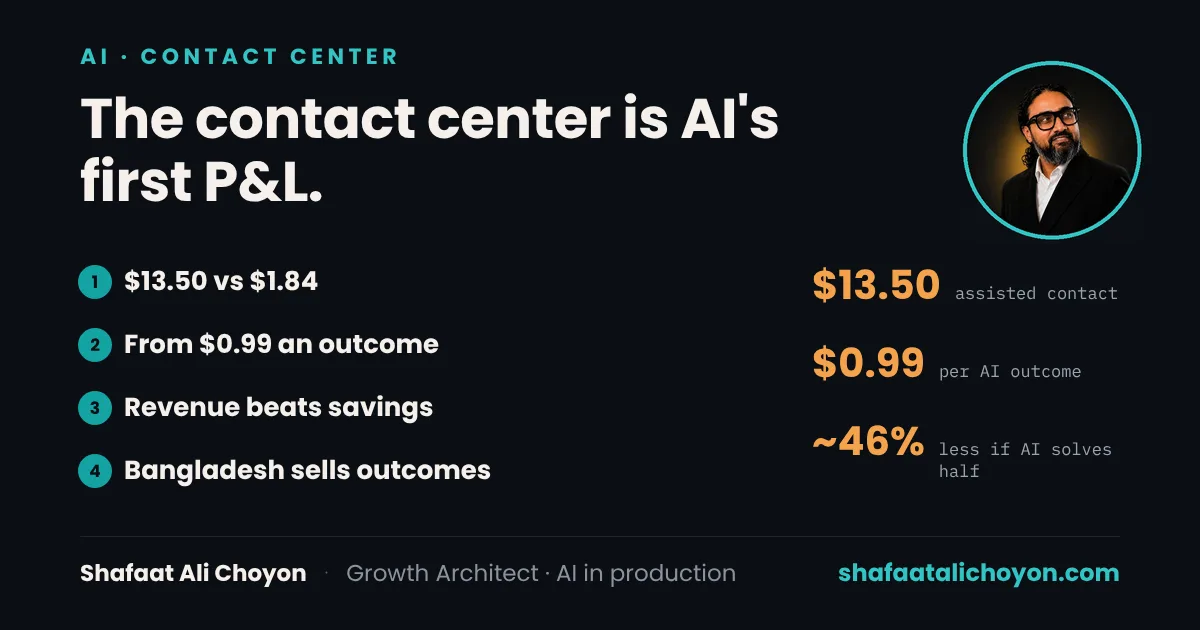
Most AI projects argue about productivity in vague words. The contact center does not have to. It already knows its unit cost. Gartner's benchmark puts the median cost of a self-service contact at $1.841 and an assisted one, by phone, chat or email, at $13.501. Now AI agents are sold by the result: Intercom lists its Fin agent from $0.992 per outcome. When you can price a unit of work on both sides, you have a profit and loss statement, not a pilot. That is why the contact center is where AI first shows up as a line on the books.
Why the contact center gets an AI P&L first
In the call-center cliff I wrote about what AI voice agents do to the jobs. This is the follow-up about the money, because the money has become easy to see.
Most functions cannot price a unit of their own work. Marketing argues about attribution. Legal bills by the hour. The contact center counts everything: volume, handle time, cost per contact, repeat contacts. My first job was in customer service, for about 80,000 customers, and the first numbers anyone taught me were calls per hour and cost per call. That habit is why this function is ready for AI before almost any other. The denominator already exists.
Per-outcome pricing finishes the job. If a vendor bills only when the agent resolves something, the finance team can compare two prices for the same unit. That comparison is the whole business case.
How much does an AI agent cost compared with a human agent?
Take a line the size of the Lifebuoy hotline we set up at Praava Health, about 3,000 calls a day, or roughly 90,000 a month. At Gartner's US median of $13.50, that is about $1.2 million a month. Now say an AI agent fully resolves half of those contacts at $0.99 each. You pay about $45,000 for the AI half and about $608,000 for the human half. The month costs roughly 46% less.
That is the headline. The fine print matters more:
- The calls left for people get harder. The AI takes the simple ones, so each human call gets longer. Expect your cost per human contact to rise even as the total falls.
- "Resolved" needs a definition you control. A contact the agent closes but the customer calls back about is not resolved. Count repeat contacts within a week.
- Containment is the whole game. At 20% resolution the savings shrink fast. The rate, not the price, decides the business case.
In health, the bigger line is revenue
Here is the insight I would put in front of a hospital board. In most industries the contact center is a cost center, so AI is a cost story. In health care, the phone line is where patients get scheduled, reminded and rescheduled, so AI is also a revenue story.
In September, the patient access company DexCare bought Mila Health, whose AI agents call, text and chat with patients to schedule them. Mila reports a 54%3 response rate on outbound outreach, which it calls an 80% improvement on standard manual call-center benchmarks, and says its reminders and rescheduling cut clinic no-show rates in half. These are vendor figures, with no published baseline, so treat them as a claim to test. But even half of that effect is worth more than any saving on handle time. An empty appointment slot is paid-for capacity thrown away.
At Praava, I never thought of the hotline as a cost line. It was a front door. When people get a trusted answer quickly, they come in. That is the line a health system should measure its AI against: kept appointments, not deflected calls.
Bangladesh's call centers are earning more, not less
Now the flip, from Bangladesh. You would expect a country that sells contact-center labor to the world to be losing to AI. Some firms are. The Daily Star reported that one outsourcing firm, ASL BPO, went from more than 250 staff in mid-2023 to 150, and that one AI customer-service company, Mevrik, handles nearly 100,0005 repetitive queries a day for a single client, work that would otherwise need hundreds of agents.
Yet the sector's earnings are rising. The industry body BACCO said outsourcing earnings reached $900 million4 in the first half of 2025, above the $850 million earned in all of 2024. Its president said AI was helping close the skill gap and that work orders had grown. The sector employs somewhere between 80,000 and 90,000 people, depending on which BACCO figure you read.
The lesson for US buyers is hiding in that split. Firms that sell seats shrink when AI arrives. Firms that sell outcomes, and use AI to deliver more of them, grow. A US health system should run its own contact center the same way: stop budgeting by headcount and start budgeting by resolved contacts and kept appointments.
Build the P&L before you buy the agent
If I were building this for a health system or a large clinic group, I would do five things before signing any vendor contract:
- Price today's contact honestly. Use fully loaded cost: salary, benefits, software, supervision and turnover. The last two are the easiest to forget.
- Sort contacts by intent. Scheduling, reminders, directions, "are my results in", billing questions. Automate the repeatable ones first and leave clinical judgment with people.
- Buy outcomes, defined your way. Pay per resolved contact, with "resolved" meaning no repeat contact within seven days.
- Re-staff for the hard calls. Fewer people, longer calls, more skill. My free AI agent vs human cost calculator shows the savings at your containment rate, and the hotline staffing calculator sizes the human team for what is left.
- Measure the revenue line. Track no-shows, kept appointments and repeat visits before and after. If the AI does not move those, the savings on handle time are the smaller prize.
The short version
- Gartner's median contact costs $1.84 in self-service and $13.50 assisted, and AI agents now sell from $0.99 an outcome.
- The contact center gets an AI P&L first because it already prices its own unit of work.
- Containment decides the case: resolve half at those prices and a 90,000-call month costs about 46% less, before the harder calls get longer.
- In health, the bigger prize is revenue: one AI scheduling vendor reports halving no-shows, a claim worth testing.
- Bangladesh's outsourcing earnings rose to $900 million in six months while some seat-based firms shrank. Sell, and buy, outcomes.
If your call center billed you per kept appointment instead of per agent, what would you change first?
Frequently asked questions
What does a customer service contact cost?
Gartner's benchmark puts the median cost per contact at $1.84 for self-service and $13.50 for assisted channels such as phone, chat and email. AI agents are now priced by result, for example from $0.99 per outcome for Intercom's Fin agent.
Can AI reduce no-shows in health care?
One AI scheduling company, Mila Health, which DexCare acquired in September 2026, reports that its automated reminders and rescheduling cut clinic no-show rates in half, with a 54% response rate on outreach. These are vendor figures without a published baseline, so health systems should test them.
Is AI hurting Bangladesh's call center and outsourcing industry?
It is reshaping it. Some firms have cut staff, such as one that went from more than 250 people to 150. But BACCO reported outsourcing earnings of $900 million in the first half of 2025, above the $850 million earned in all of 2024, and said AI was helping close the skill gap.
Sources
- Gartner, Benchmarks to Assess Your Customer Service Costs (1 February 2024). gartner.com ↗
- Intercom, Pricing (accessed 20 October 2026). intercom.com ↗
- HIT Consultant, DexCare acquires Mila Health for AI care coordination (21 September 2026). hitconsultant.net ↗
- The Business Standard, AI push lifts outsourcing exports near $1b already in first half (22 August 2025). tbsnews.net ↗
- The Daily Star, BPO's next chapter: Survive the AI wave or sink (18 July 2025). thedailystar.net ↗
Md Shafaat Ali Choyon (MPH, CHES®, MBA, MCIM) is a growth, marketing and public-health strategist who builds and runs AI in production, with 17 years across telecom, fintech, e-commerce, consumer tech and healthcare in the US and Bangladesh. See the essays or the portfolio.