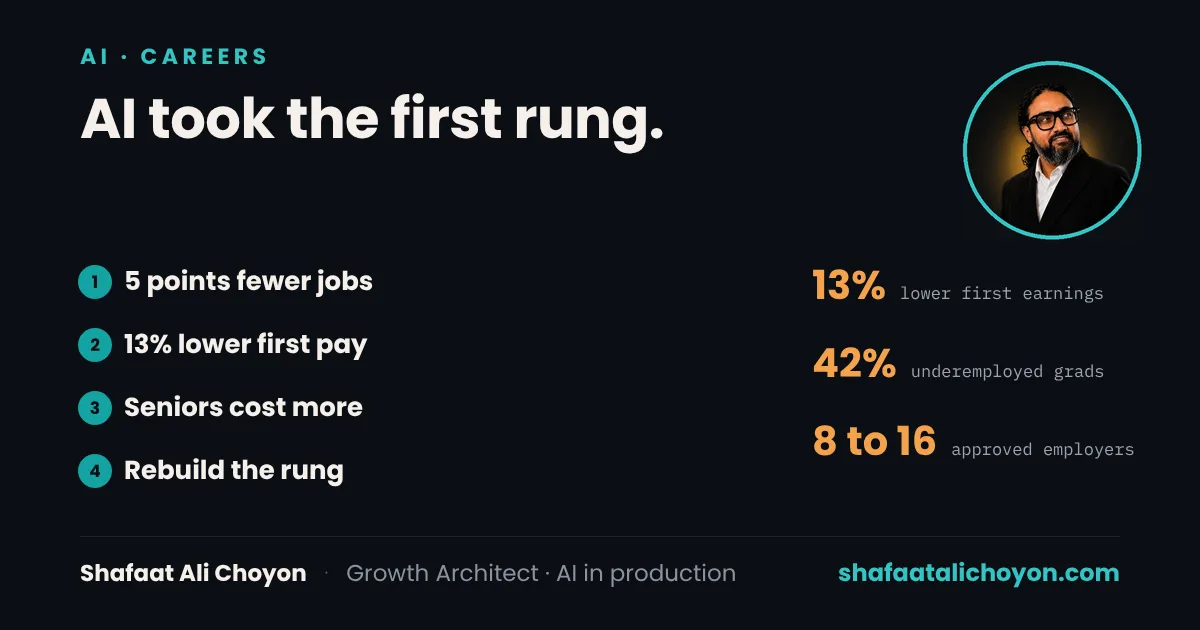
In September 2026, Census Bureau researchers published the clearest evidence yet of what AI is doing to the start of careers. Graduates from the tenth of college majors most exposed to AI became 5 percentage points1 less likely to have a job one quarter after graduating, once ChatGPT arrived. Those who found work earned 13% less in their first full quarter. The authors compare that loss to graduating into a major recession, except there was no recession.
In an earlier essay I asked where the graduate jobs went. The new data answers part of that question and raises a harder one. If AI takes the first rung of the ladder, who trains the people who will run your company in 2036?
Is AI really taking entry-level jobs?
The evidence is now more than anecdote. The Census paper uses administrative records, not surveys, and finds that outcomes for the most AI-exposed majors began to diverge right after ChatGPT's release in late 2022. About half of the earnings loss came from lower pay inside the same industries. The other half came from graduates moving into lower-wage work, mainly restaurants and retail. The gaps narrow over time but stay large for the most exposed majors.
An earlier Census paper found the mechanism: firms in the most AI-exposed industries did not fire young workers so much as stop hiring them2. The wider market tells the same story. The New York Fed puts unemployment for graduates aged 22 to 27 at about 5.6%, and underemployment, graduates in jobs that do not need a degree, at 42%3 in the second quarter of 2026.
These are working papers, and AI is not the only force at play. But the direction is consistent, and it is the direction a builder should plan for.
The first rung was where the training happened
I started my career in customer service, handling about 80,000 customers. Nobody would call that strategy work. But it is where I learned how customers actually think, what makes them angry, and what makes them stay. Every growth role I held after that, in telecom, e-commerce and health care, drew on it.
That is the kind of work AI now does first: answering routine questions, drafting first versions, sorting cases. I build and run agentic AI in production, and I would make the same automation call. The work gets done faster and cheaper, and often well. The mistake is assuming the training that came with it was free and will appear on its own.
It will not. The bill arrives later, when you need a manager and have no one ready. Wharton research on one US investment bank found that external hires were paid about 18% to 20%4 more than people promoted from within, got lower performance ratings for their first two years, and were more likely to leave. Cut the junior hire today and you buy the senior hire later, at a premium, with worse odds.
Bangladesh has lived without a first rung for years
Bangladesh did not need AI to break the entry level. In 2024, 8.85 lakh5 of the country's 26.24 lakh unemployed people were university graduates, about one in three, according to the national Labour Force Survey. Among unemployed young people, about 36% relied mainly on relatives and friends to find work. When the formal ladder is missing, the network becomes the ladder, and people without one stay stuck.
What I saw work in Bangladesh was employers deciding to build the rung themselves. At ACCA, part of my job was growing the number of approved employers, firms recognized for meeting a set standard in training and developing their finance staff. We doubled them from 8 to 16. Each one was a company choosing to own its talent pipeline rather than hope the market would supply it.
That is the flip. The US is now meeting a problem Bangladesh has managed for a decade: plenty of graduates and too few first jobs. The answer there was never to wait for the market. It was for employers to treat training as part of the job design.
How to rebuild the rung with AI, not against it
AI does not have to delete the entry-level job. It can change what the job teaches. In my own work, the work AI leaves behind is checking, judging and knowing the customer. Those are exactly the skills a junior needs to learn, and they now learn them faster, because the first draft is already done.
If I were redesigning a team's entry level this quarter, I would do five things:
- Redesign the junior role, do not delete it. Make the junior the person who reviews, corrects and signs off on AI output, with a senior checking their calls.
- Hire fewer, train harder. A smaller cohort on a structured 12-month rotation beats a large one left alone with a chatbot.
- Put the customer in the first year. Every junior should handle real customer contact early, even if AI handles most of it, because that is where judgment starts.
- Count the bench. Track how many roles you fill by internal promotion each year. If that number falls, the cut is coming due.
- Price the alternative honestly. My free staff turnover cost calculator shows what replacing people costs, which is the number to compare against a junior salary.
The short version
- Graduates of the most AI-exposed majors became 5 points less likely to be employed soon after graduating, and earned 13% less in their first full quarter, per Census research.
- Recent-graduate underemployment hit 42% in the second quarter of 2026, according to the New York Fed.
- External hires cost more and perform worse at first: about 18% to 20% higher pay and lower ratings for two years in Wharton research.
- Bangladesh shows the long version: about one in three unemployed people in 2024 was a university graduate, and the answer there has been employers building their own training rungs.
- Rebuild the rung with AI: juniors who review and correct AI output learn judgment faster than the old entry level ever taught it.
If every entry-level task on your team were automated tomorrow, where would your next manager learn the job?
Frequently asked questions
Is AI reducing jobs for new college graduates?
Census Bureau research published in September 2026 found that graduates of the most AI-exposed majors became 5 percentage points less likely to have a job one quarter after graduating after ChatGPT's release, and earned 13% less in their first full quarter.
What is the underemployment rate for recent college graduates?
The New York Fed puts underemployment for graduates aged 22 to 27 at 42% in the second quarter of 2026, meaning they work in jobs that do not need a degree. Their unemployment rate was about 5.6%.
How many university graduates are unemployed in Bangladesh?
According to the national Labour Force Survey, 8.85 lakh of Bangladesh's 26.24 lakh unemployed people in 2024 were university graduates, about one in three.
Sources
- US Census Bureau, Graduating into Disruption: Labor Market Outcomes for AI-Exposed College Majors, CES-WP-26-56 (9 Sep 2026). census.gov ↗
- Fortune, AI, ChatGPT and college majors: graduates pushed into retail jobs (17 Sep 2026). fortune.com ↗
- Federal Reserve Bank of New York, The Labor Market for Recent College Graduates (2026 Q2). newyorkfed.org ↗
- Knowledge at Wharton, Why External Hires Get Paid More, and Perform Worse, Than Internal Staff (28 Mar 2012). knowledge.wharton.upenn.edu ↗
- The Daily Star, One in three graduates remains jobless for up to 2yrs (28 Sep 2025). thedailystar.net ↗
Md Shafaat Ali Choyon (MPH, CHES®, MBA, MCIM) is a growth, marketing and public-health strategist who builds and runs AI in production, with 17 years across telecom, fintech, e-commerce, consumer tech and healthcare in the US and Bangladesh. See the essays or the portfolio.