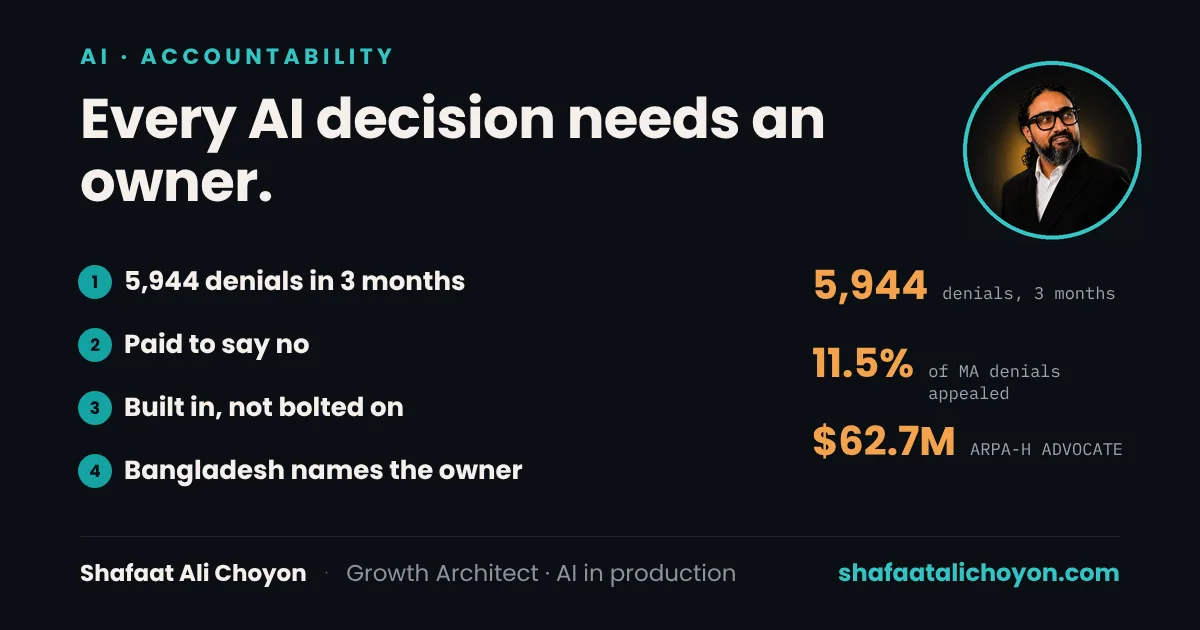
In its first three months, Medicare's AI prior authorization pilot let two private vendors deny 5,9441 requests for care. One request went unanswered for 83 days1. In the same year, another arm of the same government committed $62.7 million to build autonomous AI agents for heart failure patients. Both projects put an algorithm in front of a patient. Only one of them answered the question every operator should ask first: when the agent decides, who owns the decision?
What went wrong with Medicare's AI prior authorization pilot?
The pilot is called WISeR. It started in January 2026 in six states: New Jersey, Ohio, Oklahoma, Texas, Arizona and Washington2. Private vendors use AI to review prior authorization requests for 13 services in its first year, things like pain injections, spinal surgery and nerve treatments.
The Electronic Frontier Foundation sued for the records and released about 1,000 pages in September. They show delays well past the 72 hours CMS promised, one vendor that denied more requests than it approved, and providers describing patients in deep pain while they waited. A month before launch, one vendor wrote that it would go live without full functionality and approve everything automatically until it could catch up.
The records also show how vendors are paid. They earn money for denials, but not for denials that are reversed on appeal. Low quality scores cut that payment by only 5 to 10%. That is not an AI problem. It is an ownership problem. The system pays someone to say no and makes nobody pay for saying no wrongly.
A human in the loop is not an owner
CMS says a qualified clinician reviews every denial. That sounds like accountability, but research cited by the EFF suggests reviewers are swayed by the first answer they see. A human who signs off on an AI's decision without the time or the authority to overturn it is a rubber stamp.
Appeals are not a fix either. Across Medicare Advantage in 2024, insurers handled nearly 53 million4 prior authorization requests and denied 4.1 million4. Just 11.5%4 of denials were appealed, and 80.7%4 of appeals overturned the denial. Read those two numbers together. Most wrong denials are never challenged, because the cost of the challenge sits with a sick patient, not with the system that made the call.
Accountability can be designed in before launch
ARPA-H's program, called ADVOCATE3, shows the other path. Announced on 9 September 2026, it runs four years and $62.7 million to build an agent that supports heart failure patients between visits and escalates to their care team. Look at what is wired in from day one:
- A rule gate. One team uses clinician-built rules to check every proposed action against approved protocols before it runs.
- A supervisor. Stanford is building a second AI that watches the first after deployment, flags unsafe advice and writes a reason for each claim it checks.
- An outside referee. Johns Hopkins Applied Physics Laboratory evaluates performance and clinical outcomes independently.
- A regulator at the table. The first teams must submit an FDA authorization package within 24 months of contract award3.
Same government, same year, same kind of technology. The difference is that ADVOCATE treats accountability as part of the product, while WISeR bolted it on as a review step and an appeal form.
Bangladesh wrote the owner into its policy draft
In January 2026, Bangladesh published a draft National AI Policy for consultation. It sorts AI into four risk tiers and puts healthcare in the high-risk group. It says life-altering clinical decisions will remain with certified medical professionals, and it introduces strict liability5 for high-risk AI, so the deployer answers for harm whatever it intended. An independent oversight committee would audit systems for bias. The policy is still being formulated6, but the instinct is right, and it is the part the US debate keeps skipping. America argues about whether a human looked at the decision. The Bangladesh draft asks who pays when it is wrong.
I learned why that matters at national scale. At SureCash we delivered a government stipend to about 10 million beneficiaries on mobile money. At that size, every automated rule touches thousands of families, and a payment that fails without a named owner simply disappears into a queue. Scale does not forgive vague ownership. It multiplies it.
The operator's rule: an owner and a trail for every decision
If you are putting an agent into a workflow that touches care, money or eligibility, here is the checklist I would run before it goes live. My free AI use-case risk triage scores where your use case sits and which controls it needs.
- Name one owner per decision type. A person with the authority to overturn the agent and the time to do it, not a committee.
- Log the why, not just the what. Inputs, the rule or model version, the output and the human action, kept long enough to audit.
- Pay for right answers. If a vendor earns more for denials, measure and penalize the denials that get overturned.
- Gate irreversible actions. Anything that blocks care or moves money waits for a check the agent cannot skip.
- Make the challenge cheap. If only about one in nine denials gets appealed, the burden is in the wrong place. Review a random sample yourself.
When we digitized operations at Laser Treat with ERP and BI, the gains, about $0.5M lower operating cost and better patient retention, came from finally seeing every step and who owned it. Agents need the same visibility. I made a related case about running AI in production in Verification is the real product.
The short version
- Two WISeR vendors denied 5,944 Medicare requests in three months, and one request waited 83 days for an answer.
- Vendors are paid for denials but not for denials reversed on appeal, so the incentive points the wrong way.
- Appeals do not fix it: in Medicare Advantage only 11.5% of denials were appealed, and 80.7% of those were overturned.
- ARPA-H's $62.7 million ADVOCATE program builds accountability in, with a rule gate, a supervisor agent and an outside evaluator.
- Bangladesh's draft AI policy names the owner: clinicians keep life-altering decisions and deployers carry strict liability.
If your AI agent made a wrong call tomorrow, could you name the person who owns it within one minute?
Frequently asked questions
What is the WISeR model?
WISeR is a Medicare pilot that started in January 2026 in six states: New Jersey, Ohio, Oklahoma, Texas, Arizona and Washington. Private vendors use AI to review prior authorization requests for 13 services1 in its first year. Records released by the Electronic Frontier Foundation show two vendors denied 5,944 requests in the first three months.
What is ARPA-H's ADVOCATE program?
ADVOCATE is a four-year, $62.7 million ARPA-H program announced on 9 September 2026 to build an AI agent that supports heart failure patients between visits and escalates to their care team. It includes clinician-built rules that check each action before it runs, a supervisory AI from Stanford and independent evaluation by Johns Hopkins Applied Physics Laboratory.
Who is responsible when an AI system makes a healthcare decision?
There is no single answer in US law yet. In Medicare's WISeR pilot, a clinician must review every denial, and patients can appeal. Bangladesh's draft National AI Policy goes further: it keeps life-altering clinical decisions with certified medical professionals and puts strict liability on those who deploy high-risk AI.
Sources
- Electronic Frontier Foundation, New Records Reveal Problems with Medicare's AI Prior Authorization Experiment (8 September 2026). eff.org ↗
- Medicare Rights Center, New records show Medicare WISeR AI prior authorization model causing inappropriate denials of care (24 September 2026). medicarerights.org ↗
- ARPA-H, ARPA-H launches the world's first bid to build an FDA-authorized clinical AI for cardiovascular care (9 September 2026). arpa-h.gov ↗
- KFF, Medicare Advantage Insurers Made Nearly 53 Million Prior Authorization Determinations in 2024 (2026). kff.org ↗
- The Daily Star, Draft AI policy targets innovation, better public services (26 January 2026). thedailystar.net ↗
- The Business Standard, Bangladesh drafting human-centric national AI policy: Minister (18 July 2026). tbsnews.net ↗
Md Shafaat Ali Choyon (MPH, CHES®, MBA, MCIM) is a growth, marketing and public-health strategist who builds and runs AI in production, with 17 years across telecom, fintech, e-commerce, consumer tech and healthcare in the US and Bangladesh. See the essays or the portfolio.