The clearest place to watch AI meet real jobs isn't a think-piece — it's a call center. Voice agents are now good enough to handle a large share of routine customer contact, and an entire global industry is built on exactly that routine. This is where the abstract "AI will change work" argument becomes concrete, with real people and real livelihoods on the line. I want to look at it honestly, and as a builder — not to cheer the disruption or deny it.
Bangladesh built a real industry on this work
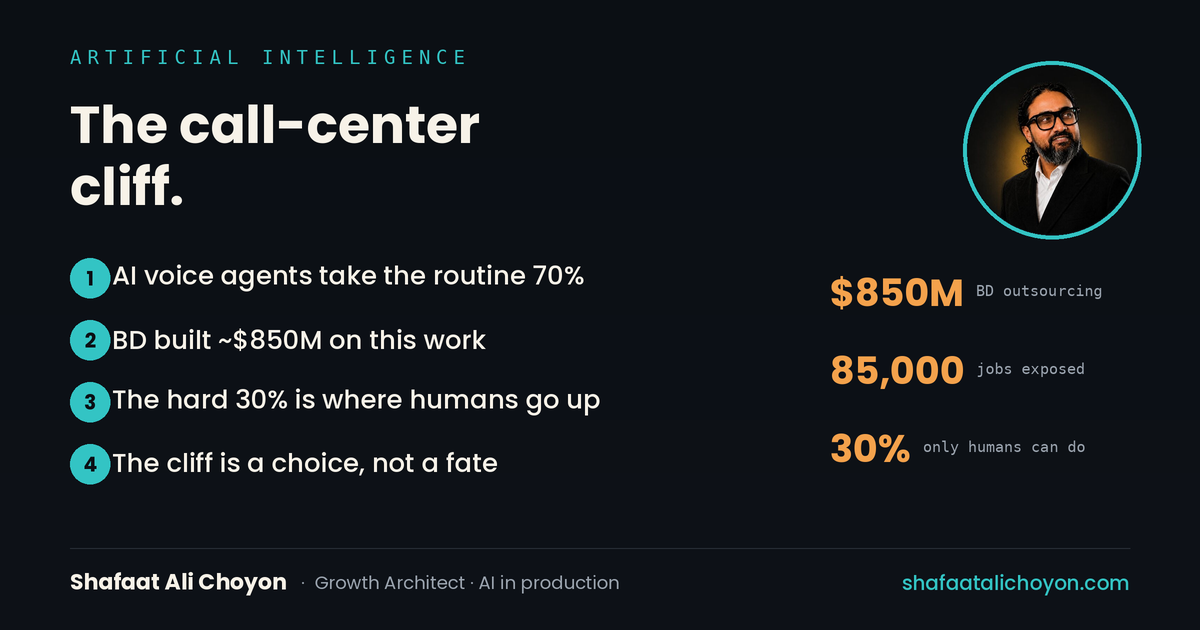
For Bangladesh, this is not academic. The country has grown an IT-enabled-services and outsourcing sector worth around $2.1 billion, with the contact-center and outsourcing industry alone near $850 million and roughly 85,000 jobs, and a national goal of $5 billion and 300,000 jobs by 2030. A lot of that rests on voice and back-office tasks that AI agents can increasingly do. Pretending otherwise helps no one. The tier of work that was a first rung onto the digital economy for tens of thousands of young people is exactly the tier most exposed.
But "the cliff" is a choice, not a fate
Here's where I refuse the doom framing. AI voice agents are genuinely good at the scripted, repetitive 70% of contacts. They are not good at the hard 30% — the emotional call, the ambiguous complaint, the judgment call, the moment a human voice is the whole point. The move isn't mass unemployment; it's a shift in what the job *is*. The routine tier shrinks; the roles that grow are supervision, escalation, quality, empathy, and building and steering the agents themselves. That's not a smaller industry — it's a higher one, if the workforce is moved up in time.
I've watched this movie before, on the other side
Every technology I've worked near did this. Mobile money didn't eliminate financial work; it moved millions of people from cash-handling into a digital economy that needed new skills — I helped bring roughly 10 million onto those rails at SureCash. Agentic AI did the same to my own work: my throughput jumped about 10×, and the scarce thing became judgment and taste, not typing. The pattern repeats — production gets automated, and the value migrates to the parts machines can't do. The danger isn't the technology. It's being too slow to move people to the new rung.
The builder-optimist's call
For Bangladesh specifically, this is an urgent, winnable race: reskill the outsourcing workforce toward AI supervision, prompt and workflow design, quality assurance, and the human-judgment tier — and the country keeps climbing the value chain instead of falling off it. The same is true for US call-center workers. The optimistic path is real, but it isn't automatic; it has to be built, deliberately and fast. The question worth arguing isn't "will AI take the calls?" It's "are we moving people up quickly enough to meet it?"
The short version
- AI voice agents can now handle the routine bulk of customer contact — the exact work a huge outsourcing industry is built on.
- Bangladesh has ~$850M and ~85,000 jobs riding on this tier, aiming for $5B and 300,000 by 2030; the exposure is real.
- The "cliff" is a choice: the hard 30% (judgment, empathy, escalation, building the agents) is where humans move up.
- Every tech I've worked near did this — value migrates to what machines can't do; the risk is moving people too slowly.
In your industry, what's the routine tier AI will absorb — and are you actively moving people to the higher rung, or just waiting for the cliff?
Md Shafaat Ali Choyon (MPH, CHES®, MBA, MCIM) is a growth, marketing and public-health strategist who builds and runs AI in production, with 16+ years across telecom, fintech, e-commerce, consumer tech and healthcare in the US and Bangladesh. See the essays or the portfolio.