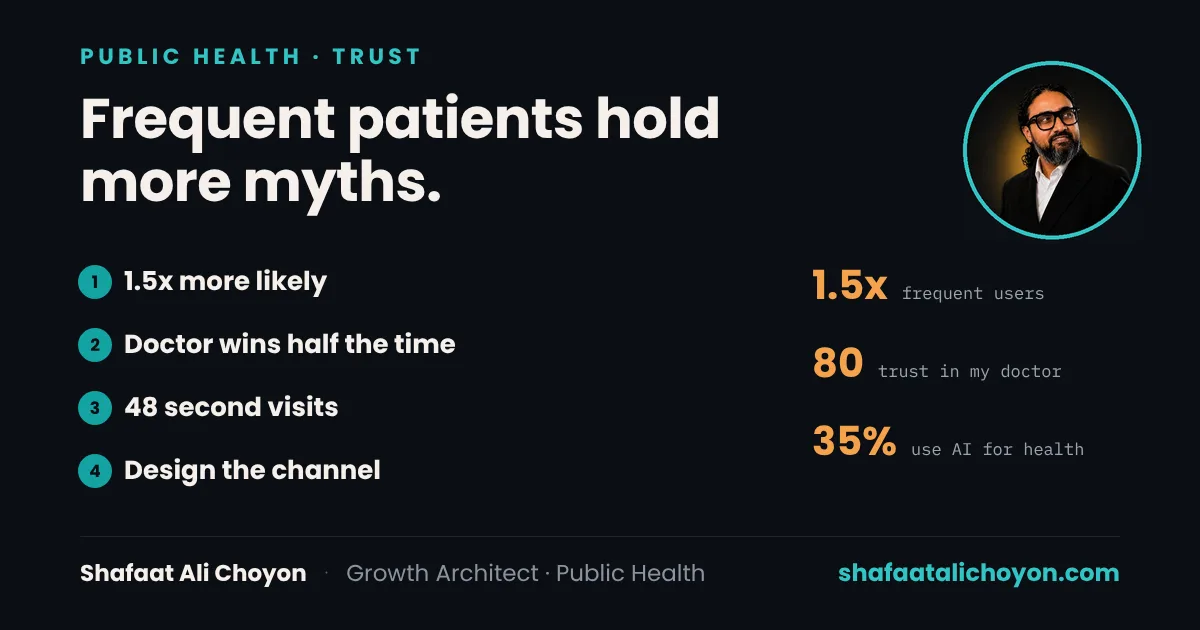
The people who see the health system most often are not the best informed. In a 2026 analysis with the Yale School of Public Health, Edelman found that people with frequent contact with the health system in recent years were over 1.5 times1 as likely as people with little or no contact to hold three or more divisive health beliefs. These are the patients in the waiting room every month. They trust their doctor more than anyone else, and they still leave with myths intact.
That is not a failure of trust. It is a failure of design. The clinic is the most trusted media channel most people will ever walk into, and it is run as if its only job is the visit.
Why do frequent patients believe more health myths?
The survey does not say why, and I will not pretend it does. But its other numbers point to an answer. Edelman surveyed more than 16,000 people across 16 countries in February and March 2026. Across nine of those markets, confidence in finding reliable health answers fell from 61% to 51%3 in a single year. Among people holding three or more divisive beliefs, half regularly take part in a group or community where health information is shared. And 35%2 of people now use AI to manage their health, most of them for immediate answers.
My reading, as someone who has run health services: frequent patients have more questions than any visit can answer. The question starts in the exam room and gets answered later, at 11 at night, by a group chat, a video or a chatbot. Interestingly, people holding more divisive beliefs are also more likely to rate their own health as good. This is not just a story about sick, desperate people. It is a story about unanswered questions.
The doctor still wins, but only half the time
"My doctor" is the most trusted health voice in all 16 markets, with a trust score of 80, ahead of medical scientists and far ahead of journalists. That is the good news.
The harder number: when a doctor and another source disagree, 51% say they always follow the doctor. Another 34% say it depends, and 15% always follow the other source. Half the waiting room is persuadable, in either direction.
In the US, the trust that remains is local. Trust in national health authorities fell 9 points to 51, and trust in drug and vaccine regulators fell 11 points to 41. Hospitals and local pharmacies both score 74. When national voices lose trust, the clinic and the pharmacy counter become the last broadcast channels people still believe.
Bangladesh shows what happens when the visit is 48 seconds
A review in BMJ Open of primary care visits in 67 countries5 found the average consultation lasted 48 seconds in Bangladesh, the shortest measured4, against more than 20 minutes in the US. Nobody in Bangladesh pretends patient education happens inside the visit. There is no time.
So the providers that win build the message around the visit instead. At Praava Health, where I led marketing and corporate sales, the trust work happened in the lab report, the price list and the phone line. We replaced referral kickbacks with transparent pricing, and lab margins rose from about 30% to 50%. Telling patients the truth about cost turned out to be good business. The Lifebuoy hotline we set up took about 3,000 calls a day, because people had somewhere to take the next question.
Here is the flip. A US clinic has more than 20 times the minutes of a Dhaka clinic, and its most frequent patients still hold more myths. Time is not the fix. A channel for the question that comes after the visit is.
How do you turn a clinic into a channel?
This is health communication work, and the same rules apply as for any campaign. My MPH capstone showed that fixing the measurement up front made a campaign's reach about 3x larger. For a practice, a health system or a pharmacy chain, I would start here:
- Prebunk your top three. Every specialty knows the three myths its patients bring in. Answer them on the wall, in the portal and on the after-visit sheet, before the patient asks.
- Write for a sixth-grade reader. One page, plain words, one action. My free health message readability checker scores the sheet before it is printed.
- Answer the 11 p.m. question. Patients already use AI. Give them a good one: an assistant trained on your own clinical guidance, with a nurse reviewing what it says and a clear route to a human. That beats leaving them to whatever they find.
- Script the front desk and the pharmacy counter. They see patients more often than the doctor does, and patients trust them. Give them the same three answers.
- Measure belief, not handouts. Ask two myth questions at check-in each quarter and track the share who get them right. My free risk communication calculator helps decide how hard to push each message.
Clarity is an intervention, not polish. In a clinic, it is also a channel strategy.
The short version
- Frequent health system users were over 1.5 times as likely to hold three or more divisive health beliefs, according to Edelman and Yale in 2026.
- "My doctor" scores 80 on trust, the top voice in all 16 markets, but only 51% always follow the doctor when sources conflict.
- US trust is now local: national health authorities fell to 51 and regulators to 41, while hospitals and local pharmacies score 74.
- Bangladesh's 48-second visit forced providers to build trust around the visit, through pricing, lab reports and hotlines.
- The fix is design: prebunk the top myths, write plainly, answer the after-visit question, and measure what patients believe.
If your most loyal patients walked out of their next visit with one myth corrected, which one would you choose, and where would they hear it?
Frequently asked questions
Do frequent health care users believe more health misinformation?
Yes, according to a 2026 Edelman analysis with the Yale School of Public Health. People with frequent contact with the health system were over 1.5 times as likely as those with little or no contact to hold three or more divisive health beliefs.
Do patients still trust their doctors?
Yes. "My doctor" is the most trusted health voice in all 16 markets in the 2026 Edelman survey, with a trust score of 80. But when a doctor and another source disagree, only 51% say they always follow the doctor.
How long is a doctor's visit in Bangladesh compared with the US?
A review in BMJ Open of 67 countries found the average primary care consultation lasted 48 seconds in Bangladesh, the shortest measured, compared with more than 20 minutes in the US.
Sources
- Edelman, 2026 Edelman Trust Barometer Special Report with Yale: Trust and Health analysis (2026). edelman.com ↗
- Edelman, 2026 Edelman Trust Barometer Special Report: Trust and Health, full report PDF (Apr 2026). edelman.com ↗
- Fortune, Health misinformation crisis: Edelman Trust Barometer global survey (22 Apr 2026). fortune.com ↗
- BMJ Open blog, Primary care consultations last less than 5 minutes for half the world's population (8 Nov 2017). blogs.bmj.com ↗
- Irving G et al., International variations in primary care physician consultation time: a systematic review of 67 countries, BMJ Open (2017). eprints.soton.ac.uk ↗
Md Shafaat Ali Choyon (MPH, CHES®, MBA, MCIM) is a growth, marketing and public-health strategist who builds and runs AI in production, with 17 years across telecom, fintech, e-commerce, consumer tech and healthcare in the US and Bangladesh. See the essays or the portfolio.