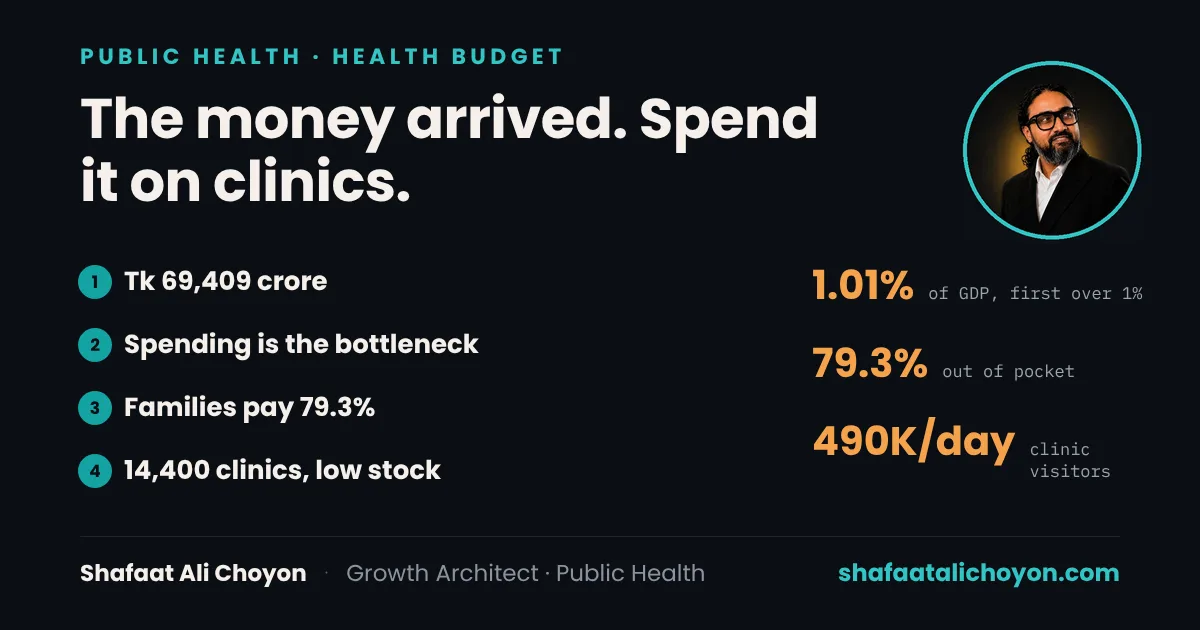
Bangladesh's budget for 2026-27 puts Tk 69,409 crore1 into health. That is 1.01%1 of GDP, the first time the country has crossed 1%. The health ministry's own share is up 50% on last year's original budget, and it more than doubles last year's revised figure. After years of arguing that health was underfunded, the money has arrived. The harder question is where it lands. My answer: below the hospital, where most Bangladeshis actually meet the health system and where most of their own money already goes.
How much is Bangladesh spending on health in 2026-27?
The total is Tk 69,409 crore. Of that, Tk 62,852 crore sits with the health ministry, and about Tk 6,557 crore funds health work in other ministries. Inside the ministry's share, Tk 35,026 crore is for development and Tk 27,826 crore for running costs. A block of Tk 23,522 crore1 in the development budget has not yet been tied to specific projects.
The budget also cuts taxes on medical imports. Removing VAT and advance tax on dialysis filters should cut the cost of each dialysis session by about Tk 800. Cardiac stents could get up to Tk 20,000 cheaper. These help real patients. But they are hospital-end savings, for people who are already very sick.
The bottleneck is spending, not money
Here is the uncomfortable number. In the first ten months of the last fiscal year, the two divisions of the health ministry could not spend even one-tenth1 of their development budget, according to the Daily Star's reporting. Health economist Shafiun Nahin Shimul of Dhaka University warned that inefficiency, corruption and bureaucratic delays could stop people from feeling the increase at all.
That changes the strategy. A large unassigned block, in a ministry that struggles to complete projects, is at risk of sitting idle. Money that has to wait for projects to be selected and approved will move slowly. Money that flows through recurring things, like medicines on shelves and staff at clinics, moves every month.
Families already pay 79% of the bill
A study by the Bangladesh Institute of Development Studies, presented in May, found that out-of-pocket payments now make up 79.3%2 of health spending, the highest in South Asia and up from 68.5% in 2020. About 65%2 of health needs go unmet. The poorest households spend about 35% of their income on health care; the richest, about 5%. Medicines and diagnostic tests are the largest costs.
I saw this from the inside at Praava Health, where I ran marketing and corporate sales. Most of our patients paid out of pocket, and diagnostics sat at the center of what we offered. When we replaced referral kickbacks with transparent pricing, patients could see what they were paying for, and our lab margins still rose from about 30% to 50%. Honest prices on everyday tests are not a cost to the system. They are how you bring people in early.
Bangladesh has the network the US is missing
This is where reading both countries helps. The US spends less than 5%4 of its total health spending on primary care, and more than 30% of American adults had no usual source of care in 2022. The world's biggest health spender has underfunded its front door.
Bangladesh built that front door. More than 14,4003 community clinics serve about 490,0003 people a day, roughly 160 million visits a year. The flip is that Bangladesh does not need to invent primary care. It needs to stock it. About 84%3 of health workers report patients coming back again and again because medicines were not available. Clinic readiness to manage diabetes and high blood pressure was measured at just 38.7%, while one rural screening found 34.5% of people had high blood pressure.
I have seen what a channel below the hospital can do. The Lifebuoy hotline we set up at Praava handled about 3,000 calls a day, because people would use a door that was close and trusted. I wrote earlier about where to spend $200 million on health. With this budget, the same question now comes with real money attached.
Where I would put the first taka
If I were advising on the block allocation, I would push it into things that reach patients every month:
- Keep clinic shelves full. Fund a steady supply of blood pressure and diabetes medicines for every community clinic. Stockouts push patients to buy medicines with their own money. My free prevention ROI calculator shows what a controlled patient saves later.
- Measure who is still missing. Map which districts and groups have the highest unmet need. My free coverage gap planner sizes the gap and the cost of closing it.
- Publish prices for common tests. Transparent prices at public and private labs cut the biggest out-of-pocket costs and build trust.
- Add a phone and AI layer. A hotline, backed by an AI assistant for routine questions and a clinician for the rest, sends the right patients to clinics early and keeps the rest out of crowded hospitals.
- Report spending monthly, by clinic. If the money is not reaching the front line by the third month, move it.
The short version
- Bangladesh's FY2026-27 health budget is Tk 69,409 crore, 1.01% of GDP, the first time above 1%.
- Spending capacity is the risk: the ministry spent less than one-tenth of its development budget in ten months last year.
- Families pay 79.3% of health costs out of pocket, mostly for medicines and tests.
- Bangladesh has 14,400+ community clinics, a front door the US lacks, but they often run out of medicines.
- Spend below the hospital: medicines, clinic staff, honest test prices and a hotline reach patients this year.
If you had to show results from this budget by next June, which part of the health system would you fund first?
Frequently asked questions
What is Bangladesh's health budget for 2026-27?
The total health budget for FY2026-27 is Tk 69,409 crore, equivalent to 1.01% of GDP, the first time it has crossed 1%. The health ministry's share is Tk 62,852 crore, up 50% from the previous year's original budget.
How much do Bangladeshis pay out of pocket for health care?
A Bangladesh Institute of Development Studies study found that out-of-pocket payments make up 79.3% of health spending, the highest in South Asia, up from 68.5% in 2020. Medicines and diagnostic tests are the biggest costs.
How many community clinics does Bangladesh have?
More than 14,400 community clinics operate across Bangladesh, serving about 490,000 people a day and roughly 160 million visits a year. Many face shortages of medicines and staff.
Sources
- The Daily Star, Health gets biggest boost (12 June 2026). thedailystar.net ↗
- The Daily Star, 65% of healthcare needs unmet as out-of-pocket costs soar: BIDS (8 May 2026). online91.thedailystar.net ↗
- Dhaka Tribune, Inside Bangladesh's community clinics promise (29 June 2026). dhakatribune.com ↗
- American Academy of Family Physicians, 2025 Primary Care Scorecard weighs 'cost of neglect' (20 March 2025). aafp.org ↗
Md Shafaat Ali Choyon (MPH, CHES®, MBA, MCIM) is a growth, marketing and public-health strategist who builds and runs AI in production, with 17 years across telecom, fintech, e-commerce, consumer tech and healthcare in the US and Bangladesh. See the essays or the portfolio.