The best distribution channel I ever used in health wasn't an app, a clinic, or an ad campaign. It was a bar of soap. And the reason it worked says something most health programs still get wrong: the hard part usually isn't the message — it's the delivery.
Distribution is the intervention
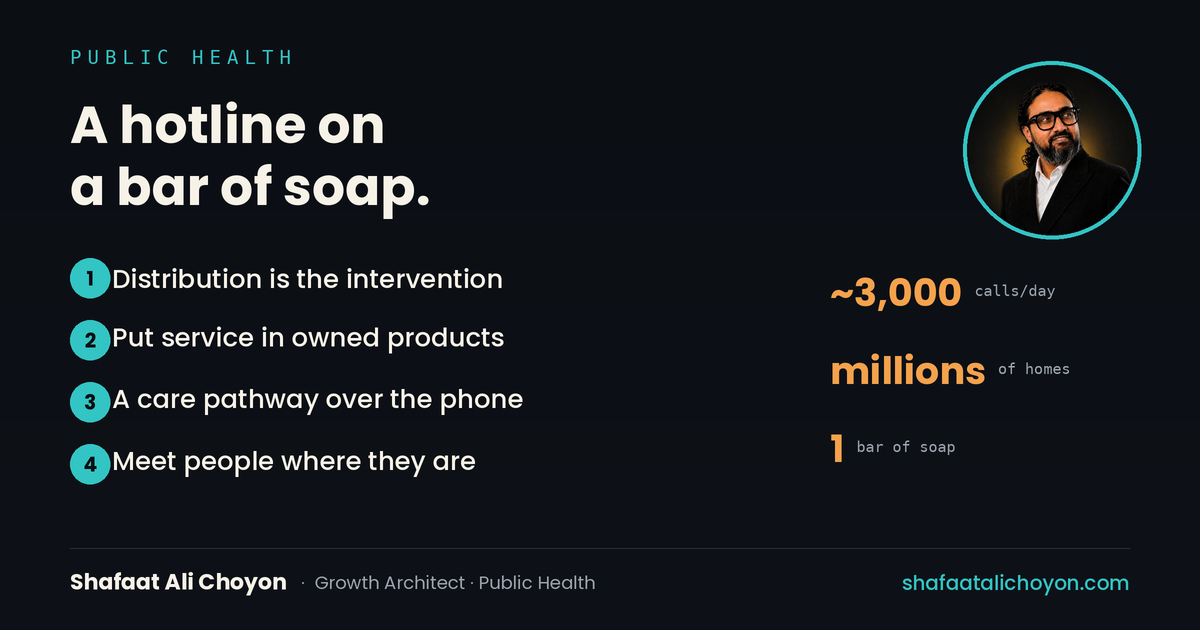
We printed a health hotline on the packaging of the market-leading soap and put it in millions of homes. Doctors on the line took roughly 3,000 calls a day. The genius wasn't a cleverer health message; it was putting a live medical service *inside a product people already owned and trusted*. No app to download, no clinic to find, no new habit to form. The channel did the work that persuasion usually fails to do.
A whole clinic, delivered down a phone line
This wasn't a tip line. It was a care pathway. Basic cases got a prescription over the phone; complex ones were referred to the nearest government facility; lab needs were routed to sample-collection points. We ran an actual triage-and-referral system through an object sitting in someone's bathroom — which, in a country with a severe shortage of doctors, reached people who would otherwise have reached no one.
Why this beats "awareness"
An awareness campaign asks people to change — to notice, to care, to act. Distribution removes the ask entirely; it meets people inside what they're already doing. That's the difference between a billboard about handwashing and a doctor one phone number away on the soap you're already holding. Behavior follows the path of least resistance, so the highest-leverage move is almost always to shorten the path, not amplify the plea.
The dual-market lesson
US health outreach still leans on portals and apps people must find, download, and log into — a stack of friction before any care happens. The soap-packet model argues the opposite: embed the service in the rails people already use, whether that's a retailer, a messaging app, or a product in the cupboard. The channel you piggyback on matters more than the message you write.
The short version
- In health, the hard part is usually delivery, not the message.
- I put a live medical hotline on a bar of soap; it took ~3,000 calls a day in millions of homes.
- It ran a real triage-and-referral pathway — a clinic delivered down a phone line.
- Distribution removes the ask; embedding service in what people already use beats awareness.
What product or channel do the people you serve already trust — and what would it look like to put your service inside it?
Md Shafaat Ali Choyon (MPH, CHES®, MBA, MCIM) is a growth, marketing and public-health strategist who builds and runs AI in production, with 16+ years across telecom, fintech, e-commerce, consumer tech and healthcare in the US and Bangladesh. See the essays or the portfolio.