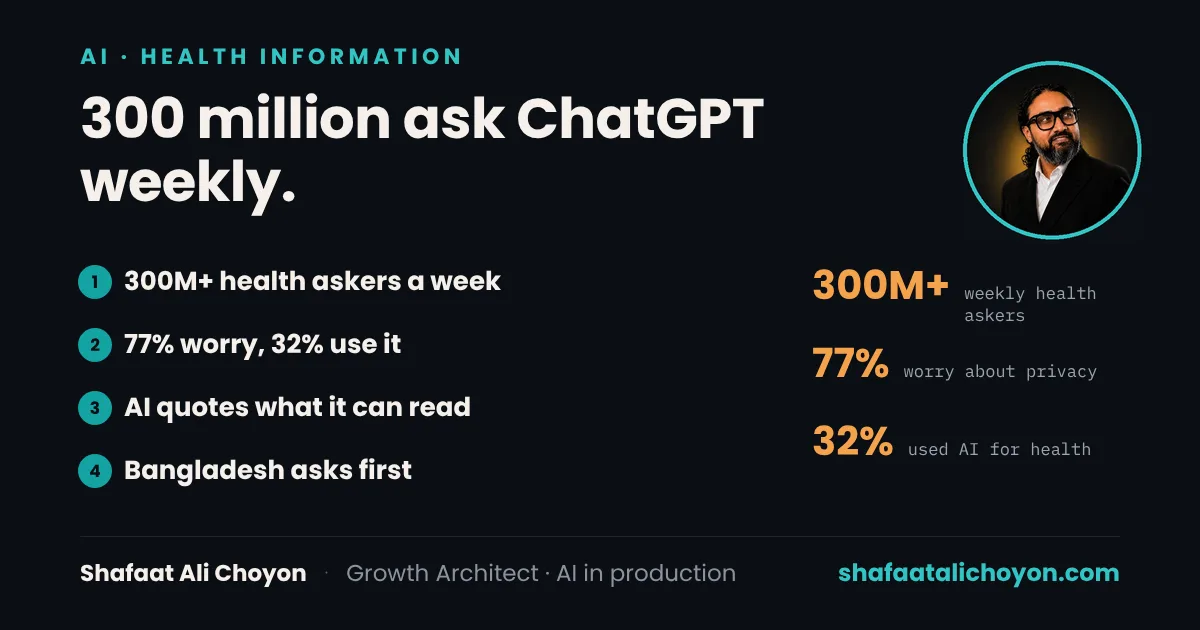
In January, OpenAI said more than 230 million1 people a week asked ChatGPT health and wellness questions. In late July, when it opened Health in ChatGPT to US adults, it put the number at more than 300 million2 a week. That is about 70 million more people in six months. The new feature lets US users connect medical records and Apple Health, so the answers can be about their own medicines, lab results and recent visits. Whatever you think of it, the first stop for a health question has moved.
Consent got solved by design, not by debate
In an earlier essay I argued that consent is health AI's real bottleneck. The new development is how it got handled. By default, ChatGPT asks permission before it uses connected records. OpenAI says connected records and Apple Health data are excluded from model training and ad targeting, and data from a disconnected source is deleted within 30 days.
People still worry. A KFF poll fielded in late February and early March found 77%3 of US adults are concerned about the privacy of medical information they give to AI tools. Yet 32%3 had used AI for health information or advice in the past year, and 41% of those users had already uploaded test results or doctors' notes. Worry and use live side by side.
That tells me consent stopped being a wall. It became a setting, and people click through settings when the reward is an answer late at night, when no clinic is open. So the bottleneck moves. The question now is what the answer is made of.
Where does AI get its health answers?
Look at what AI cites. The SEO firm SE Ranking studied 50,8074 German-language health searches in Google's AI Overviews. YouTube was the single most cited source, at 4.43%4 of all citations. Academic research and medical journals together got 0.48%. About 65.55%4 of citations came from sources not designed to ensure medical accuracy.
That study covers Google in Germany, not ChatGPT in the US, so I hold it loosely. But the pattern matches what I see when I build for AI readers. Answer engines quote what they can read, lift and summarize. A creator who explains what a cholesterol number means, in plain words, is easy to quote. A hospital page written for compliance review, with the answer buried in paragraph six, is not.
Plain language is now a distribution strategy
For years, writing health information at a sixth-to-eighth-grade reading level was treated as a courtesy, something equity teams asked for. It is now distribution. When hundreds of millions of people a week ask a model, the clearest trustworthy page becomes the source, and the rest might as well not exist.
I learned this on my own site. I rebuilt it to be read by AI, not just Google: the answer first, short sentences, a named source and a date on every claim. I also run an assistant on it, Ask Shafaat, which answers from my own writing. The work was less about technology than about editing. For every page I asked: what is the one sentence a machine should quote?
The same discipline showed up in my MPH capstone, where fixing the measurement up front made a campaign's reach about 3x larger. Clear words and clear measurement compound. A health system that rewrites its top 50 patient questions in plain language, and then checks which pages AI actually cites, is doing both.
Bangladesh has always asked before it paid
Here is the part you only see if you read both markets. KFF found that 41% of Americans who use AI for health say a major reason is to look up information before deciding whether to see a provider. Uninsured adults were about twice as likely as insured adults to use AI for mental health advice, 30% against 14%. Americans facing high costs are behaving like Bangladeshi patients always have: as buyers who ask before they spend.
In Bangladesh, out-of-pocket payments made up about 79%5 of health financing in 2024, according to a study from the Bangladesh Institute of Development Studies. The poorest households spend about 35% of their income on health care. At Praava Health, most of our patients paid out of pocket. The Lifebuoy hotline we set up drew about 3,000 calls a day, because people wanted a trusted answer from a doctor before deciding what to do next. The pharmacy counter, the hotline and now the chatbot do the same job: triage before the wallet opens.
That is the flip. The US is moving toward the ask-first habit Bangladesh has lived with for decades, and the lesson from Dhaka is blunt. Whoever gives the clear, trusted first answer shapes what the patient does next, including whether they come to you at all.
What health organizations should publish now
If I ran content for a health system, a public health department or a clinic group, I would treat AI answers as a channel and build for it:
- Write one plain answer per common question. One page, the answer in the first two sentences, at a sixth-to-eighth-grade level. My free health message readability checker scores a draft in seconds.
- Make the "see a clinician" line easy to quote. KFF found 58% of people who used AI for physical health later followed up with a doctor. Say plainly which symptoms mean "come in now".
- Name the source and the date. It helps a reader, and a model, decide your page is the safer one to repeat.
- Publish in the languages people ask in. In Michigan that includes Spanish and Arabic. In Bangladesh it means Bangla first, not a translated afterthought.
- Check what AI says about you every month. Ask your top questions and record whose page gets cited. If it is not yours, rewrite the page, not the press release.
The short version
- OpenAI counts more than 300 million weekly health askers, up from 230 million in January, and US users can now connect their records.
- Consent became a design setting: 77% of US adults worry about AI privacy, yet 32% used AI for health in the past year.
- AI quotes what it can read: in one German study, about 65.55% of health citations came from sources not built for medical accuracy.
- Bangladesh shows where this goes: with about 79% of health financing paid out of pocket, people have always asked before they paid.
- Plain language is distribution: the clearest trustworthy page becomes the answer.
If 300 million people asked your most common health question this week, would the answer quote you?
Frequently asked questions
How many people use ChatGPT for health questions?
OpenAI says more than 300 million people a week ask ChatGPT health-related questions, up from more than 230 million it reported in January 2026. In the US, a KFF poll found 32% of adults used AI for physical or mental health information or advice in the past year.
Can ChatGPT connect to my medical records?
Yes, for US users through Health in ChatGPT. It can connect medical records and Apple Health data, and by default it asks permission before using them. OpenAI says this data is excluded from model training and ad targeting, and data from a disconnected source is deleted within 30 days.
Are people worried about privacy when using AI for health?
Yes. KFF found 77% of US adults are concerned about the privacy of medical information given to AI tools. Even so, 41% of people who use AI for health have uploaded personal medical information such as test results or doctors' notes.
Sources
- OpenAI, Introducing ChatGPT Health (7 January 2026, updated 23 July 2026). openai.com ↗
- gHacks, OpenAI launches Health in ChatGPT for US users, connecting Apple Health and medical records (25 July 2026). ghacks.net ↗
- KFF, KFF Tracking Poll on Health Information and Trust: Use of AI for Health Information and Advice (25 March 2026). kff.org ↗
- Search Engine Journal, Google Health AI Overviews Cite YouTube More Than Any Hospital Site (15 January 2026). searchenginejournal.com ↗
- UNB, Unmet healthcare needs persist in Bangladesh as OOP spending soars to 79%: BIDS study (5 May 2026). unb.com.bd ↗
Md Shafaat Ali Choyon (MPH, CHES®, MBA, MCIM) is a growth, marketing and public-health strategist who builds and runs AI in production, with 17 years across telecom, fintech, e-commerce, consumer tech and healthcare in the US and Bangladesh. See the essays or the portfolio.