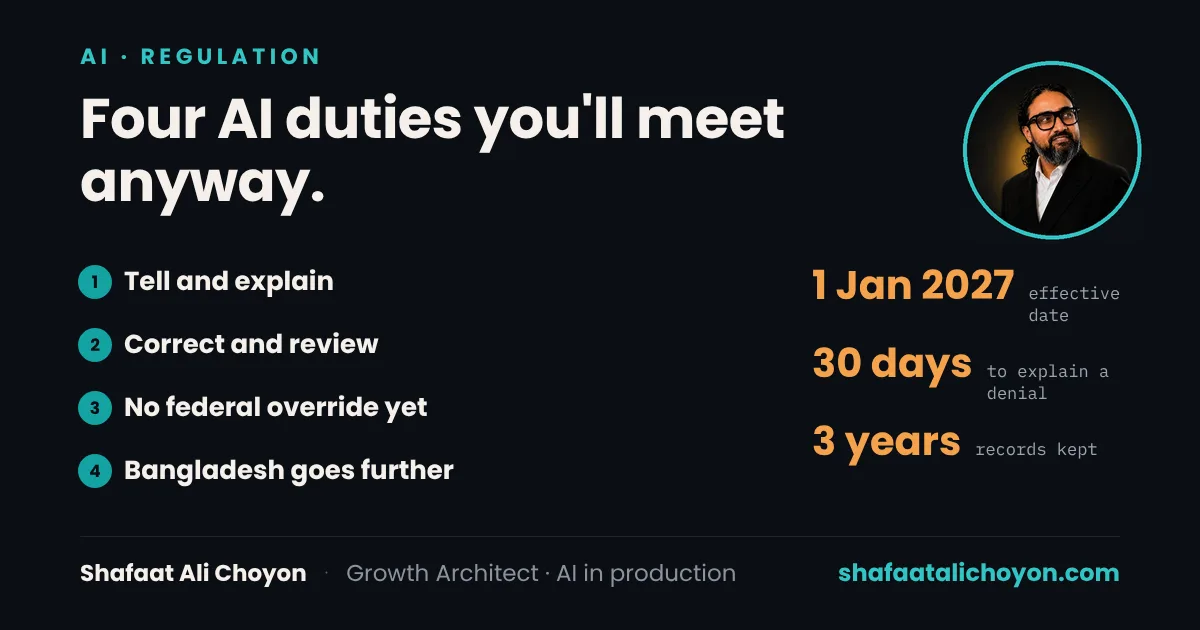
On 14 May 2026, Colorado repealed the AI law it had passed two years earlier and replaced it with a narrower one. From 1 January 20272, any company that uses automated decision-making technology to materially influence a decision about someone's education, job, loan, insurance, health care or government services in Colorado must meet four duties. Tell people first. Explain a bad outcome. Let them fix their data. Give them a real human review. Most product teams will read that as a compliance task. I read it as a product spec, and a cheap one.
What does Colorado's new AI law require?
The new law, SB 26-189, puts the duties on the company that deploys the system:
- Notice before use. A clear notice that automated technology will shape the decision. A prominent public notice can count.
- An explanation after a bad outcome. Within 30 days3 of an adverse outcome, such as a denial or worse terms, a plain-language account of the decision, the technology's role and the person's rights.
- A right to correct. People can ask to fix personal data that is wrong or materially inaccurate.
- Meaningful human review. Where commercially reasonable, a trained reviewer with the authority to override, who must not simply defer to the machine.
Developers must give deployers documentation on intended uses, limits and how to review outputs. Both keep records for at least 3 years2. Only the attorney general enforces it, and companies get a 60-day3 window to fix a violation unless it was knowing or repeated.
What Colorado dropped tells you where the US is going
The old law asked for risk management programs, annual impact assessments and a duty of reasonable care against algorithmic discrimination. All of that is gone. What survived is the part a customer can see.
That is not an accident. Washington has tried to stop states from regulating AI and has not managed it. In July 2025 the Senate voted 99 to 14 to strip a 10-year moratorium on state AI laws from the budget bill. A December 2025 executive order set up a Justice Department task force to challenge state AI laws, and in April 2026 the Justice Department joined a lawsuit against Colorado's original law5. Still, no federal statute overrides state rules yet1.
So the floor that survives the politics is the consumer-facing floor: notice, explanation, correction, review. If you are betting on which duties will outlast the next fight in Congress, bet on those four.
The four duties are just good product
Strip away the legal language and each duty is something a well-run business already wants.
Notice is trust. Explanation is customer support done before the complaint. Correction is free data cleaning. Human review is an escalation path, which every service business needs anyway.
I have seen transparency pay for itself. At Praava Health we replaced referral kickbacks with transparent pricing, and lab margins rose from about 30% to 50%. At Ekhanei, building the motorbike category from zero in about two and a half months depended on trust by design, because buyers would not hand over money to a stranger otherwise. Telling people how a decision was made is not a tax on growth. In low-trust markets it is the growth strategy.
Bangladesh is already stricter on one point
Here is the flip. Bangladesh's Personal Data Protection Ordinance, gazetted in November 2025, gave citizens the right to access and correct their data, and the right to restrict automated decisions made with it6. It treated health, financial, genetic and biometric data as sensitive, with enhanced protection. Parliament has since enacted a Personal Data Protection Act 20267.
Compare that with Colorado. Its human review applies only to the extent it is commercially reasonable. HIPAA-covered health entities are largely exempt for most uses, and FDA-regulated medical devices are excluded. A health AI product could be lightly touched in Denver and fully covered in Dhaka.
The lesson for anyone building across both markets is simple. Do not build a Colorado version and a Bangladesh version. Build once, to the strictest rule you will face, and switch features off where the law is looser. It is far cheaper than retrofitting an explanation screen into a live product.
Build once, for the strictest market
Here is the spec I would hand a product team this quarter. My free AI use-case risk triage shows which of your use cases make consequential decisions and need it first.
- Log every decision. Inputs, model version, output and any human action, kept at least three years. Every other duty depends on this.
- Write the adverse-outcome letter now. One page, plain language, what was decided, what the AI did, and how to ask for review. Test it on real users.
- Give correction a front door. A form or a phone line that actually changes the data and re-runs the decision.
- Staff the human review. Name reviewers, train them, give them power to override, and track how often they do.
- Ship one design. Same notices and controls in every market, tuned only where a law is stricter.
I made a related case when the EU paused its rules: use the extra time to build, not wait. Colorado is the US version of the same lesson.
The short version
- From 1 January 2027, Colorado's SB 26-189 sets four duties for AI that shapes decisions on jobs, loans, insurance, education, health care and public services.
- The duties are notice, an explanation within 30 days of a bad outcome, data correction and meaningful human review.
- Colorado dropped impact assessments and risk programs, and no federal law overrides state AI rules yet.
- Bangladesh's 2025 data ordinance gave a right to restrict automated decisions, stricter than Colorado on that point.
- Build once, to the strictest market, with decision logs, plain-language notices and staffed human review.
If a customer asked tomorrow why your AI turned them down, could you answer in one plain page?
Frequently asked questions
When does Colorado's new AI law take effect?
Colorado's SB 26-189, signed on 14 May 2026, takes effect on 1 January 2027. It replaces the state's earlier AI law and is enforced only by the attorney general, with a 60-day window to fix a violation unless it was knowing or repeated.
What are the four duties in Colorado's AI law?
Deployers must give notice before automated technology shapes a consequential decision, explain an adverse outcome within 30 days, let people correct inaccurate personal data, and offer meaningful human review by a trained reviewer who can override the decision, where commercially reasonable.
Does any federal law override state AI laws?
Not yet. In July 2025 the Senate voted 99 to 1 to remove a 10-year moratorium on state AI laws from the budget bill. A December 2025 executive order set up a Justice Department task force to challenge state AI laws, but no federal statute preempts them.
Sources
- CASRAI, The federal AI moratorium and the state preemption fight in 2026 (20 September 2026). casrai.org ↗
- Holland & Knight, Colorado Governor Signs SB 189, Significantly Amending the State's AI Law (May 2026). hklaw.com ↗
- Davis Wright Tremaine, Colorado AI Act Repealed and Replaced by Narrower Statute Focused on Transparency Requirements and Enhanced Consumer Rights (May 2026). dwt.com ↗
- Office of Sen. Ed Markey, Senate strikes AI moratorium from budget reconciliation bill overnight in overwhelming 99-1 vote (1 July 2025). markey.senate.gov ↗
- McDermott Will & Schulte, Colorado AI law in flux: comprehensive replacement bill signed after federal court blocks predecessor's enforcement (27 May 2026). mcdermottlaw.com ↗
- Prothom Alo, Govt issues gazettes of 2 landmark ordinances on data protection, governance (9 November 2025). en.prothomalo.com ↗
- The Daily Star, The need to protect our data (2 July 2026). thedailystar.net ↗
Md Shafaat Ali Choyon (MPH, CHES®, MBA, MCIM) is a growth, marketing and public-health strategist who builds and runs AI in production, with 17 years across telecom, fintech, e-commerce, consumer tech and healthcare in the US and Bangladesh. See the essays or the portfolio.