Give me real money for a health system and the hardest question isn't how to spend it — it's where a dollar actually changes an outcome, versus where it just looks impressive in a press release. Bangladesh is a live case: the World Bank committed roughly $200 million to strengthen urban primary care for vulnerable populations. That number is a useful prompt. If it were mine to allocate, I wouldn't start with the thing that photographs well. I'd start with the thing that moves the outcome.
The temptation is always the shiny layer
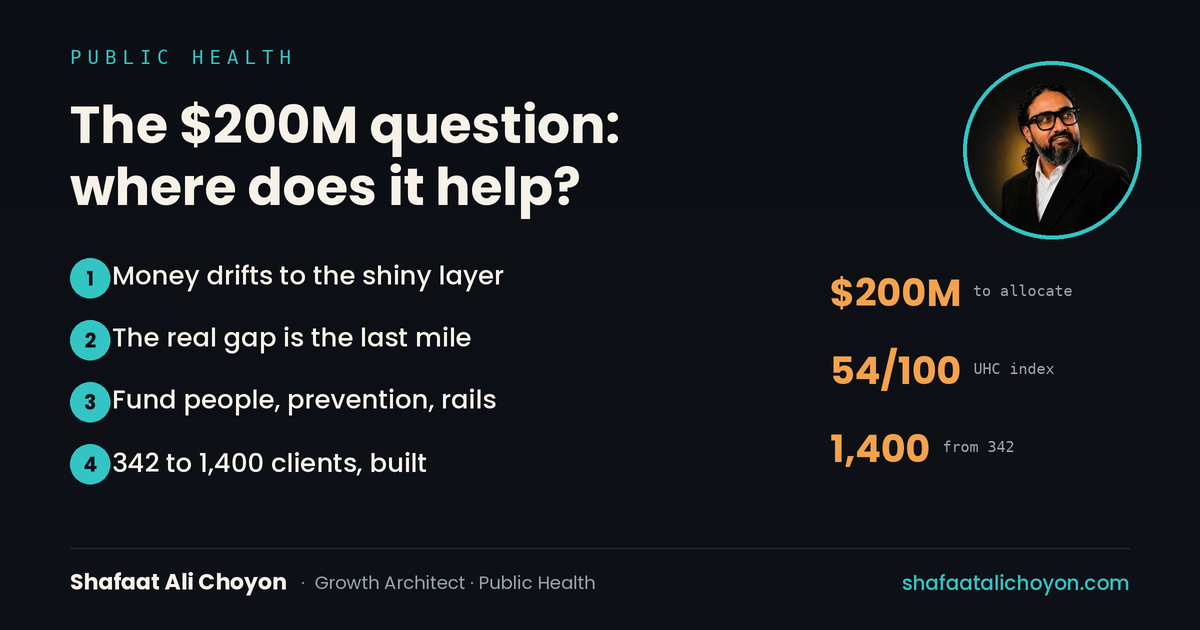
Health money gravitates toward the visible: a flagship hospital, a national app, a telemedicine platform with a launch event. Some of that matters. But Bangladesh already scores about 54 out of 100 on the universal-coverage service index, and out-of-pocket costs push tens of millions into hardship. The gap isn't a shortage of impressive buildings or software. It's the unglamorous distance between a service existing and a person actually reaching it, trusting it, and being able to pay. Money spent on the shiny layer rarely closes that distance.
Where I'd actually put it
I'd spend it on the last mile, in three unglamorous buckets. First, people — community health workers who live in the neighborhoods they serve, the exact model that already sustains Bangladesh's immunization above 90%. Second, prevention, which is nearly impossible to retrofit once a system's incentives harden but cheap to build in while it's still forming. Third, the rails — the payment and data plumbing that lets a poor patient actually transact with the system. None of it demos well. All of it decides whether the other spending works.
This is a lesson every builder faces
You don't need a national budget to face this question — every team allocates scarce resources between what looks like progress and what produces it. I've made the call on the ground. At Praava we grew corporate health programs from 342 to roughly 1,400 clients by treating prevention and access as a business, not a grant — screening, population-scale programs, care that reached people where they were. The lesson generalizes cleanly to the US, where enormous sums buy marginal improvements for the already-served while the highest-need patients get almost nothing.
The short version
- The World Bank's ~$200M for Bangladeshi urban primary care is the right prompt: where does a dollar change an outcome?
- Health money drifts to the visible; the real gap is the last mile between a service existing and someone reaching it.
- I'd fund people (community health workers), prevention, and the payment/data rails — not the shiny layer.
- I've run this trade-off in practice: Praava corporate health, 342 to ~1,400 clients, prevention as a business.
If you had real money for the system you work in, where would you spend it to change an outcome — not to look like progress?
Md Shafaat Ali Choyon (MPH, CHES®, MBA, MCIM) is a growth, marketing and public-health strategist who builds and runs AI in production, with 16+ years across telecom, fintech, e-commerce, consumer tech and healthcare in the US and Bangladesh. See the essays or the portfolio.