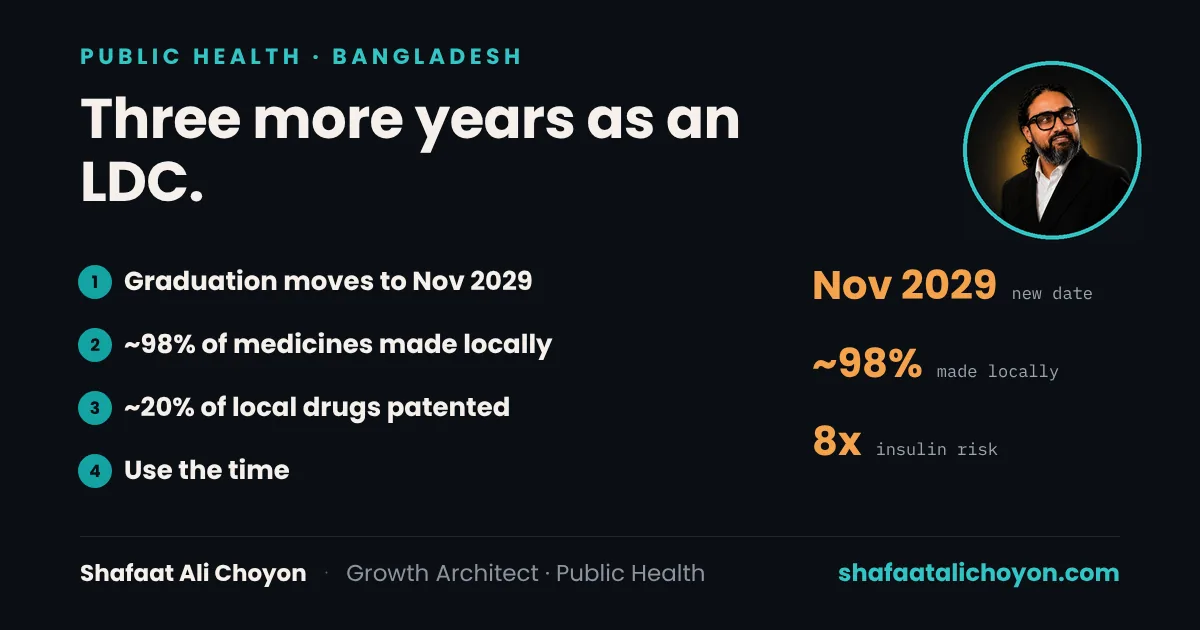
On 29 October 2026 the UN General Assembly gave Bangladesh three more years. The country was due to leave the UN's group of least developed countries on 24 November 2026. The date is now 24 November 20291. Three years is a long time in trade policy and a short time in medicine. The question is not whether Bangladesh deserved the delay. It is what the country buys with it.
What changed?
In February the new government asked the UN for a three-year extension of the preparatory period, citing global shocks, economic strain and political upheaval. The UN's Committee for Development Policy agreed that an extension was appropriate, but advised a shorter one2. In July the UN Economic and Social Council passed the request to the General Assembly without recommending a length3. On 29 October the Assembly granted the full three years, on a draft tabled by Uruguay for the G-77, with no country objecting4. The resolution calls it an exceptional decision.
The committee attached a condition that matters more than the date. The extra time is for reform: financial sector stability, tax revenue, diversification and preparing private firms. It also said it does not foresee supporting any further extension5. This is the last one. And trade preferences in the extra years still depend on each importing country's own rules1.
What three years of LDC status are worth
The obvious value is trade. Bangladesh uses about 67% of the trade benefits offered to all 44 LDCs, and about 73% of its exports are linked to LDC preferences, by the estimates of Mohammad Abdur Razzaque, chairman of the research group RAPID6. UNCTAD has estimated that exports could fall by more than $17.5 billion7, about a third, if those preferences were lost. Apparel carries most of that weight.
The less obvious value is medicine, and for health it is the bigger one.
The medicine clock
In 2025 local companies supplied about 98%8 of the medicines Bangladesh uses, in a market worth more than $3.5 billion, and exported to more than 160 countries. Much of that rests on one rule. As an LDC, Bangladesh does not have to apply full patent protection to medicines under the WTO's TRIPS agreement, so local firms can make drugs that are still patented elsewhere.
About 20% of the drugs made in Bangladesh are still under patent, by the estimate of Mustafizur Rahman, a distinguished fellow at the Centre for Policy Dialogue. Citing a South Centre study, he has said insulin prices could rise eightfold8 without the exemption. The industry also imports about $1.2 billion of active ingredients a year, and of the 42 plots set aside for ingredient makers in the park announced in 2008, only four were working in 20258.
The warning sign in 2025 was not a price. It was a queue: more than 1,0009 applications for generic and biosimilar medicines, including cancer drugs, had waited about two and a half years for a decision, while the industry argued that registering them before graduation was the way to keep them cheap afterwards. The extra time is worth most if that queue gets cleared, not if it gets three more years to grow.
Reform, not rest
The committee's conditions point at the real weaknesses. Tax revenue was about 6.8%10 of GDP in 2025-26 on provisional figures, one of the lowest ratios in the world. Classified loans were 32.78%11 of bank lending at the end of June 2026. External debt service was about $4.5 billion in 2025-2612 and is projected at about $7.6 billion by 2028-2913. None of those get easier by waiting, and graduation in 2029 will arrive with or without the work done.
What I would do with the three years
I have seen the parts of this up close, from the patient's side of a Bangladeshi health business. At Praava Health most patients paid out of pocket, so every price was visible and compared. When we replaced referral kickbacks with transparent pricing, lab margins moved from about 30% to 50% while prices for patients came down. Efficiency can absorb cost, if you design for it.
At SureCash we delivered a government stipend to about 10 million beneficiaries on mobile money. That is the tool for the hardest case: if some patented medicines do get more expensive after 2029, a targeted subsidy for people on insulin or cancer treatment, paid on digital rails, costs far less than keeping every price low for everyone.
So the list I would put in front of a health ministry, a drug maker or a hospital group is short:
- Clear the registration queue now. Every generic registered before graduation is a price that stays low after it.
- Build the ingredient base. Gas and power for the ingredient park are an industrial policy problem with a health outcome.
- Know which medicines are exposed. List the patented drugs patients depend on, the patent end dates, and the licences worth negotiating early.
- Design the targeted subsidy before it is needed. The payment rails already exist. The eligibility rules and the budget do not.
- Treat the revenue gap as a health issue. A state that collects less than 7% of GDP in tax cannot pay for medicines, primary care or the subsidy above.
For US readers the lesson runs the other way. The US already lives under full patent rules and knows what a medicine with no generic competitor costs. Bangladesh joins that world in 2029. A Bangladesh that graduates ready keeps making affordable medicines for its own patients and for export; one that graduates unready imports more of them at higher prices.
The short version
- Graduation moved from 24 November 2026 to 24 November 2029, granted by the UN General Assembly on 29 October 2026 as an exceptional decision.
- The condition is reform: tax revenue, banks and private-sector readiness. The UN's development committee does not foresee supporting another extension.
- Trade benefits can run three more years, subject to each importing country's rules; about 73% of exports are linked to LDC preferences.
- Medicines are the health risk: about 98% are made locally, about 20% of local drugs are still patented, and insulin prices could rise eightfold without the exemption, by one study.
- Use the time: clear the drug registration queue, build the ingredient base, map the exposed medicines and design a targeted subsidy.
If your organisation buys, makes or prescribes medicines in Bangladesh, which three drugs would you protect first, and is anyone already working on them?
Frequently asked questions
When will Bangladesh graduate from LDC status?
On 24 November 2029. It was scheduled for 24 November 2026, and on 29 October 2026 the UN General Assembly granted Bangladesh a three-year extension. The UN's Committee for Development Policy has said it does not foresee supporting another extension.
What happens to medicine prices in Bangladesh after LDC graduation?
As an LDC, Bangladesh can make medicines that are still patented elsewhere without paying royalties. After graduation, new and still-patented medicines need licences or royalties, so prices for those drugs could rise. About 20% of locally made drugs are still under patent; older, off-patent medicines are not affected.
What does Bangladesh need to do before graduating?
The UN committee asked for progress on financial sector stability, tax revenue, diversification and preparing private firms. For health, the priorities are registering generic medicines before graduation, building local production of active ingredients and preparing targeted support for patients on medicines whose prices may rise.
Sources
- The Business Standard, Bangladesh gets 3 more years before LDC graduation (30 October 2026). tbsnews.net ↗
- The Financial Express, UN CDP suggests shorter deferral (4 June 2026). today.thefinancialexpress.com.bd ↗
- The Business Standard, ECOSOC backs Bangladesh's request for LDC graduation extension (22 July 2026). tbsnews.net ↗
- Prothom Alo, Bangladesh's LDC graduation postponed by 3 years to November 2029 (30 October 2026). en.prothomalo.com ↗
- The Business Standard, UN committee backs Bangladesh's request to extend LDC graduation preparatory period (3 June 2026). tbsnews.net ↗
- The Daily Star, LDC graduation: UN body backs Bangladesh's perks till 2029 (3 June 2026). thedailystar.net ↗
- The Daily Star, LDC graduation could cost Bangladesh $17.5b in exports: UNCTAD (2026). thedailystar.net ↗
- The Daily Star, The end of exemption? (1 August 2025). thedailystar.net ↗
- The Business Standard, 1,000 drug registrations stuck as Bangladesh risks losing TRIPS waiver (31 August 2025). tbsnews.net ↗
- The Financial Express, Tax-GDP ratio edges up despite weak economic activity (10 August 2026). thefinancialexpress.com.bd ↗
- The Business Standard, Ten banks hold over 72% of Tk6 lakh crore defaulted loans (10 September 2026). tbsnews.net ↗
- UNB, Foreign aid commitments declined in 2025-26 fiscal (2 August 2026). unb.com.bd ↗
- The Financial Express, Country's external debt repayments to far outstrip receipts in three years (19 July 2026). thefinancialexpress.com.bd ↗
Md Shafaat Ali Choyon (MPH, CHES®, MBA, MCIM) is a growth, marketing and public-health strategist who builds and runs AI in production, with 17 years across telecom, fintech, e-commerce, consumer tech and healthcare in the US and Bangladesh. See the essays or the portfolio.