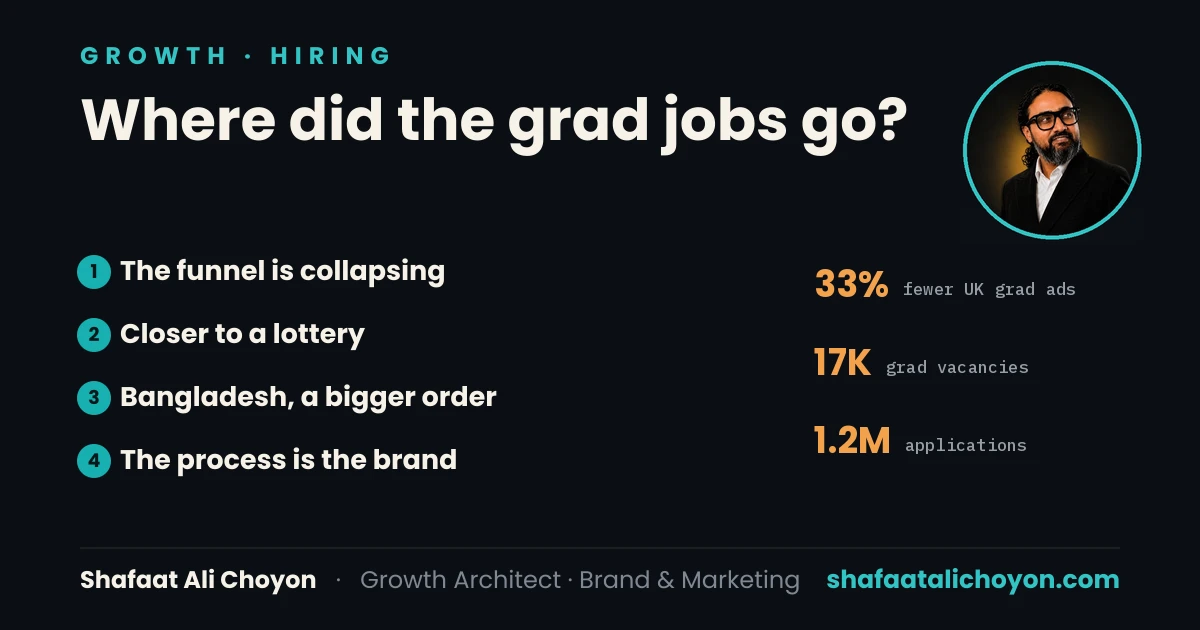
UK job ads for recent graduates fell 33% year on year by June 2025, according to Indeed. Employers in the UK's Institute of Student Employers received 1.2 million applications for just under 17,0002 graduate vacancies in 2024, while 38% of UK workers4 overall say they plan to change jobs this year. The talent market is contracting at the entry point and churning everywhere else at once.
A funnel that's collapsing at the exact wrong end
A 33% year-on-year drop in UK graduate job ads isn't a soft market correction, it's a structural narrowing of the one door every career used to walk through. Set against 1.2 million applications for just under 17,000 graduate vacancies, about 140 applications per job, the ratio isn't competitive, it's close to a lottery. Meanwhile 38% of the existing UK workforce plans to change jobs this year, which means the people already employed are also on the move, pulling recruiting attention away from the entry-level pool that most needs it. Employers reading this as a buyer's market are missing the second-order effect: the graduates who do land roles under this pressure will remember exactly which employers made the process humane and which ones treated 1.2 million applications as noise to filter, and that memory becomes the employer brand five years from now.
Where the same pressure is a different order of magnitude
Bangladesh makes this problem look different, not smaller. It's a market of about 176 million people3, nearly 50 million of them aged 10 to 24, and its own well-documented graduate un- and underemployment challenge, degree holders routinely unemployed at multiples of the national rate, a mismatch between what universities produce and what the formal job market absorbs. A UK-style employer brand strategy, polish the careers page, run a graduate scheme, doesn't scale to that demographic pressure. What does is the distribution logic behind SureCash, the Bangladesh fintech platform I worked with that reached roughly 10 million unbanked people with government stipend distribution, with no bank branch required. The lesson transfers directly to talent: in a market defined by sheer population size and constrained institutional infrastructure, employer and talent brand strategy has to be built for reach at scale from day one, mobile-first, low-friction, assuming no existing branch network or campus pipeline, rather than adapted after the fact from a model built for a smaller, denser labor market.
The employer brand that wins this decade
Whether the constraint is 1.2 million applications for 17,000 roles or 176 million people in a labor market with limited absorption capacity, the answer is the same discipline: build for scale and dignity simultaneously, because the applicants an employer disrespects today are the market's memory of that employer tomorrow. 33% fewer graduate job ads means every remaining role is watched more closely than it's ever been.
The short version
- UK job ads for recent graduates fell 33% year on year1 (Indeed, June 2025).
- ISE employers got 1.2 million applications for just under 17,000 graduate vacancies in 2024, a near-lottery ratio.
- Bangladesh's 176-million-person market needs mobile-first, branch-free talent reach, the SureCash model applied to hiring.
- How an employer treats applicants under scarcity becomes its brand for the next hiring cycle.
When 1.2 million applications land on 17,000 roles, what does your process say about who you actually are?
Frequently asked questions
How much have entry-level graduate roles declined?
UK job ads for recent graduates fell 33% year on year by June 2025, and ISE employers received 1.2 million applications for just under 17,000 graduate vacancies in 2024, while 38% of UK workers overall say they plan to change jobs this year, so the market is contracting at the entry point and churning everywhere else at once.
Why doesn't a UK-style employer brand strategy work in Bangladesh?
Bangladesh is a market of about 176 million people, nearly 50 million of them aged 10 to 24, with well-documented graduate under- and unemployment. Polishing a careers page or running a graduate scheme doesn't scale to that demographic pressure, what does is the mobile-first, branch-free distribution logic behind SureCash, which reached roughly 10 million unbanked people.
Why does the hiring process itself become the employer brand?
With UK graduate job ads down 33%, every remaining role is watched more closely than ever. Graduates who land roles under this pressure will remember which employers made the process humane and which treated 1.2 million applications as noise to filter, and that memory becomes the employer brand five years from now.
Sources
- The Guardian. theguardian.com ↗
- Institute of Student Employers. ise.org.uk ↗
- BSS (citing UNFPA State of World Population 2025). bssnews.net ↗
- New Possible, What Workers Want 2026. newpossible.io ↗
Md Shafaat Ali Choyon (MPH, CHES®, MBA, MCIM) is a growth, marketing and public-health strategist who builds and runs AI in production, with 17 years across telecom, fintech, e-commerce, consumer tech and healthcare in the US and Bangladesh. See the essays or the portfolio.